
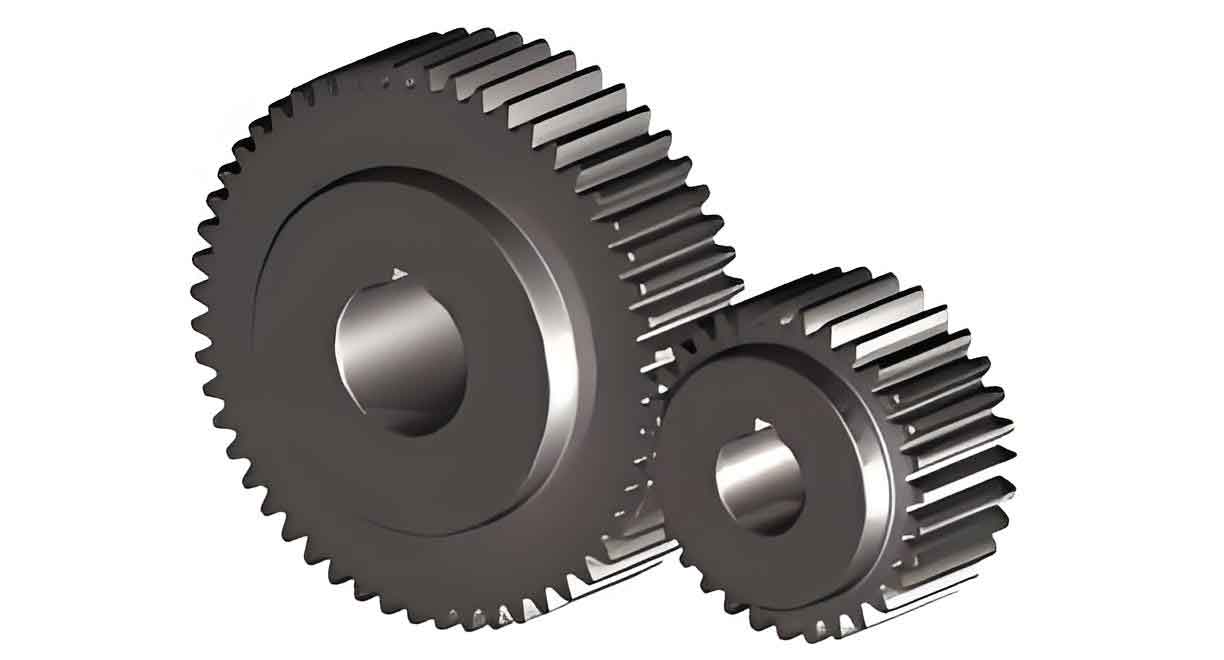
Spur gears remain fundamental components in agricultural machinery due to their stable transmission performance and high impact resistance. This study proposes an analytical approach using the potential energy method to calculate time-varying meshing stiffness, which significantly influences vibration characteristics and operational efficiency in equipment like seedling cultivators.
1. Fundamentals of Spur Gear Meshing
The meshing process of involute spur gears satisfies three essential conditions:
| Condition | Mathematical Expression |
|---|---|
| Constant Transmission Ratio | $$i_{12} = \frac{\omega_1}{\omega_2} = \frac{r_{b2}}{r_{b1}}$$ |
| Contact Line Continuity | $$N_1N_2 \geq p_b$$ |
| Pressure Angle Consistency | $$\alpha_1 = \alpha_2 = 20^\circ$$ |
Key meshing parameters for spur gears include:
$$ \epsilon_\alpha = \frac{B_1B_2}{p_b} \geq 1.2 $$
Where \( B_1B_2 \) represents the actual contact path length and \( p_b \) denotes base pitch.
2. Potential Energy Components in Meshing Stiffness Calculation
The total potential energy in spur gear meshing comprises four elements:
| Energy Type | Expression |
|---|---|
| Bending Energy | $$U_b = \int_0^d \frac{F_b^2}{2k_b}dx$$ |
| Shear Energy | $$U_s = \int_0^d \frac{F_s^2}{2k_s}dx$$ |
| Axial Compression | $$U_a = \int_0^d \frac{F_a^2}{2k_a}dx$$ |
| Hertzian Contact | $$U_h = \frac{F_n^2}{2k_h}$$ |
3. Stiffness Derivation Using Potential Energy Method
The comprehensive meshing stiffness \( k_{total} \) for spur gears is derived through energy equivalence:
$$ \frac{1}{k_{total}} = \sum_{i=1}^n \left( \frac{1}{k_{b,i}} + \frac{1}{k_{s,i}} + \frac{1}{k_{a,i}} \right) + \frac{1}{k_h} $$
Individual stiffness components are calculated as:
Bending Stiffness:
$$ \frac{1}{k_b} = \int_{-\alpha_1}^{\alpha_2} \frac{3[1+\cos\alpha_1(\alpha_2-\alpha)\sin\alpha – \cos\alpha]^2(\alpha_2-\alpha)\cos\alpha}{2EL[\sin\alpha + (\alpha_2-\alpha)\cos\alpha]^3}d\alpha $$
Shear Stiffness:
$$ \frac{1}{k_s} = \int_{-\alpha_1}^{\alpha_2} \frac{1.2(1+\nu)(\alpha_2-\alpha)\cos\alpha\cos^2\alpha_1}{EL[\sin\alpha + (\alpha_2-\alpha)\cos\alpha]}d\alpha $$
Axial Compression Stiffness:
$$ \frac{1}{k_a} = \int_{-\alpha_1}^{\alpha_2} \frac{(\alpha_2-\alpha)\cos\alpha\sin^2\alpha_1}{2EL[\sin\alpha + (\alpha_2-\alpha)\cos\alpha]}d\alpha $$
Hertzian Contact Stiffness:
$$ k_h = \frac{\pi EL}{4(1-\nu^2)} $$
4. Parametric Analysis of Spur Gear Meshing
Critical parameters influencing spur gear meshing stiffness include:
| Parameter | Effect on Stiffness | Typical Range |
|---|---|---|
| Module (m) | $$k \propto m^{1.85}$$ | 2–8 mm |
| Pressure Angle (α) | $$k \propto \cos^2\alpha$$ | 14.5°–25° |
| Face Width (L) | Linear relationship | 20–200 mm |
| Young’s Modulus (E) | Direct proportionality | 200–210 GPa |
5. Dynamic Meshing Characteristics
For spur gears with contact ratio \( \epsilon_\gamma = 1.4–2.1 \), the time-varying stiffness follows:
$$ k(t) = k_{avg} + \Delta k\sin(2\pi f_m t + \phi) $$
Where meshing frequency \( f_m = z_n/60 \) and stiffness variation \( \Delta k \) typically ranges 15–30% of \( k_{avg} \).
6. Practical Application in Agricultural Machinery
When applied to a seedling cultivator transmission system (module 5 mm, 24 teeth), the calculated meshing stiffness shows:
| Operating Condition | Single Tooth Pair (N/m) | Double Tooth Pair (N/m) |
|---|---|---|
| Static Loading | 1.82×10⁸ | 3.15×10⁸ |
| Dynamic Loading | 1.65×10⁸ | 2.98×10⁸ |
| 10% Wear | 1.43×10⁸ | 2.67×10⁸ |
The potential energy method demonstrates superior computational efficiency compared to FEM, with relative errors below 6.2% in practical spur gear applications.
7. Conclusion
This analytical framework enables accurate prediction of spur gear meshing stiffness variations, providing essential data for optimizing agricultural machinery designs. Future research directions include thermal-elastic coupling analysis and nonlinear vibration modeling for enhanced spur gear performance prediction.