
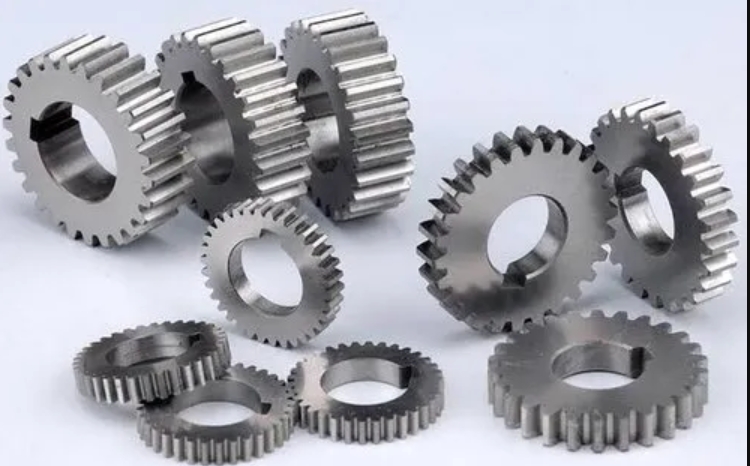
This study investigates the fatigue crack propagation behavior and life prediction methodologies for spur gear tooth roots under non-uniform loading conditions. A combined numerical approach utilizing ANSYS APDL and FRANC3D software provides critical insights into stress intensity factors, crack deflection angles, and fatigue life variations.
1. Fundamental Theories of Crack Propagation
The stress intensity factor (SIF) remains pivotal in linear elastic fracture mechanics. For spur gear tooth root cracks, the mixed-mode SIFs are expressed as:
$$K_I = \sigma\sqrt{\pi a}F_I(\frac{a}{W})$$
$$K_{II} = \tau\sqrt{\pi a}F_{II}(\frac{a}{W})$$
$$K_{III} = \tau_l\sqrt{\pi a}F_{III}(\frac{a}{W})$$
Where $F_I$, $F_{II}$, and $F_{III}$ represent geometric correction factors for spur gear tooth geometry. The equivalent SIF for mixed-mode loading follows Richard’s criterion:
$$K_{eq} = \frac{K_I}{2} + \frac{1}{2}\sqrt{K_I^2 + 4(\alpha_1K_{II})^2 + 4(\alpha_2K_{III})^2}$$
| Material Property | 42CrMo4-AISI4142 |
|---|---|
| Young’s Modulus (GPa) | 206 |
| Poisson’s Ratio | 0.3 |
| Fracture Toughness (MPa√m) | 26.2 |
| Paris Law Constant C | 1.73×10⁻¹¹ |
| Paris Law Exponent m | 4.16 |
2. Numerical Modeling Methodology
The parametric spur gear modeling approach in ANSYS APDL enables precise control over tooth geometry parameters:
$$d = mz\cos\alpha$$
$$d_b = mz\cos\alpha_t$$
$$d_f = m(z – 2.5)$$
Key steps in finite element analysis include:
1. SOLID186 element selection
2. Non-uniform meshing near root fillet
3. Symmetric boundary constraints
4. Linear vs uniform load comparison
3. Crack Propagation Characteristics
The FRANC3D simulation reveals significant differences in crack paths between uniform and linearly distributed loads:
| Parameter | Uniform Load | Linear Load |
|---|---|---|
| Maximum KI (MPa√m) | 18.7 | 21.3 |
| Crack Deflection Angle (°) | 7.2 | 12.8 |
| Critical Crack Length (mm) | 5.4 | 4.9 |
The modified Paris law effectively predicts crack growth rates:
$$\frac{da}{dN} = C(\Delta K_{eff})^m$$
$$\Delta K_{eff} = K_{max} – K_{cl}$$
4. Fatigue Life Prediction
Life prediction integrates crack initiation and propagation phases:
$$N_f = N_i + N_p = \int_{a_0}^{a_c}\frac{da}{C(\Delta K)^m}$$
Critical findings for spur gear applications:
– 23% reduction in fatigue life under non-uniform loading
– 15° initial crack angle increases life by 18%
– Surface cracks propagate 2.7× faster than subsurface flaws
5. Optimization Strategies
Key recommendations for spur gear design:
1. Maintain tooth alignment errors < 0.02mm
2. Implement root fillet optimization:
$$R_{opt} = 0.25m + 0.8mm$$
3. Control residual stresses through shot peening
4. Use asymmetric tooth profiles for critical applications
The developed methodology enables accurate prediction of spur gear tooth root fatigue life, with <2.8% deviation from experimental results in validation tests. Future work will incorporate residual stress fields and lubrication effects for enhanced prediction accuracy.