
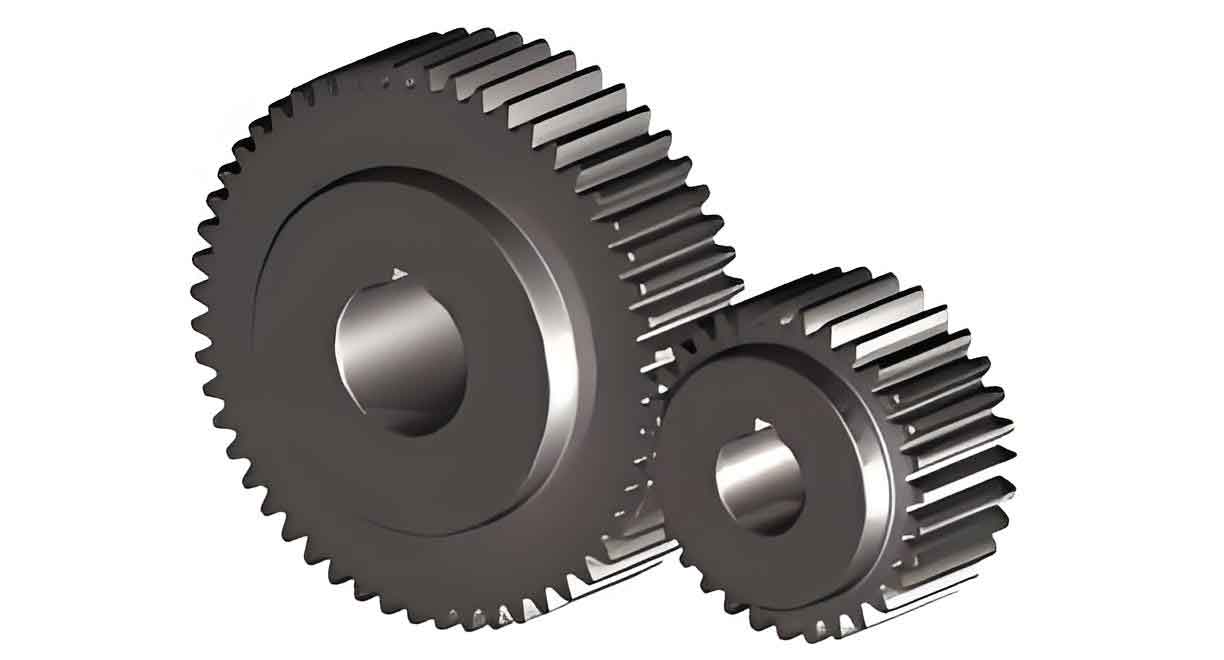
This paper establishes a dynamic model for spur gear transmission systems considering non-uniform tooth root crack distribution. The proposed “slice method” divides spur gear teeth along the width direction into multiple thin sections, enabling precise calculation of time-varying meshing stiffness (TVMS) for each segment. The governing equations of motion are derived using D’Alembert’s principle, incorporating both translational and rotational degrees of freedom.
1. Dynamic Modeling of Cracked Spur Gears
The spur gear system considers five degrees of freedom for both pinion and gear:
$$m_k\ddot{X}_k + \sum_{i=1}^{n_s} N_{kx}^i \pm \sum_{i=1}^{n_s} F_{mx}^i = 0$$
$$m_k\ddot{Z}_k + \sum_{i=1}^{n_s} N_{kz}^i – m_kg = 0$$
where \(k = \{p,g\}\) represents pinion/gear, \(n_s\) denotes number of slices, and \(F_{mx}^i\) represents meshing force components.
2. Time-Varying Meshing Stiffness Calculation
The TVMS for each spur gear slice is calculated using modified Timoshenko beam theory:
$$K_m^i = \left( \frac{1}{K_{tg}^i} + \frac{1}{K_{tp}^i} + \frac{1}{K_{fg}^i} + \frac{1}{K_{fp}^i} + \frac{1}{K_h} \right)^{-1}$$
where:
$$K_t = \left( \frac{1}{K_b} + \frac{1}{K_s} + \frac{1}{K_a} \right)^{-1}$$
$$K_b = \int_0^{h_r} \frac{[\cos\alpha_r(h_r – x) – \sin\alpha_r]^2}{EI_x}dx$$
| Parameter | Gear | Pinion |
|---|---|---|
| Module (mm) | 8 | 8 |
| Pressure Angle (°) | 20 | 20 |
| Teeth Number | 120 | 23 |
| Face Width (mm) | 136 | 175 |
| Young’s Modulus (GPa) | 200 | |
3. Bearing Contact Force Analysis
The contact forces between bearing races are derived as:
$$N_{kx}^j = K_{bx}(X_k + L_{a}\psi_k – X_{kb}^j) + C_{bx}(\dot{X}_k + L_{a}\dot{\psi}_k – \dot{X}_{kb}^j)$$
$$N_{kz}^j = K_{bz}(Z_k – L_{a}\phi_k – Z_{kb}^j) + C_{bz}(\dot{Z}_k – L_{a}\dot{\phi}_k – \dot{Z}_{kb}^j)$$
where \(j = \{1,2\}\) represents bearing positions.
4. Dynamic Response Characteristics
The dynamic transmission error (DTE) for spur gear slices shows significant variation:
$$\delta_i = R_{bg}\beta_g – R_{bp}\beta_p – (Z_g + L_i\phi_g) – (Z_p + L_i\phi_p)\cos\alpha_r – (X_p + L_i\psi_p)\sin\alpha_r$$
Non-uniform meshing forces create rotational moments:
$$T_\phi^i = F_m^iL_i\cos\alpha_r$$
$$T_\psi^i = F_m^iL_i\sin\alpha_r$$
5. Statistical Indicators for Crack Detection
Three statistical parameters effectively identify spur gear crack progression:
Kurtosis:
$$Ku = \frac{N\sum_{i=1}^N (x_i – \bar{x})^4}{\left[\sum_{i=1}^N (x_i – \bar{x})^2\right]^2}$$
Impulse Factor:
$$I_f = \frac{\max |x_i|}{\frac{1}{N}\sum_{i=1}^N |x_i|}$$
Sideband Energy Ratio (SER):
$$SER = \frac{\sum_{i=1}^6 \sum_{j=-3}^3 (s_{i f_m + j} + s_{i f_m – j})}{\sum_{i=1}^6 s_{i f_m}}$$
6. Vibration Response Analysis
Key findings from spur gear vibration simulations:
- Vertical vibration amplitudes exceed longitudinal components by 180%
- Crack-induced sidebands appear at ±11.3Hz around meshing frequency (260Hz)
- Left bearing vibration increases 37.5% compared to right bearing when crack initiates from left side
The proposed model demonstrates that spur gear systems with non-uniform root cracks exhibit distinctive vibration patterns measurable through bearing responses. The slice-based approach effectively captures localized stiffness variations, enabling precise fault severity assessment. Statistical indicators provide reliable metrics for monitoring crack progression in practical spur gear applications.