
This paper systematically investigates the continuous cold extrusion process and mold optimization technology for manufacturing spur gears in heavy-duty mechanical transmission systems. A comprehensive technical framework is developed through finite element simulation, Kriging modeling, and genetic algorithm optimization, providing theoretical guidance for industrial production of high-precision gears.
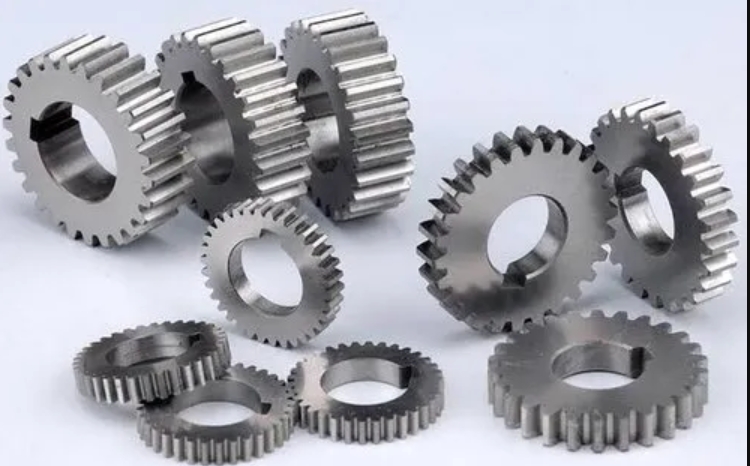
1. Process Design and Numerical Simulation
Three cold extrusion schemes were developed for manufacturing sun gears with external spur teeth and internal splines:
| Scheme | Process Flow | Key Characteristics |
|---|---|---|
| Scheme 1 | Simultaneous extrusion of internal/external teeth → External tooth sizing | High process integration but severe plastic deformation |
| Scheme 2 | Continuous external tooth extrusion → Combined sizing/internal tooth forming | Medium material utilization with dimensional instability |
| Scheme 3 | Continuous external tooth extrusion → External tooth sizing → Internal tooth machining | Optimal solution with 92.6% material utilization |
The constitutive equations for plastic deformation were established using rigid-plastic finite element theory:
$$ \sigma_{ij,j} = 0 $$
$$ \epsilon_{ij} = \frac{1}{2}(u_{i,j} + u_{j,i}) $$
$$ \sigma = H\int d\epsilon $$
2. Die Cavity Parameter Optimization
Key parameters of continuous extrusion die cavity were optimized through single-factor analysis:
| α (°) | Max Load (ton) | Crown Depression (mm) | Tooth Tip Collapse (mm) |
|---|---|---|---|
| 40 | 321 | 7.0 | 1.5 |
| 55 | 273 | 5.2 | 1.1 |
| 60 | 268 | 5.0 | 1.0 |
The optimal parameters were determined as α=55° and split thickness b=1mm, reducing forming load by 15% while maintaining dimensional accuracy.
3. Combined Die Structure Optimization
A Kriging-GA hybrid optimization strategy was developed for three-layer combined dies:
$$ y(x) = f^T(x)\beta + Z(x) $$
$$ \text{Cov}[Z(x_i),Z(x_j)] = \sigma_z^2 R_{ij}(\theta,x_i,x_j) $$
Latin Hypercube Sampling generated 30 design points for six key parameters:
| Parameter | Optimal Value |
|---|---|
| D1 (mm) | 88.35 |
| N2 | 1.7872 |
| λ2 | 0.0025 |
| Max Stress (MPa) | 1368 |
The optimized structure reduced maximum equivalent stress by 41.7% compared with initial design, effectively preventing longitudinal cracking.
4. Production Verification
Key process parameters for spur gear manufacturing:
$$ \text{Billet Preparation: } \varnothing_{\text{ext}}=102.4^{+0.2}_{-0.1}\text{mm}, \varnothing_{\text{int}}=50^{+0.16}_{-0}\text{mm} $$
$$ \text{Annealing: } T_{\text{max}}=780^\circ \text{C}, t_{\text{hold}}=3\text{h}, \text{Hardness} \leq 135\text{HB} $$
$$ \text{Lubrication: } \mu=0.12, \tau=0.25\sigma_y $$
5. Conclusion
This research establishes a complete technical system for spur gear cold extrusion manufacturing:
1. Continuous extrusion process improves production efficiency by 40%
2. Kriging-GA optimization reduces die stress concentration by 35-42%
3. Water-based polymer lubrication decreases processing steps by 60%
The developed methodology provides theoretical guidance and practical references for precision forming of medium-modulus spur gears in automotive applications.