
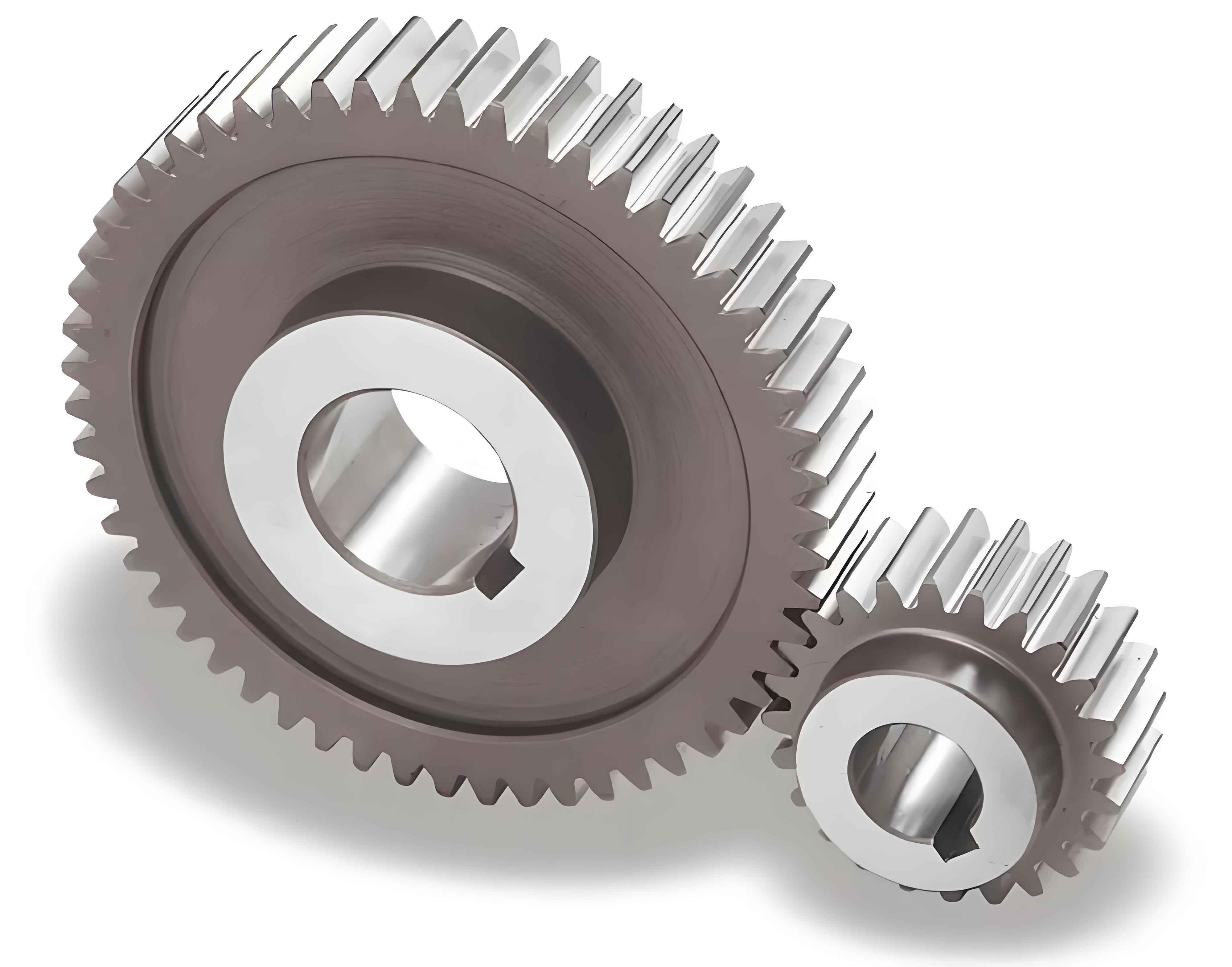
Spur gears, as fundamental transmission components, face increasing demands for precision and efficiency in modern manufacturing. This study proposes a novel two-step cold forging process combining inward flow and mandrel exchange to address challenges in traditional machining, such as high energy consumption and low material utilization. The methodology leverages multi-physics coupling analysis to optimize forming loads and improve mechanical properties.
1. Process Design and Theoretical Framework
The coupled forming process consists of:
- Pre-forging stage: Creates a preliminary gear profile with controlled material redistribution
- Final forging stage: Achieves net-shape geometry through mandrel exchange and inward flow control
The governing equation for material flow during deformation considers both geometric constraints and plastic strain:
$$ \sigma_{eff} = \sqrt{\frac{3}{2}\mathbf{S}:\mathbf{S}} $$
where $\sigma_{eff}$ represents effective stress and $\mathbf{S}$ denotes deviatoric stress tensor.
2. Finite Element Modeling Parameters
| Parameter | Value |
|---|---|
| Gear module (m) | 1.5 mm |
| Pressure angle (α) | 20° |
| Friction factor (μ) | 0.12 |
| Workpiece material | AISI-1045 (cold) |
| Mesh type | Tetrahedral elements |
3. Key Innovations in Tooling Design
The mandrel exchange mechanism enables controlled material flow through three pad configurations:
| Pad Type | Protrusion Angle | Fillet Radius | Load Reduction |
|---|---|---|---|
| A | 30° | 0 mm | 42% |
| B | 55° | 0 mm | 48% |
| C | 55° | 3 mm | 53% |
The optimized pad geometry (Type C) demonstrates superior performance due to stress distribution improvement:
$$ \tau_{max} = \frac{\sigma_1 – \sigma_3}{2} \leq \tau_y $$
where $\tau_{max}$ is maximum shear stress and $\tau_y$ represents yield shear strength.
4. Numerical Simulation Results
DEFORM-3D analysis reveals significant improvements over conventional closed-die forging:
| Performance Metric | Traditional Process | Coupled Method |
|---|---|---|
| Peak Forming Load | 9.03 kN | 4.60 kN |
| Material Utilization | 68% | 92% |
| Surface Finish (Ra) | 12.5 μm | 3.2 μm |
The velocity field distribution during final forging stage confirms effective material flow control:
$$ v_r = \frac{\partial \phi}{\partial r}, \quad v_\theta = \frac{1}{r}\frac{\partial \phi}{\partial \theta} $$
where $v_r$ and $v_\theta$ represent radial and tangential velocity components, respectively.
5. Industrial Implementation
Practical verification using 1000kN hydraulic press demonstrates:
- Complete tooth profile formation with dimensional accuracy < IT9
- Consistent surface hardness of 28-32 HRC
- Production cycle time reduction by 40% compared to machining
The developed methodology provides a technical foundation for mass production of high-precision spur gears in automotive and aerospace applications, significantly advancing net-shape manufacturing capabilities.