
1. Introduction
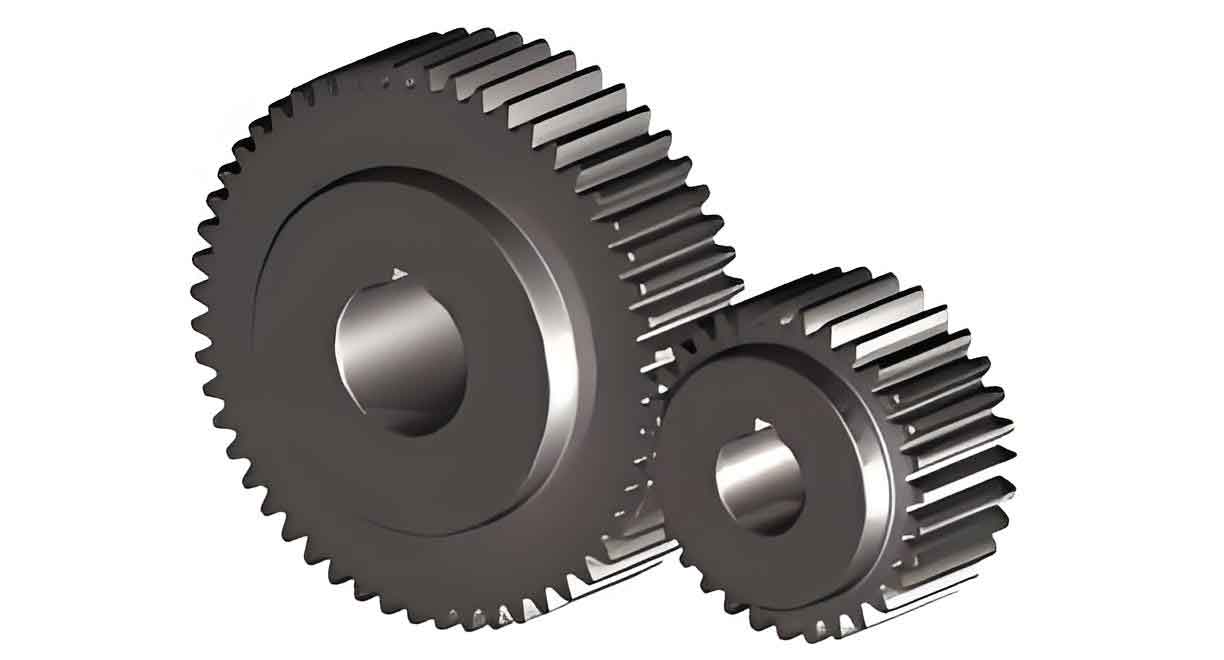
Spur gear systems are critical components in mechanical power transmission, where time-varying mesh stiffness (TVMS) governs their dynamic behavior. Pitting damage on tooth surfaces significantly alters TVMS, leading to vibration anomalies. This study establishes a novel pitting model for spur gears, quantifies stiffness variations, and validates results through experiments.
2. Pitting Modeling and Mesh Stiffness Calculation
2.1 Geometric Representation of Pitting
Three pitting severity levels are defined for spur gears:
| Level | Pitting Area Ratio | Ellipse Parameters (mm) |
|---|---|---|
| Mild | 5-15% | Major axis ≤0.8, Minor axis ≤0.3 |
| Moderate | 15-30% | Major axis 0.8-1.5, Minor axis 0.3-0.6 |
| Severe | 30-50% | Major axis ≥1.5, Minor axis ≥0.6 |
2.2 Potential Energy Method for TVMS
The total TVMS of spur gears considering pitting damage is calculated as:
$$ \frac{1}{k_{\text{mesh}}} = \frac{1}{k_b} + \frac{1}{k_s} + \frac{1}{k_a} + \frac{1}{k_c} $$
Where:
$$ k_b = \frac{Ew(2h)^3}{12L^3}, \quad k_s = \frac{Ew(2h)}{2.4(1+\nu)L}, $$
$$ k_a = \frac{Ew(2h)}{L}, \quad k_c = \frac{\pi Ew}{4(1-\nu^2)} $$
3. Dynamic Response Analysis
The motion equation for a spur gear pair with pitting damage is:
$$ m_{\text{eq}}\ddot{x} + c\dot{x} + k_{\text{mesh}}(t)x = F_m + F_{\text{err}} $$
Where equivalent mass:
$$ m_{\text{eq}} = \frac{I_pI_g}{I_pr_g^2 + I_gr_p^2} $$
| Parameter | Range | Stiffness Reduction |
|---|---|---|
| Major Axis | 0.5-2.0 mm | 8.7%-32.4% |
| Minor Axis | 0.2-1.0 mm | 4.1%-18.9% |
| Pitting Count | 3-15 | 6.5%-28.3% |
4. Experimental Validation
We developed a spur gear test rig with controlled pitting damage:
$$ \text{Error Index} = \frac{1}{N}\sum_{i=1}^{N}\left|\frac{f_{\text{exp}}(i) – f_{\text{sim}}(i)}{f_{\text{exp}}(i)}\right| \times 100\% $$
Key experimental parameters:
| Parameter | Value |
|---|---|
| Module | 3 mm |
| Teeth Number | 28 |
| Pressure Angle | 20° |
| Torque Load | 50-200 Nm |
5. Results and Discussion
The vibration response of spur gears shows characteristic changes due to pitting:
$$ \text{Amplitude Modulation Index} = \frac{A_{\text{max}} – A_{\text{min}}}{A_{\text{max}} + A_{\text{min}}} $$
For severe pitting cases:
$$ \text{THD} \geq 15\%,\quad \text{Signal Kurtosis} \geq 4.8 $$
6. Conclusion
This study establishes a comprehensive framework for analyzing spur gear dynamics with pitting damage. The elliptical pitting model accurately predicts TVMS variations, while experimental results validate the theoretical predictions. The proposed methodology provides fundamental insights for spur gear condition monitoring and fault diagnosis.