
Within the domain of advanced gear technology, specifically concerning hydraulic systems, gear pumps play a pivotal role. The double circular arc gear pump offers distinct advantages over traditional involute gear pumps, including enhanced load-bearing capacity, smoother flow pulsation, and reduced noise levels. The rotors of such pumps utilize double circular arc helical gears. The fundamental transverse tooth profile typically consists of upper and lower circular arcs connected by a transition curve. Research into optimizing this transition curve, particularly using involute forms, has been significant for improving performance metrics like flow pulsation and noise. This paper details an integrated methodology for the precise parametric modeling and subsequent NC machining simulation of an involute-transition double circular arc helical gear, leveraging the combined power of MATLAB, Siemens NX, and Vericut software, thereby showcasing advancements in modern gear technology.
The precise geometric definition of the gear tooth profile is paramount. The transverse tooth profile of the involute double circular arc helical gear is dictated by fundamental gear parameters. We established the following parameters for both the driving and driven gears within the pump rotor system:
| Parameter | Symbol | Unit | Driving Gear Value | Driven Gear Value |
|---|---|---|---|---|
| Normal Module | $m_n$ | mm | 2.0 | 2.0 |
| Transverse Module | $m_t$ | mm | 2.57 | 2.57 |
| Number of Teeth | $z$ | – | 7 | 7 |
| Normal Pressure Angle | $\alpha_n$ | ° | 28 | 28 |
| Face Width | $B$ | mm | 10 | 10 |
| Helix Angle | $\beta$ | ° | 39 | 39 |
| Pitch Circle Diameter | $d$ | mm | $d = m_t \times z = 17.99$ | $d = m_t \times z = 17.99$ |
| Base Circle Diameter | $d_b$ | mm | $d_b = d \times \cos(\alpha_t)$ | $d_b = d \times \cos(\alpha_t)$ |
| Transverse Pressure Angle | $\alpha_t$ | ° | $\alpha_t = \tan^{-1}(\tan(\alpha_n)/\cos(\beta))$ | $\alpha_t = \tan^{-1}(\tan(\alpha_n)/\cos(\beta))$ |
Accurately generating the involute transition curve within CAD software like NX can be challenging. To overcome this limitation inherent in complex curve handling within some CAD packages, we developed a dedicated program in MATLAB. This program calculated the coordinates of the involute profile points based on the derived transverse pressure angle $\alpha_t$ and the base circle radius $R_b = d_b / 2$. The core parametric equations implemented were:
$$ x = R_b \cdot \cos(\theta) + R_b \cdot \theta \cdot \sin(\theta) $$
$$ y = R_b \cdot \sin(\theta) – R_b \cdot \theta \cdot \cos(\theta) $$
where $\theta$ is the involute roll angle. The angle parameter $\theta_0$ for positioning the involute segment was calculated using:
$$ \theta_0 = \tan(\alpha_t) – \alpha_t + \frac{\pi}{2z} $$
The MATLAB code iterated over a defined range of $\theta$ values with a fine resolution (e.g., step 0.01) to ensure a smooth curve. The calculated (x, y) coordinate pairs were then written to a .dat file format. A subset of these generated points is shown below:
| Point ID | X-Coordinate (mm) | Y-Coordinate (mm) | Z-Coordinate (mm) |
|---|---|---|---|
| 1 | 2.254304 | 7.078319 | 0.0 |
| 2 | 2.280141 | 7.224460 | 0.0 |
| 3 | 2.278897 | 7.669461 | 0.0 |
| 4 | 2.132757 | 8.396562 | 0.0 |
| 5 | 1.731835 | 9.354320 | 0.0 |
| 6 | 0.983170 | 10.459558 | 0.0 |
| 7 | 0.087159 | 11.376868 | 0.0 |
| 8 | -1.437721 | 12.457394 | 0.0 |
| 9 | -3.528415 | 13.370079 | 0.0 |
This .dat file was imported into Siemens NX 12.0 using the “Points from File” or “Spline through Points” functionality. Within NX, a fully parametric model was constructed. Key geometric elements like the pitch circle, tip circle, and root circle were defined using expressions linked to the basic gear parameters ($z$, $m_n$, $\beta$, $\alpha_n$). The centers of the upper and lower circular arcs were positioned on the pitch circle. The imported involute points were used to create a smooth spline representing the transition curve. This spline, along with the defined upper and lower circular arcs, formed a single tooth profile on the transverse plane. Mirroring and circular patterning operations completed the full transverse gear profile. To create the three-dimensional helical gear, a helix was constructed along the pitch cylinder. The helix lead $L$ (pitch) is a critical parameter calculated using the helix angle $\beta$ and pitch diameter $d$:
$$ L = \frac{\pi \cdot d}{\tan(\beta)} $$
For our parameters ($d \approx 17.99$ mm, $\beta = 39^\circ$), $L \approx 70$ mm. Three helical guide curves were generated along the face width (10 mm). The transverse tooth profile was then swept along these helical paths using the “Sweep” command, resulting in an accurate 3D solid model of the double circular arc helical gear. The driven gear was modeled similarly but with an opposite helix angle (e.g., $-39^\circ$).
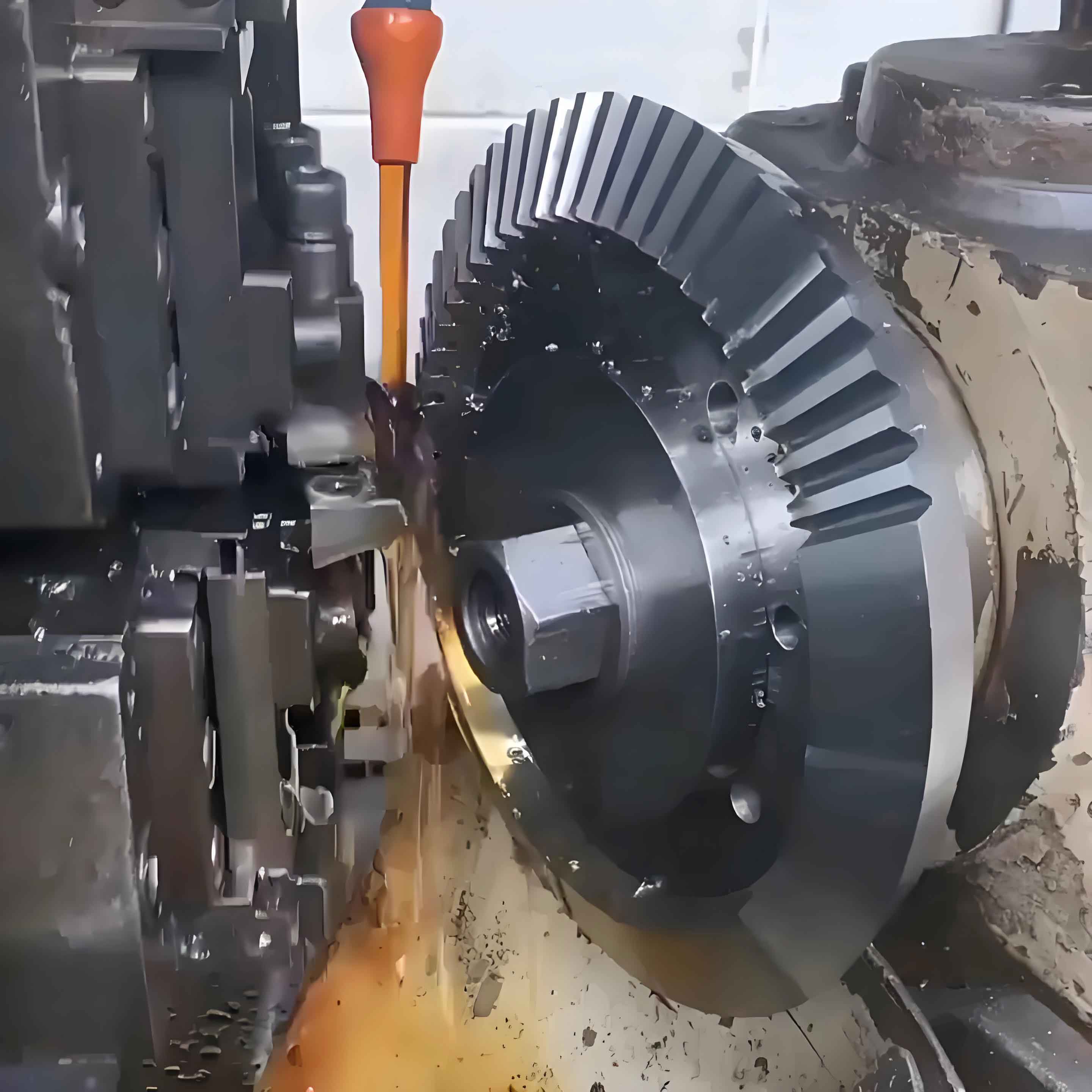
To validate the meshing behavior of the designed rotor pair (driving and driven gears), a kinematic simulation was performed within NX Motion. The gears were assembled with constraints: face alignment, gear shaft parallelism, and a contact constraint between mating tooth flanks. A revolute joint was applied to each gear shaft. A constant rotational velocity (e.g., 60 rpm) was applied to the driving gear joint using a polynomial driver. A gear coupling joint was defined to establish the speed ratio (1:1 for identical gears). The simulation solved over a defined period, animating the meshing process. The simulation confirmed smooth, continuous rotation without any interference or collision between the teeth, verifying the correctness of the geometric model and assembly for this specific application of gear technology.
Transitioning from design to manufacturing, the integrated CAM capabilities of Siemens NX were leveraged for NC programming. The 3D gear model was imported into the NX Manufacturing module, initializing a multi-axis milling environment. A ball-nose end mill was selected as the cutting tool. To ensure the tool could access the concave circular arc profiles of the tooth flanks without gouging, the ball diameter must be smaller than the profile arc radius. A $\phi$1 mm diameter ball-nose end mill was chosen with a suitable flute length and overall tool length.
The machining strategy employed a “Surface Area” contouring operation. The gear solid body was designated as the part geometry. A cylindrical stock model, slightly oversized (e.g., radius offset by 0.2 mm), was defined as the initial workpiece. The “Surface Area” driving geometry selected the complex tooth flank surfaces. The tool axis was controlled using the “Away from Line” strategy, generally pointing the tool axis away from the gear axis to maintain optimal cutting contact. Given the minimal stock allowance (focusing on near-net-shape or finish machining), roughing parameters were set with a small stock allowance (0.03 mm), followed by a finishing pass with zero stock allowance. Cutting parameters were defined:
| Machining Parameter | Value | Unit |
|---|---|---|
| Spindle Speed (Finishing) | 1200 | rpm |
| Cutting Feedrate | 200 | mm/min |
| Stepover Distance | 0.1 | mm |
| Tool Diameter | 1.0 | mm |
Generating the toolpath resulted in a complex multi-axis trajectory closely following the helical gear tooth surfaces. NX provided robust visualization tools, including toolpath replay and material removal simulation, confirming the absence of gouging and verifying complete coverage within the integrated environment, eliminating potential errors from model translation – a significant benefit for complex gear technology applications. Finally, the verified toolpath was post-processed using an appropriate NX Post Processor (e.g., for a 5-axis FANUC controller) to generate the machine-specific G-code (NC program).
The generated NC program, while verified within NX CAM, required further validation in a realistic virtual machining environment. Vericut 9.2 software was employed for this purpose. A digital twin of the target 5-axis CNC milling machine was constructed within Vericut, accurately modeling its kinematic chain (machine structure, axes travel limits, rotary axis configurations). The FANUC 31i-M control system definition (fan31im.ctl) was loaded to accurately interpret the G-code syntax. The following components were added to the project:
- Machine Model: Representing the physical structure and kinematics.
- Control System: FANUC 31i-M.
- Fixtures: Necessary workholding.
- Stock: Cylindrical blank matching the CAM setup ($\phi$~18.4 mm x 10 mm).
- Cutting Tool: Defined identically to the NX CAM tool ($\phi$1 mm ball-nose).
- Design Model: The finished double circular arc gear geometry for comparison.
- NC Program: The G-code output from the NX post-processor.
The coordinate system (G54 work offset) was aligned with the machine setup. The simulation was executed within Vericut. The software dynamically simulated the material removal process, accurately reflecting machine movements, tool engagement, and the resulting workpiece geometry. Crucially, Vericut’s “Auto-Diff” module continuously compared the in-process workpiece against the design model, highlighting any deviations (gouges or excess material). Its collision detection system monitored for unintended contacts between machine components, tool holders, fixtures, and the stock. The Vericut log window and status display provided real-time feedback. The simulation concluded successfully with no collisions or gouges detected, and the final simulated workpiece perfectly matched the design model geometry. This comprehensive verification confirmed the correctness of the NC program, the suitability of the machining strategy, and the absence of kinematic issues on the target machine tool, providing high confidence for physical machining. This virtual validation step is indispensable for complex, high-value components like those in advanced gear technology.
To further validate the geometric integrity and manufacturability of the design, a physical prototype was produced using Additive Manufacturing (AM). The NX-generated 3D CAD model was exported in STL format. An Aurora A8 industrial-grade 3D printer, utilizing Nylon material (PA12), was employed for its ability to produce durable and dimensionally stable parts suitable for visual and functional verification. The gear was printed at a 1:1 scale. The resulting physical model clearly exhibited the characteristic double circular arc profile on the tooth flanks and the helical tooth orientation. This tangible prototype confirmed the accuracy of the modeling process, the feasibility of the gear geometry, and served as a valuable reference for the machining process development, bridging the gap between digital design and physical realization in gear technology.
This research presented a fully integrated digital workflow for the design, modeling, simulation, and NC programming of complex involute-transition double circular arc helical gears. Key contributions and conclusions are:
- Parametric Modeling: The methodology successfully overcame CAD limitations for complex curve generation by integrating MATLAB for precise involute coordinate calculation and NX for robust parametric solid modeling based on fundamental gear parameters. This ensured geometric accuracy essential for high-performance gear technology.
- Integrated CAM & NC Programming: Utilizing NX’s integrated CAM module directly on the parametric model enabled efficient generation of collision-free, gouge-free multi-axis toolpaths for the complex helical surfaces. The seamless transition from CAD to CAM within a single software environment eliminated potential data translation errors.
- Comprehensive Virtual Validation: Kinematic simulation in NX Motion verified correct meshing behavior. More critically, the Vericut machining simulation provided a high-fidelity virtual environment to validate the NC program, confirm the absence of collisions and gouges, and ensure the final part geometry matched the design intent *before* physical machining. This significantly reduces risk and cost in manufacturing complex gears.
- Practical Verification: The successful 3D printing of the gear model provided tangible confirmation of the design’s geometric soundness and manufacturability.
The presented approach, integrating MATLAB, NX CAD/CAM, and Vericut, forms a robust and efficient workflow for the development and virtual manufacturing of advanced gear geometries like the double circular arc helical gear. It enhances accuracy by eliminating model translation steps, reduces development time through integrated simulation, and significantly mitigates the risk of costly errors during physical machining. This methodology provides a valuable reference for the modeling and NC machining of other complex, non-standard helical gears and rotors, pushing the boundaries of precision manufacturing in modern gear technology.