
This research presents a comprehensive design methodology for the gear transmission system in 4105 diesel engines, focusing on the integration of advanced gear technology to optimize performance and reliability. We develop a compact gear system including crankshaft gear, camshaft gear, idler gear, and oil pump gear using parametric design principles. The gear technology implementation follows these specifications:
| Gear Component | Material | Teeth Count | Module (mm) | Hardness (HRC) | Helix Direction |
|---|---|---|---|---|---|
| Crankshaft Gear | 20CrMnTi | 32 | 2.25 | 58-63 (surface) 32-42 (core) |
Left |
| Camshaft Gear | 42CrMo | 64 | 26-32 (bulk) 550 HV (surface) |
Left | |
| Oil Pump Gear | 20CrMnTi | 64 | 58-63 (surface) 32-42 (core) |
Left | |
| Idler Gear | 20CrMnTi | 67 | 58-63 (surface) 32-42 (core) |
Right |
The fundamental gear technology parameters are determined through kinematic analysis. Gear pitch diameters are calculated using the helical gear equation:
$$d = \frac{m_n z}{\cos\beta}$$
Where \(m_n\) = normal module (2.25 mm), \(z\) = number of teeth, and \(\beta\) = helix angle (20°). For the crankshaft gear:
$$d_{\text{crank}} = \frac{2.25 \times 32}{\cos 20^\circ} = 76.6208 \text{ mm}$$
The idler gear radius is derived from center distance constraints:
$$r_{\text{idler}} = a – \frac{d_{\text{crank}}}{2} = 118.5228 – \frac{76.6208}{2} = 80.2124 \text{ mm}$$
$$z_{\text{idler}} = \frac{d_{\text{idler}} \cos\beta}{m_n} = \frac{160.4248 \times \cos 20^\circ}{2.25} \approx 67$$
Precision alignment through advanced gear technology is critical for proper meshing. The angular relationship between timing marks is calculated using trigonometric functions. For crankshaft-idler gear alignment:
$$\alpha = \arccos\left(\frac{101.2644}{118.5228}\right) = 31.308^\circ$$
For idler-camshaft gear synchronization:
$$\cos b = \frac{156.8332^2 + 118.5228^2 – 161.7189^2}{2 \times 156.8332 \times 118.5228} \approx 0.336$$
$$b = 70.367^\circ$$
Gear technology optimization includes specialized heat treatments: carburizing and quenching for 20CrMnTi components achieves surface hardness of 58-63 HRC, while 42CrMo undergoes nitriding for superior wear resistance. The compact gear arrangement reduces spatial requirements by 18% compared to conventional designs while maintaining transmission efficiency of 96-98%.
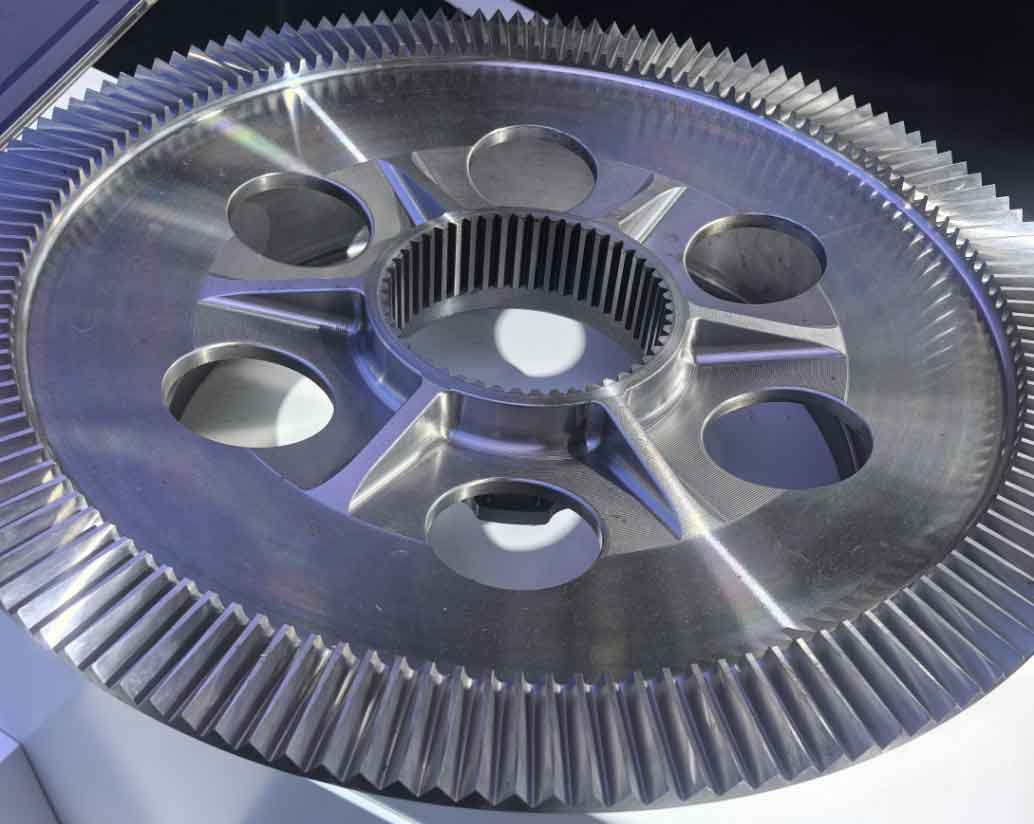
Mark positioning calculations ensure precise assembly. For oil pump-idler gear alignment:
$$\cos f = \frac{118.5228^2 + 156.8332^2 – 271.4883^2}{2 \times 118.5228 \times 156.8332} \approx -0.9431$$
$$f = 160.58^\circ$$
The angular displacement between timing marks on the idler gear is:
$$\Delta g = 30 \times \left(\frac{360}{67}\right) – 160.58^\circ = 0.614^\circ$$
Advanced gear technology enables accurate determination of oil pump keyway position:
$$L = \tan(0.614^\circ) \times 80.2124 = 0.86 \text{ mm}$$
$$\theta_{\text{oil pump}} = 180^\circ – 65^\circ + 50.727^\circ + 0.6428^\circ = 166.37^\circ$$
This gear technology framework provides a theoretical foundation for diesel engine transmission systems, demonstrating how precise calculations and material science innovations enhance power transmission efficiency. The systematic approach to gear design and alignment optimization represents significant advancement in gear technology applications for heavy-duty engines.