
Gear transmission systems in ball mills play a critical role in industrial production, where their performance directly impacts equipment efficiency and operational lifespan. This research comprehensively investigates vibration and acoustic characteristics of ball mill gear systems, addressing three fundamental aspects: material properties, installation precision, and dynamic behavior. Material selection significantly influences vibration propagation, as expressed through the relationship between stress amplitude and fatigue life:
$$ \sigma_a = \sigma’_f (2N_f)^b $$
Where $\sigma_a$ represents stress amplitude, $\sigma’_f$ denotes fatigue strength coefficient, $N_f$ is cycles to failure, and $b$ signifies fatigue strength exponent. Advanced gear technology utilizes this relationship to optimize material selection for vibration resistance.
Material Property Analysis
Alloy steel remains the preferred material due to its superior strength and wear resistance. Microstructural analysis reveals that uniform fine-grained structures enhance fatigue resistance, while carbide distribution affects stress concentration. Hardness and strength properties directly determine load-bearing capacity:
| Material Property | Impact on Gear Performance | Optimal Range |
|---|---|---|
| Hardness (HRC) | Wear resistance and surface durability | 55-62 HRC |
| Yield Strength (MPa) | Load distribution under operational stress | ≥ 850 MPa |
| Fatigue Limit (MPa) | Vibration resistance during cyclic loading | ≥ 500 MPa |
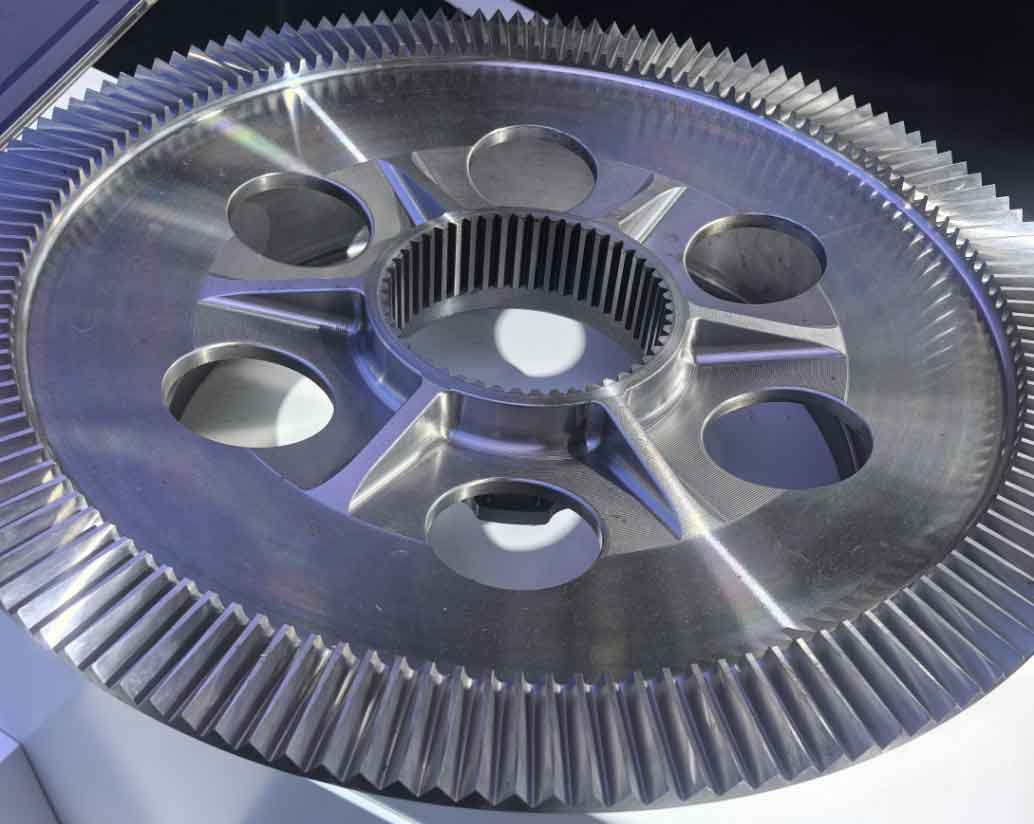
The Basquin equation further quantifies fatigue behavior in modern gear technology applications:
$$ \sigma_a = \sigma_f’ (2N_f)^b $$
Installation Precision and Technical Requirements
Precision alignment remains paramount in gear technology implementation. Misalignment exceeding 0.1mm induces eccentric motion, while tooth profile errors beyond 5μm amplify vibration. Thermal management proves critical as temperature fluctuations cause dimensional changes:
$$ \Delta L = \alpha \cdot L_0 \cdot \Delta T $$
Where $\Delta L$ is dimensional change, $\alpha$ is thermal expansion coefficient, $L_0$ is original dimension, and $\Delta T$ is temperature variation. Lubrication effectiveness directly correlates with vibration reduction through oil film thickness calculation:
$$ h_{\min} = 1.25 R_x \left( \frac{\eta U}{E’ R} \right)^{0.7} (W)^{-0.13} $$
Vibration suppression techniques include:
- Vibration-absorbing materials (e.g., rubber pads with damping coefficient ζ ≥ 0.15)
- Anti-vibration mounts reducing transmission by 40-60%
- Dynamic balancing achieving residual unbalance < 1 g·mm/kg
Vibration Generation Mechanisms
Gear meshing frequency represents a primary vibration source in gear technology systems:
$$ f_m = \frac{N \cdot n}{60} $$
Where $f_m$ is meshing frequency (Hz), $N$ is tooth count, and $n$ is rotational speed (RPM). Mass imbalance follows the relationship:
$$ F_u = m \cdot e \cdot \omega^2 $$
Where $F_u$ is unbalanced force, $m$ is mass, $e$ is eccentricity, and $\omega$ is angular velocity. Vibration sources are quantified below:
| Vibration Source | Vibration Amplitude (mm/s) | Frequency Characteristics |
|---|---|---|
| Tooth contact imperfection | 0.05-0.15 | 1-3 × meshing frequency |
| Mass imbalance | 0.02-0.09 | 1 × rotational frequency |
| Speed mismatch | 0.03-0.20 | Variable sidebands |
| Bearing defects | 0.01-0.18 | BPFO/BPFI frequencies |
Optimization Solutions
Advanced gear technology incorporates multi-faceted vibration control through precision manufacturing governed by:
$$ \text{Tolerance grade} \leq \text{ISO 5} $$
Noise reduction strategies utilize sound power level calculations:
$$ L_W = 10 \log_{10} \left( \frac{W}{W_0} \right) $$
Where $L_W$ is sound power level (dB), $W$ is sound power, and $W_0$ is reference power (10⁻¹² W). Dynamic balancing applies the formula:
$$ U_{\text{per}} = \frac{9549 \cdot G \cdot M}{n} $$
Where $U_{\text{per}}$ is permissible unbalance (g·mm), $G$ is balance quality grade, $M$ is rotor mass (kg), and $n$ is maximum speed (RPM). Comprehensive solutions include:
- Micro-geometry optimization reducing noise by 6-8 dB(A)
- Active vibration control systems with 70-90% suppression efficiency
- Acoustic enclosures achieving 15-25 dB insertion loss
Conclusion
This analysis demonstrates that optimized gear technology significantly enhances ball mill performance through material science, precision engineering, and dynamic control. Implementing these solutions reduces maintenance costs by 25-40% while improving operational environment comfort. Future advancements in gear technology will focus on smart monitoring systems integrating IoT sensors with predictive maintenance algorithms, further revolutionizing industrial gear applications.