
Face gear drives, originating from Fellow Corporation’s innovations, represent specialized transmission mechanisms combining cylindrical gears with bevel gears. These systems have found successful applications in robotics joint reducers, helicopter power-split transmissions, automotive differentials, and rear-axle drives. Compared to traditional bevel gears, face gear transmissions offer superior power density, reduced noise generation, relaxed axial positioning tolerances, and simplified maintenance procedures. To expand their applicability in spatially constrained systems requiring diverse layout configurations, we develop a comprehensive methodology for helical offset non-orthogonal face gears featuring simultaneous helix angle, axis offset, and non-orthogonal shaft arrangement.
The mathematical foundation begins with defining the cutting tool geometry. For helical face gear generation, we employ an involute helical shaper cutter characterized by basic parameters:
| Symbol | Parameter | Value |
|---|---|---|
| $N_s$ | Number of cutter teeth | 28 |
| $m_n$ | Normal module (mm) | 6.35 |
| $\alpha_n$ | Normal pressure angle (°) | 25 |
| $\beta$ | Helix angle (°) | 10 |
The cutter’s tooth surface $Σ_s$ in coordinate system $S_s$ is represented by position vector $\mathbf{R}_s$ and unit normal $\mathbf{n}_s$:
$$\mathbf{R}_s(\theta_s, \lambda_s) =
\begin{bmatrix}
\pm R_{bs} \sin D – \theta_s \cos D \\
-R_{bs} \cos D – \theta_s \sin D \\
L_s \lambda_s / 2\pi \\
1
\end{bmatrix}$$
$$\mathbf{n}_s = \frac{1}{\sqrt{L_s^2 + R_{bs}^2}}
\begin{bmatrix}
\mp L_s \cos D \\
-L_s \sin D \\
R_{bs} \\
0
\end{bmatrix}$$
where $D = \theta_{cs} + \theta_s \pm \lambda_s$, $R_{ps} = m_t N_s / 2$ is the pitch radius, $R_{bs} = R_{ps} \cos \alpha_t$ is the base radius, $\theta_{cs} = 2\pi/N_s – (\tan \alpha_t – \alpha_t)$ denotes the base circle half-space angle, $\theta_s$ is the profile parameter, $\lambda_s$ is the helical rotation parameter, and $L_s = R_{ps} / \tan \beta$ represents the lead at pitch radius.
Coordinate transformation establishes the spatial relationship between cutter ($S_s$) and face gear ($S_2$). The homogeneous transformation matrix $\mathbf{M}_{2s}$ incorporates shaft offset $E = -50$ mm, shaft angle $\gamma_m = 110^\circ$, and axial distance $L_0$:
$$\mathbf{M}_{2s} =
\begin{bmatrix}
K_{11} & K_{12} & K_{13} & E \cos \phi_2 – L_0 \sin \gamma_m \sin \phi_2 \\
K_{21} & K_{22} & K_{23} & L_0 \cos \gamma_m \\
\sin \gamma_m \sin \phi_s & \cos \phi_s & \sin \gamma_m \cos \gamma_m & L_0 \cos \gamma_m \\
0 & 0 & 0 & 1
\end{bmatrix}$$
where $K_{11} = \cos \phi_s \cos \phi_2 + \cos \gamma_m \sin \phi_s \sin \phi_2$, $K_{12} = \cos \gamma_m \cos \phi_s \sin \phi_2 – \sin \phi_s \cos \phi_2$, $K_{13} = -\sin \gamma_m \sin \phi_2$, $K_{21} = \cos \gamma_m \cos \phi_s \sin \phi_2 – \cos \phi_s \sin \phi_2$, $K_{22} = \sin \phi_s \sin \phi_2 + \cos \gamma_m \cos \phi_s \sin \phi_2$, and $K_{23} = -\sin \gamma_m \cos \phi_2$. The kinematic relationship $\phi_2 = \phi_s N_s / N_2$ governs the synchronized motion during gear shaping.
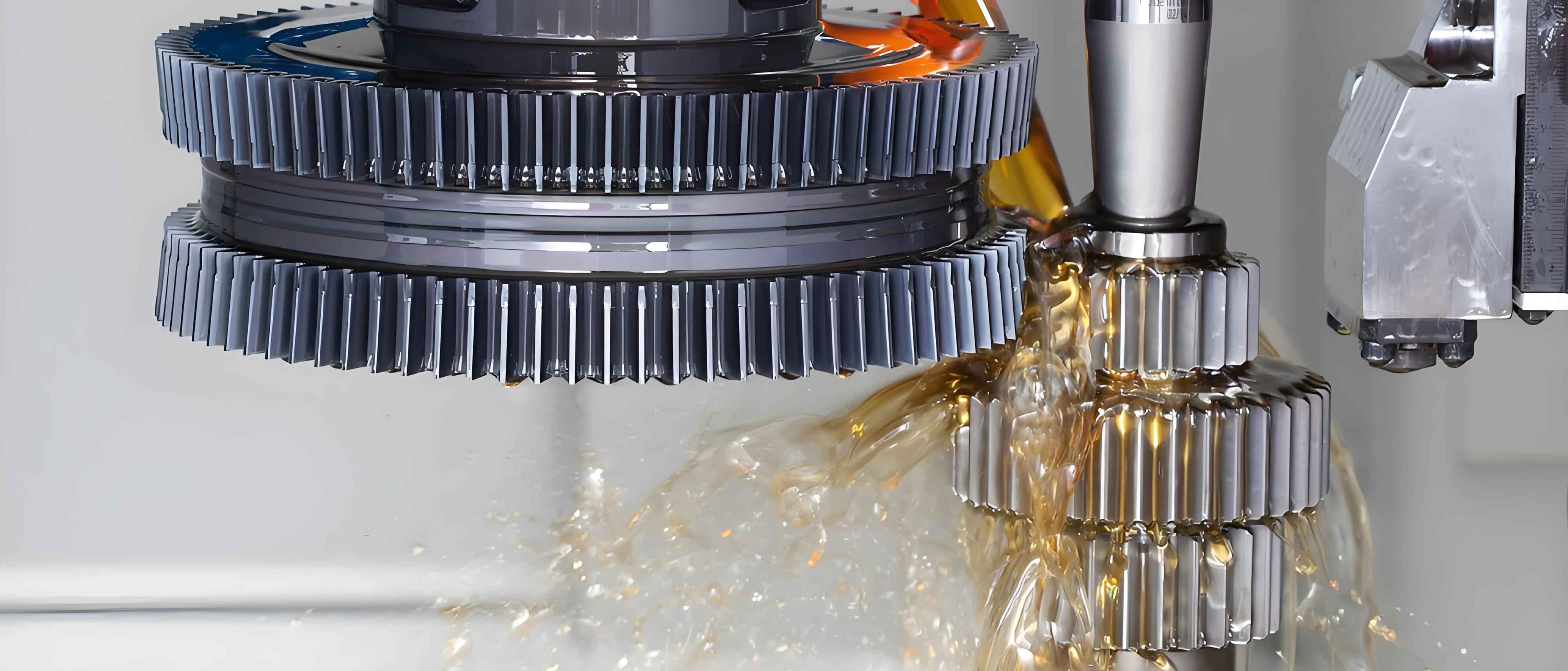
The face gear tooth surface $Σ_2$ emerges as the envelope of the cutter family during the gear shaping process, defined by the meshing equation and coordinate transformation:
$$\mathbf{R}_2(\theta_s, \lambda_s, \phi_s) = \mathbf{M}_{2s}(\phi_s) \mathbf{R}_s(\theta_s, \lambda_s)$$
$$f_2(\theta_s, \lambda_s, \phi_s) = \mathbf{n}_2 \cdot \frac{\partial \mathbf{R}_2}{\partial \phi_s} = 0$$
Numerical solution in coordinate system $S_w$ (rotated $\gamma_m$ about $x_2$-axis) facilitates visualization. For discrete points within the operating zone (inner radius: 561 mm, outer radius: 641 mm), we solve:
$$\mathbf{R}_w(1)^2 + \mathbf{R}_w(3)^2 = r^2$$
$$\mathbf{R}_w(2) = Y$$
$$f_w(\theta_s, \lambda_s, \phi_s) = 0$$
Simulation of the gear shaping process requires modeling a 6-axis CNC machine with synchronized motions:
| Axis | Function | Movement Type |
|---|---|---|
| X | Radial depth of cut | Linear |
| Y | Cutter offset adjustment | Linear |
| Z | Reciprocating cutting stroke | Linear |
| C | Cutter rotation & indexing | Rotary |
| B | Shaft angle orientation | Rotary |
| A | Workpiece rotation | Rotary |
The CNC program implements the following kinematic chain during gear shaping:
$$\begin{cases}
\phi_s = \phi_s(t) \\
\phi_2 = \dfrac{N_s}{N_2} \phi_s(t) \\
Z = Z_0 – v_f t \\
\Delta C = \dfrac{2\pi}{L_s} \Delta Z
\end{cases}$$
A representative G-code sequence for the gear shaping operation demonstrates the motion coordination:
G00 X-500 A0        (Position workpiece)
G00 B20             (Set shaft angle)
G00 Y-50            (Apply offset)
G00 Z730            (Rapid to start)
G00 X-390           (Radial approach)
G01 Z538.888 C-100.132 (Helical cutting)
G00 X-500           (Retract radial)
G00 Z718.888        (Retract axial)
M98 P0003 L4200     (Cycle subroutine)
Post-simulation deviation analysis employs a 7×11 grid across the active flank, avoiding fillet and edge zones. The normal deviation $e(i,j)$ between theoretical ($Σ_M$) and simulated ($Σ_V$) surfaces is calculated as:
$$e(i,j) = \left[ \mathbf{R}_M(i,j) – \mathbf{R}_V(i,j) \right] \cdot \mathbf{N}_M(i,j)$$
Results indicate consistent positive deviations (3.3-7.4 μm residual stock) without undercutting. This deviation stems from two sources: VERICUT’s discretization tolerance and inherent envelope approximation in the gear shaping process. Despite these residuals, the tooth flank accuracy conforms to AGMA Class 5 standards, validating the manufacturing approach for helical offset non-orthogonal face gears.