
Gears in mechanical transmission systems bear significant loads and torque, developing cracks during long-term operation. Accurate identification of crack damage severity is crucial for predicting gear reliability and enabling preventive maintenance. This study proposes a robust methodology for identifying gear crack damage degrees under variable-speed conditions, combining dynamic modeling, feature extraction, and ensemble learning.
Gear Dynamics Modeling
The dynamic behavior of gears under variable speeds is governed by nonlinear differential equations. The lumped-parameter model considers masses and inertias concentrated on gears:
$$m_1 \ddot{x}_1 + C_{p1} \dot{x}_1 + K_{p1} x_1 = -F_m \sin \alpha$$
$$m_1 \ddot{y}_1 + C_{p1} \dot{y}_1 + K_{p1} y_1 = -F_m \cos \alpha + m_1 g$$
$$J_1 \ddot{\theta}_1 = T_1 – F_m r_1$$
$$m_2 \ddot{x}_2 + C_{p2} \dot{x}_2 + K_{p2} x_2 = F_m \sin \alpha$$
$$m_2 \ddot{y}_2 + C_{p2} \dot{y}_2 + K_{p2} y_2 = F_m \cos \alpha + m_2 g$$
$$J_2 \ddot{\theta}_2 = -T_2 + F_m r_2$$
where $m_i$, $J_i$, $T_i$ represent masses, moments of inertia, and torques; $K_{pi}$, $C_{pi}$ denote bearing stiffness and damping; $\alpha$ is pressure angle; $r_i$ are base radii.
Time-varying meshing force $F_m(t)$ combines stiffness and damping effects:
$$F_m(t) = c_m \dot{\delta} + k_m(t) f(\delta)$$
where $\delta$ represents relative displacement:
$$\delta = (x_1 \sin \alpha + y_1 \cos \alpha + r_1 \theta_1) – (x_2 \sin \alpha + y_2 \cos \alpha + r_2 \theta_2) + e(t)$$
and $f(\delta)$ accounts for backlash nonlinearity:
$$f(\delta) =
\begin{cases}
\delta – b & \delta > b \\
0 & -b \leq \delta \leq b \\
\delta + b & \delta < -b
\end{cases}$$
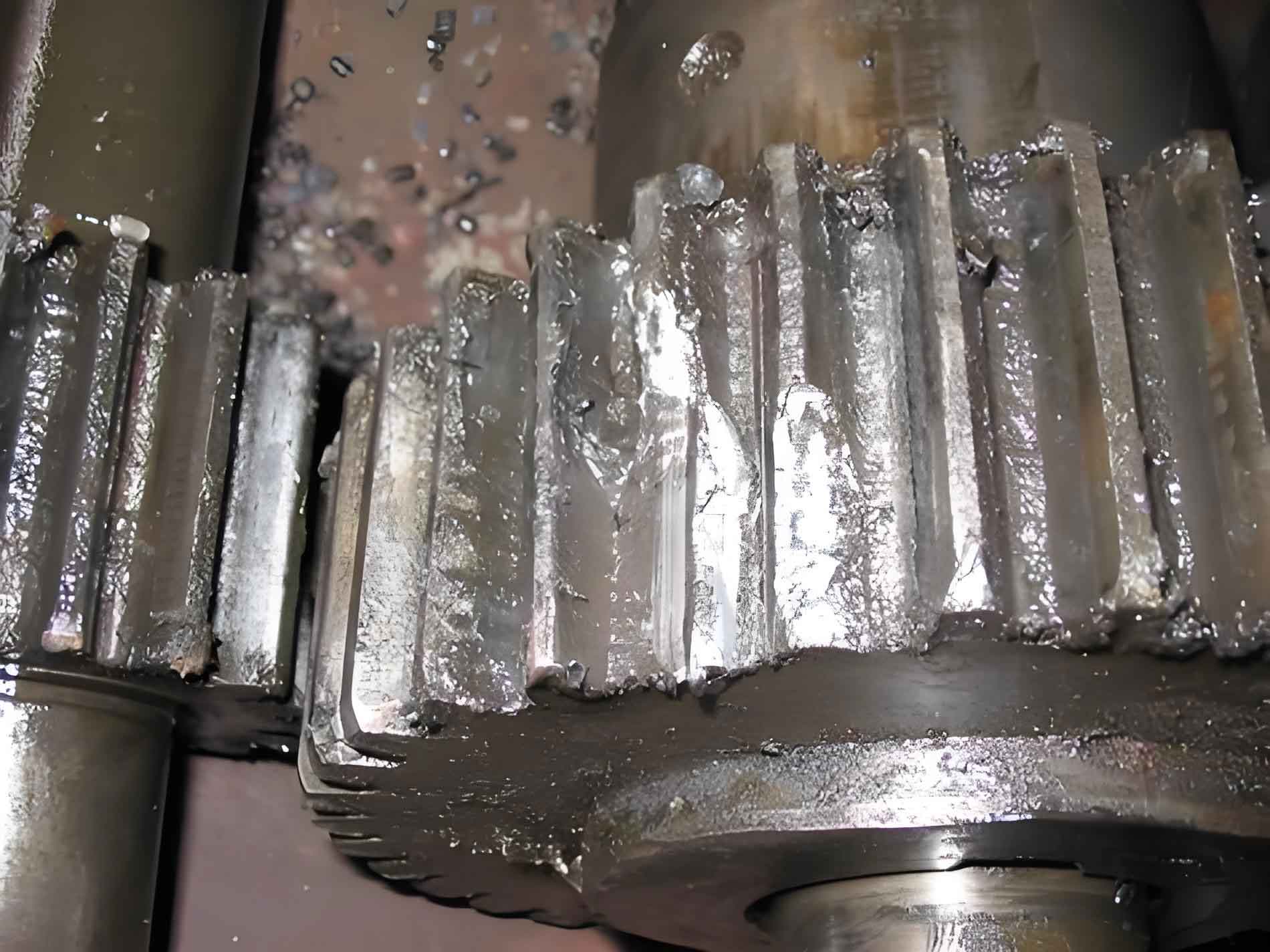
Time-Varying Meshing Stiffness Calculation
Energy method calculates stiffness considering shear deformation ($U_s$), bending ($U_b$), axial compression ($U_a$), and Hertzian contact ($U_h$):
$$U_s = \int_0^d \frac{F^2}{2GA_x} dx, \quad U_b = \int_0^d \frac{[F(d-x) – Fh]^2}{2EI_x} dx$$
$$U_a = \int_0^d \frac{F^2}{2EA} dx, \quad U_h = \frac{F^2}{2k_h}$$
Total stiffness for single/double tooth engagement:
$$k_t = \frac{1}{\frac{1}{k_h} + \frac{1}{k_b} + \frac{1}{k_s} + \frac{1}{k_a}}, \quad k_t = \sum_{i=1}^2 \frac{1}{\frac{1}{k_{h,i}} + \frac{1}{k_{b,i}} + \frac{1}{k_{s,i}} + \frac{1}{k_{a,i}}}$$
Cracked gear stiffness reduction is quantified through effective area $A_{xc}$ and moment of inertia $I_{xc}$:
$$I_{xc} =
\begin{cases}
\frac{1}{12}w(h_m + h_c)^3 & x \leq g_c \\
\frac{1}{12}w(h_m + h_c – L)^3 & x > g_c
\end{cases}$$
$$A_{xc} =
\begin{cases}
w(h_m + h_c) & x \leq g_c \\
w(h_m + h_c – L) & x > g_c
\end{cases}$$
where $L$ denotes crack length, $h_c$ crack depth, and $g_c$ crack initiation position.
Feature Extraction for Gear Failure Assessment
Two damage-sensitive features characterize gear failure progression:
1. Cumulative Fault Band Ratio (RCMFAM):
$$R_{CMFAM} = \sum_{k=1}^{N_b} \frac{X(kf_s)}{X(f_m)}$$
where $X(f)$ denotes spectral amplitude, $f_s$ fault frequency, $f_m$ meshing frequency, and $N_b=5$ harmonic count.
2. Cumulative Sideband Ratio (RCMFSM):
$$R_{CMFSM} = \sum_{k=1}^{N_s} \frac{X(nf_m \pm kf_s)}{\max[X(nf_m)]}$$
where $n$ is dominant meshing harmonic, $N_s=5$ sideband orders.
| Feature Type | Z-Score Consistency | Damage Sensitivity |
|---|---|---|
| Time-domain (F₁) | 3.82 | Low |
| Higher-order Statistics (F₂) | 2.91 | Medium |
| Frequency-domain (F₃) | 1.67 | High |
| Fault Band Amplitude (F₄) | 0.48 | Very High |
| Meshing Frequency (F₅) | 0.53 | Very High |
Ensemble SVM for Gear Failure Identification
Hybrid kernel SVM integrates multiple kernels for enhanced feature mapping:
$$K(x,y) = \alpha K_1(x,y) + (1-\alpha) K_2(x,y)$$
Bagging strategy combines M base SVM models:
$$H(A) = \text{argmax}_y \sum_{i=1}^M w_i \cdot \delta(h_i(A) = y)$$
Implementation workflow:
- Normalize features: $x_{\text{new}} = 2 \frac{x_{\text{raw}} – x_{\min}}{x_{\max} – x_{\min}} – 1$
- Generate bootstrap samples for base SVMs
- Train SVMs with hybrid RBF-polynomial kernels
- Determine weights $w_i$ via validation performance
- Aggregate predictions for final damage classification
Experimental Validation
Tests employed steel gears (pressure angle 25°) under variable speeds (500-2000 rpm). Crack progression: 0mm → 0.3mm → 0.6mm → 0.9mm.
| Crack Length (mm) | Meshing Stiffness (10⁸ N/m) | RCMFAM | RCMFSM |
|---|---|---|---|
| 0.0 | 13.2 ± 0.4 | 0.17 | 0.21 |
| 0.3 | 10.1 ± 0.6 | 0.38 | 0.45 |
| 0.6 | 7.3 ± 0.9 | 0.62 | 0.79 |
| 0.9 | 4.8 ± 1.2 | 0.91 | 1.24 |
Meshing frequency identification under variable speeds:
| Tooth Position | Actual (Hz) | Identified (Hz) | Error (%) |
|---|---|---|---|
| Healthy Gear | 185.2 | 185.1 | 0.05 |
| Cracked (Position 4) | 287.4 | 285.7 | 0.59 |
| Cracked (Position 8) | 253.8 | 254.1 | 0.12 |
Damage classification accuracy comparison:
| Method | 0.3mm Crack (%) | 0.6mm Crack (%) | 0.9mm Crack (%) |
|---|---|---|---|
| Proposed Method | 97.2 | 98.6 | 99.1 |
| Torsional Vibration [2] | 84.3 | 79.8 | 76.5 |
| Ultrasonic [3] | 82.1 | 88.7 | 72.4 |
Conclusion
This methodology accurately identifies gear failure progression under variable speeds through three innovations: 1) Dynamics modeling capturing speed-dependent responses, 2) Energy-based stiffness quantification correlating with crack severity, and 3) Ensemble SVM with hybrid kernels for robust classification. Experimental validation confirms >97% accuracy across damage levels, outperforming conventional techniques. The approach provides critical insights for predictive maintenance of transmission systems operating under non-stationary conditions, effectively preventing catastrophic gear failure through early damage detection.