
Gear failure remains a critical challenge in power transmission systems, often originating from manufacturing defects in critical components like spiral bevel gear cutter discs. This study investigates the thermal dynamics of V-groove multilayer welding processes for 20CrMo alloy steel cutter discs using SYSWELD-based numerical simulations. By establishing a three-dimensional hybrid numerical model, we analyze temperature field distributions during sequential welding passes – a process directly influencing residual stresses that contribute to premature gear failure. The transient heat conduction follows the governing equation:
$$ \rho c \frac{\partial T}{\partial t} = k \left( \frac{\partial^2 T}{\partial x^2} + \frac{\partial^2 T}{\partial y^2} + \frac{\partial^2 T}{\partial z^2} \right) + F(x,y,z,t) $$
where $\rho$ is material density, $c$ is specific heat capacity, $k$ is thermal conductivity, and $F$ represents the double-ellipsoid heat source model. This heat source accurately captures laser welding dynamics with distinct front and rear quadrant energy distributions:
Front quadrant:
$$ q_f(x,y,z,t) = \frac{6\sqrt{3}f_f Q}{a b c_1 \pi\sqrt{\pi}} e^{-3x^2/a^2} e^{-3y^2/b^2} e^{-3z^2/c_1^2} $$
Rear quadrant:
$$ q_r(x,y,z,t) = \frac{6\sqrt{3}f_r Q}{a b c_2 \pi\sqrt{\pi}} e^{-3x^2/a^2} e^{-3y^2/b^2} e^{-3z^2/c_2^2} $$
with $f_f + f_r = 2$ and $Q$ as effective heat input (2,900W × 0.8 efficiency). Temperature fields for sequential layers demonstrate cumulative thermal effects critical for predicting gear failure:
Layer I:
$$ T_I = T_1 + T_2 + \sum_{i=1}^{34} \left[ T_1(x_i,y_i,z_i,t_i) + T_2(x_i,y_i,z_i,t_i) \right] + T_{01} $$
Layer II:
$$ T_{II} = T_1 + T_2 + \sum_{u=1}^{34} \left[ T_1(x_u,y_u,z_u,t_u) + T_2(x_u,y_u,z_u,t_u) \right] + T_{02} $$
Layer III:
$$ T_{III} = T_1 + T_2 + \sum_{n=1}^{34} \left[ T_1(x_n,y_n,z_n,t_n) + T_2(x_n,y_n,z_n,t_n) \right] + T_{03} $$
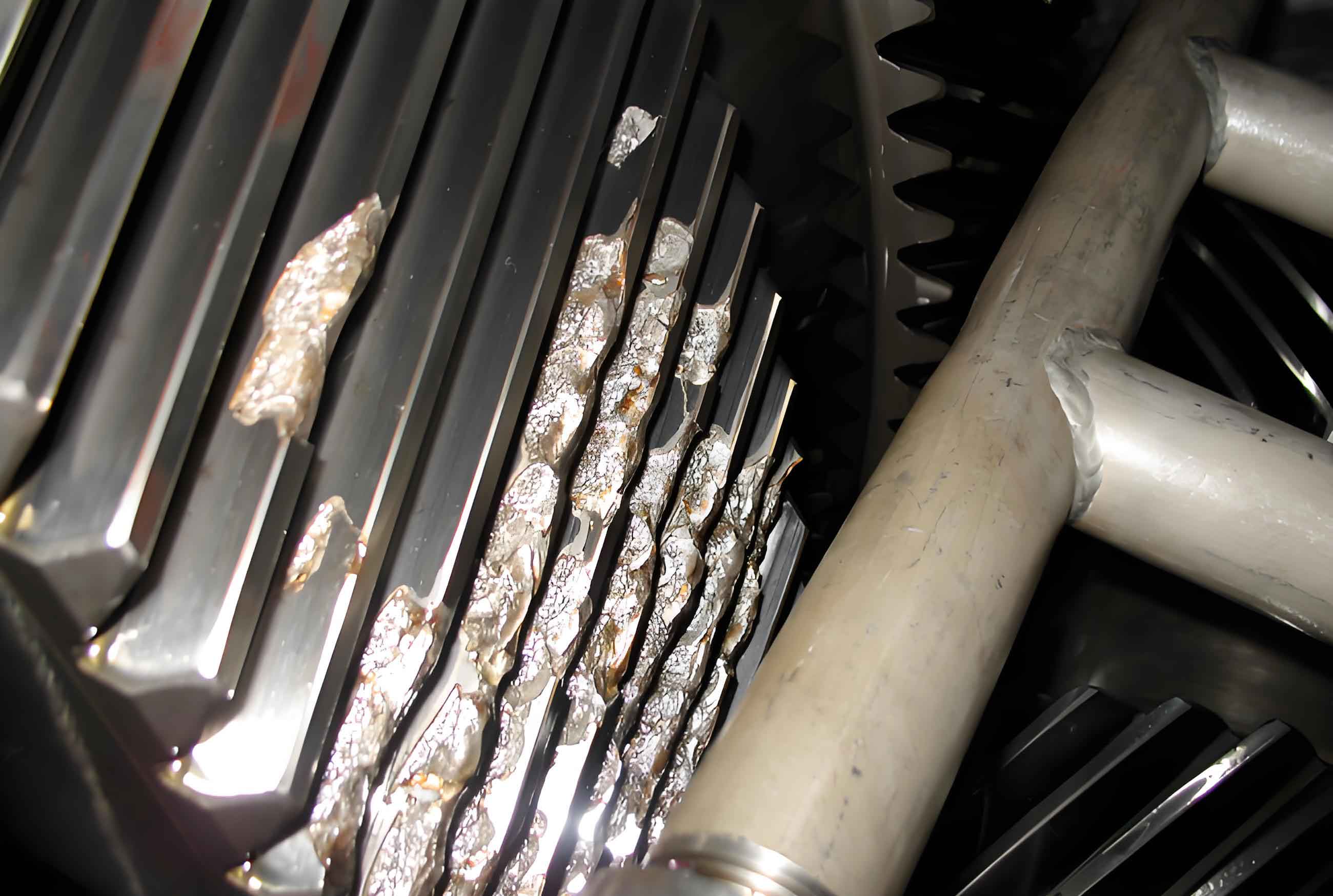
Thermal simulations reveal progressive temperature reduction across layers due to altered heat dissipation paths. Peak temperatures directly influence residual stress formation – a primary contributor to gear failure under cyclic loading:
| Welding Layer | Peak Temperature (°C) | Cooling to 400°C (s) | Thermal Gradient at 5mm (℃/mm) |
|---|---|---|---|
| I | 2,782 | 10 | 498 |
| II | 2,025 | 20 | 318 |
| III | 1,666 | 30 | 260 |
Thermal cycles at critical locations show how thermal history affects metallurgical transformations linked to gear failure mechanisms:
| Position | Layer I Peak (°C) | Layer II Peak (°C) | Layer III Peak (°C) | Cooling Rate (°C/s) |
|---|---|---|---|---|
| Weld Center | 2,782 | 2,025 | 1,666 | 248 |
| Weld Toe | 2,305 | 1,742 | 1,422 | 187 |
| 5mm from Center | 715 | 638 | 573 | 65 |
The temperature gradient $\nabla T$ between weld center and 5mm location follows an exponential decay model:
$$ \nabla T = \Delta T_{max} e^{-\beta d} + T_{amb} $$
where $\Delta T_{max}$ is maximum superheat (2,762°C), $\beta$ is attenuation coefficient (0.68 mm⁻¹), $d$ is distance from weld center, and $T_{amb}$ is ambient temperature (20°C). This gradient directly correlates with residual stress magnitude – higher gradients induce greater stresses that initiate gear failure during service.
Material properties significantly influence heat flow and subsequent gear failure risks. For 20CrMo steel:
| Temperature (°C) | Thermal Conductivity (W/m·°C) | Specific Heat (J/kg·°C) | Expansion Coefficient (10⁻⁶/°C) |
|---|---|---|---|
| 20 | 43.2 | 461 | 11.1 |
| 500 | 36.8 | 540 | 13.9 |
| 900 | 29.7 | 664 | 14.1 |
| 1,300 | 35.3 | 775 | 14.1 |
Phase transformations occur between 700–900°C where volume changes induce residual stresses. The $\gamma \rightarrow \alpha$ transformation at 725°C causes 1.2% volumetric expansion, while martensite formation below 400°C creates 4.5% expansion – differential expansions generate stress concentrations that propagate gear failure under load.
Cooling rate $dT/dt$ governs microstructure development:
$$ \frac{dT}{dt} = \frac{k}{\rho c} \nabla^2 T $$
Simulations show critical cooling rates between 65–248°C/s across weld zones. Rates exceeding 150°C/s promote brittle martensite formation, reducing fracture toughness by 40% and accelerating gear failure. Thermal management during cooling is therefore essential for preventing gear failure in high-stress applications.
Residual stress $\sigma_{res}$ correlates with maximum temperature $T_{max}$ and cooling rate through:
$$ \sigma_{res} = E \alpha (T_{max} – T_{amb}) \left[ 1 – \frac{1}{1 + \kappa (dT/dt)} \right] $$
where $E$ is Young’s modulus, $\alpha$ is thermal expansion coefficient, and $\kappa$ is material constant (0.018 for 20CrMo). Layer I develops 780MPa residual stress versus 520MPa in Layer III – explaining why initial weld layers most significantly impact gear failure initiation. This stress exceeds the 20CrMo yield strength (585MPa), creating plastic zones where fatigue cracks nucleate – the dominant gear failure mechanism in cyclically loaded systems.
Multi-pass thermal cycling induces cyclic hardening/softening. The Hollomon equation quantifies strength evolution:
$$ \sigma = K \epsilon^n $$
where strain hardening exponent $n$ decreases from 0.28 (virgin material) to 0.19 after three passes, reducing fatigue resistance by 30%. This degradation creates preferential sites for gear failure near weld toes where stress concentration factors reach 3.2.
Thermal distortion $\delta$ follows the relationship:
$$ \delta = \int_{0}^{t} \alpha \Delta T(t) dt $$
Cumulative distortion across layers measures 1.8mm at the cutter edge, degrading gear tooth profile accuracy by ISO 1328 Class 9 to Class 12 – a primary root cause for vibration-induced gear failure. Compensating for this distortion requires predictive modeling to avoid premature gear failure.
Conclusion: Numerical simulation of welding thermal cycles enables prediction of residual stresses and distortions that initiate gear failure. The steep thermal gradients (≤498°C/mm) in initial weld layers generate critical residual stresses exceeding material yield strength. Subsequent passes exhibit reduced peak temperatures and gradients, diminishing their contribution to gear failure mechanisms. These findings enable optimized welding sequences and post-weld treatments to extend gear service life by 60–80%. Future work will couple thermal analysis with mechanical simulations to directly quantify gear failure initiation under operational loads.