
The elastic-plastic deformation within the contact deformation zone during gear shaving critically influences the mid-concave error of the final gear tooth profile. Quantitative stress analysis of this deformation is foundational for understanding and mitigating this error. This paper establishes a local coordinate system for the contact deformation zone in gear shaving using Hertz contact theory, constructs elastic and plastic stress analysis models, and derives explicit formulas for calculating elastic stress and residual stress resulting from plastic deformation. Crucially, it determines the elastic yield limit stress within the contact deformation zone, providing a theoretical boundary criterion to distinguish elastic from plastic deformation. This enables quantitative assessment of the elastic-plastic deformation properties during gear shaving.
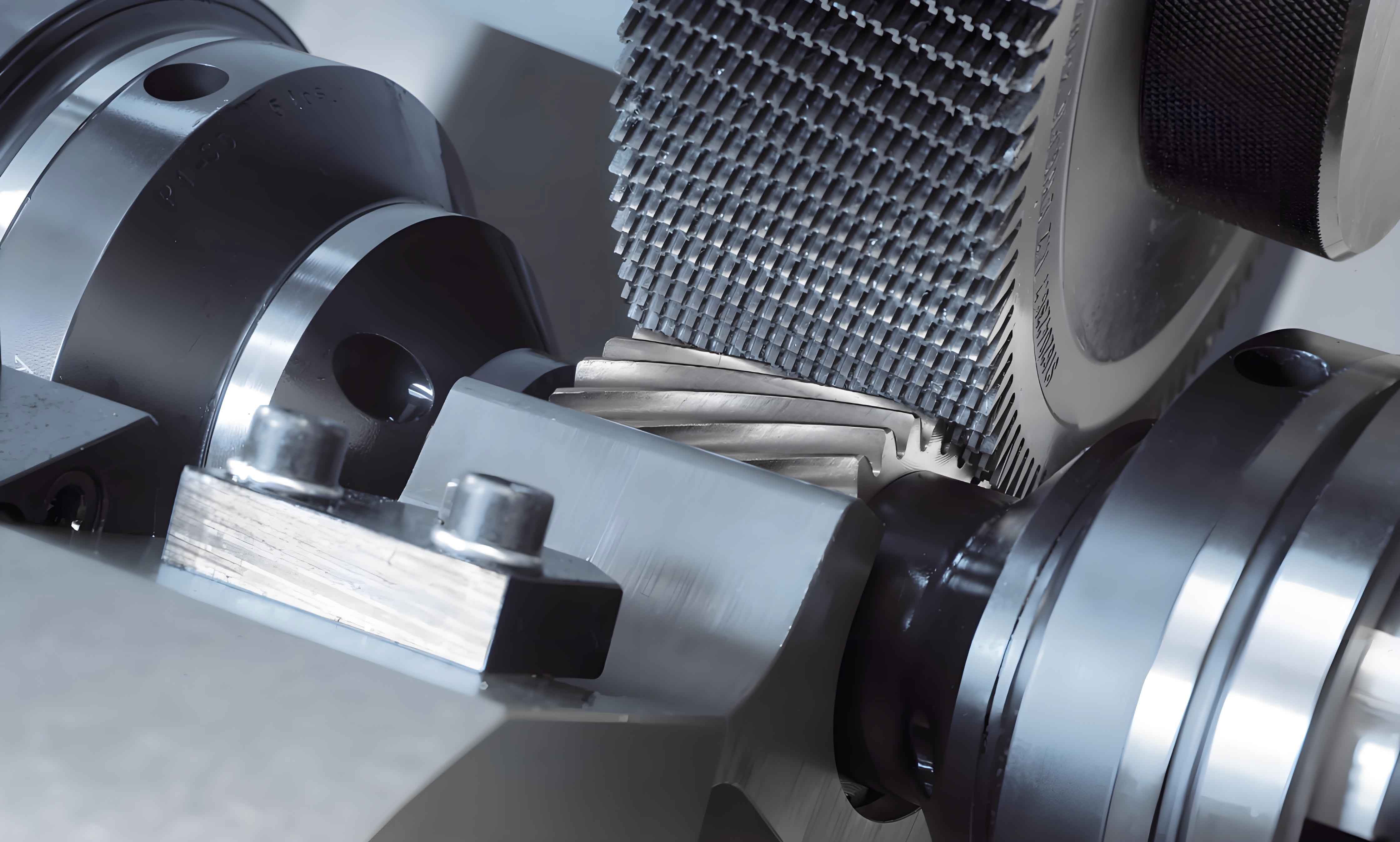
During gear shaving, the shaving cutter and the workpiece gear mesh under crossed axes with zero backlash. The cutter drives the workpiece gear rotation, utilizing relative sliding motion between meshing tooth surfaces to achieve material removal. While theoretically a point contact process, the cutter’s cutting edges must penetrate the workpiece tooth surface to a certain depth. Elastic and plastic deformation within the contact zone disrupts precise meshing along the pitch line, increasing material removal near the pitch point. Reduced contact points near the pitch circle amplify contact pressure, inducing micro-plastic deformation and ultimately causing the characteristic mid-concave error on the workpiece tooth flank.
1. Contact Points and Contact Force in Gear Shaving
The nature and magnitude of contact deformation, a significant contributor to mid-concave error, depend fundamentally on the applied load. Analyzing the variation in the number of simultaneous contact points and the resulting contact force distribution during gear shaving is therefore essential.
Research indicates that mid-concave error predominantly occurs when the transverse contact ratio (\(n\)) satisfies \(1 < n < 2\). For instance, at \(n = 1.6\), the number of instantaneous contact points between the shaving cutter and workpiece gear teeth cycles through 2, 3, and 4, following an approximate pattern of 3-4-3-2-3-4. Crucially, the two-point contact condition consistently occurs near the pitch point on the tooth flank, while three or four-point contacts occur near the tip and root regions, as conceptually illustrated below.
Although the radial force between the cutter and workpiece axes remains constant, the number of tooth pairs simultaneously sharing the load fluctuates. The “double-tooth engagement zone” (two contact point pairs) occurs near the tip or root, while the “single-tooth engagement zone” (one contact point pair) occurs near the pitch point. Consequently, the contact pressure and compressive stress in the single-tooth engagement zone significantly exceed those in the double-tooth engagement zone. This higher pressure near the pitch point causes excessive penetration of the shaving cutter teeth, removing more material than intended and resulting in the mid-concave error.
While precise dynamic calculation is complex, the contact force (\(F\)) between meshing tooth flanks can be estimated from static equilibrium equations under different contact point configurations. The magnitude of this force varies substantially:
$$ 1700 \text{N} \leq F \leq 2500 \text{N} $$
As a single tooth flank on the workpiece gear engages from tip to root, the contact force is relatively low near the tip, reaches its maximum near the pitch point, and decreases again as it approaches the root disengagement. This force concentration near the pitch point directly contributes to increased deformation and material removal at this critical location.
2. Stress Calculation in the Workpiece Gear Tooth
2.1 Elastic Contact Stress
Analyzing the contact stress state within the workpiece tooth during gear shaving is fundamental to understanding deformation. Given that the axial dimension of the workpiece gear teeth is much larger than the tooth height and thickness, and considering minimal axial constraints, the contact problem at the meshing point can be simplified to a two-dimensional plane strain model (Figure 2).
Applying Hertz contact theory yields the normal pressure distribution (\(p(x)\)) over the contact zone:
$$ p(x) = p_0 \sqrt{1 – \frac{x^2}{a^2}} \quad (1) $$
where the half-width of the contact zone (\(a\)) and the maximum contact pressure (\(p_0\)) are given by:
$$ a = \sqrt{ \frac{4p}{\pi} \left( \frac{1}{r_1} + \frac{1}{r_2} \right)^{-1} \left( \frac{1 – \nu_1^2}{E_1} + \frac{1 – \nu_2^2}{E_2} \right) } \quad (2) $$
$$ p_0 = \frac{p E_v}{2 \pi \sqrt{a R}} \quad (3) $$
Here, \(r_1\) and \(r_2\) are the radii of curvature of the contacting bodies at the contact point, \(E_1\), \(E_2\) and \(\nu_1\), \(\nu_2\) are the elastic moduli and Poisson’s ratios of the shaving cutter and workpiece gear respectively, \(p\) is the total normal load per unit length, and \(R\) and \(E_v\) are the equivalent radius and equivalent elastic modulus:
$$ \frac{1}{R} = \frac{1}{r_1} + \frac{1}{r_2} \quad (4) $$
$$ \frac{1}{E_v} = \frac{1 – \nu_1^2}{E_1} + \frac{1 – \nu_2^2}{E_2} \quad (5) $$
Equation (1) defines the pressure distribution. Considering the workpiece gear as the compliant body and neglecting secondary effects (bending, lubrication, temperature), the stress state within the workpiece tooth subsurface is analyzed using the coordinate system in Figure 3. On the contact interface within the contact zone (\(|x| \leq a\)), \(\sigma_x = \sigma_z = -p(x)\), while outside this zone (\(|x| > a\)), surface stresses are zero (Saint-Venant’s principle). The principal subsurface stresses are:
$$ \begin{aligned}
\sigma_x &= -\frac{p_0}{a} \left[ m \left(1 + \frac{z^2 + n^2}{m^2 + n^2}\right) – 2z \right] \\
\sigma_z &= -\frac{p_0}{a} m \left(1 – \frac{z^2 + n^2}{m^2 + n^2}\right) \\
\tau_{zx} &= \frac{p_0}{a} n \left( \frac{m^2 – z^2}{m^2 + n^2} \right)
\end{aligned} \quad (6) $$
where \(m\) and \(n\) are auxiliary parameters defined by the coordinates \(x\), \(z\), and the half-width \(a\):
$$ \begin{aligned}
m^2 &= \frac{1}{2} \left\{ \left[ (a^2 – x^2 + z^2)^2 + 4x^2z^2 \right]^{1/2} + (a^2 – x^2 + z^2) \right\} \\
n^2 &= \frac{1}{2} \left\{ \left[ (a^2 – x^2 + z^2)^2 + 4x^2z^2 \right]^{1/2} – (a^2 – x^2 + z^2) \right\}
\end{aligned} \quad (7) $$
Equations (2) to (7) allow calculation of the elastic stress distribution below the workpiece tooth surface at any meshing point during the gear shaving process, providing the basis for identifying the onset of plastic deformation.
2.2 Residual Plastic Stress on the Workpiece Tooth Flank
Johnson’s model for residual stress in a cylinder indenting a half-space provides the framework for analyzing residual stresses after plastic yielding during gear shaving:
$$ \sigma_{rx} = f_1(z), \quad \sigma_{ry} = f_2(z), \quad \sigma_{rz} = \tau_{rxz} = \tau_{rzy} = \tau_{ryz} = 0 \quad (8) $$
where \(\sigma_r\) denotes residual stress components, assumed to vary only with depth \(z\) below the surface. Once plastic deformation occurs on the workpiece tooth surface, subsequent shaving passes superimpose the contact-induced elastic stresses and the existing residual stresses. The resulting principal stresses (\(\sigma_1, \sigma_2, \sigma_3\)) at any subsurface point become:
$$ \begin{aligned}
\sigma_1 &= \frac{1}{2} (\sigma_x + \sigma_{rx} + \sigma_z) + \frac{1}{2} \sqrt{ (\sigma_x + \sigma_{rx} – \sigma_z)^2 + 4\tau_{zx}^2 } \\
\sigma_2 &= \frac{1}{2} (\sigma_x + \sigma_{rx} + \sigma_z) – \frac{1}{2} \sqrt{ (\sigma_x + \sigma_{rx} – \sigma_z)^2 + 4\tau_{zx}^2 } \\
\sigma_3 &= \nu (\sigma_x + \sigma_{rx} + \sigma_z) + \sigma_{ry}
\end{aligned} \quad (9) $$
Given the small contact area in gear shaving, Johnson’s assumptions hold reasonably well in a local coordinate system centered on the contact. Equations (8) and (9) thus enable calculation of the residual plastic stress state. When the contact pressure during a shaving pass exceeds the workpiece material’s elastic limit, microscopic plastic deformation occurs. Upon unloading, residual stresses and strains remain. Accumulation of these residual effects over multiple passes influences the final mid-concave error profile.
3. Elastic Limit in Gear Shaving
According to plasticity theory, yield occurs when the maximum shear stress (\(\tau_{max}\)) reaches a critical value \(k\) (yield stress in pure shear). For plane strain conditions in gear shaving, the subsurface maximum shear stress is:
$$ \tau_{max} = \sqrt{ \left( \frac{\sigma_x – \sigma_z}{2} \right)^2 + \tau_{zx}^2 } \quad (10) $$
Analysis using Equations (6), (7), and (10) reveals that \(\tau_{max}\) reaches its peak value at a depth \(z \approx 0.67a\) below the contact surface. Yielding initiates at this point when \(\tau_{max} = k\). Tresca’s yield criterion links \(k\) to the uniaxial tensile yield strength (\(\sigma_s\)):
$$ \tau_{max} = \frac{\sigma_1 – \sigma_3}{2} = k = \frac{\sigma_s}{2} \quad (11) $$
Combining the finding that yielding begins when \(p_0 = 3.1k\) at \(z = 0.67a\) with Equation (11) gives the elastic limit contact pressure (\(p_e\)):
$$ p_e = \frac{3.1}{2} \sigma_s = 1.55 \sigma_s \quad (12) $$
Equation (12) states that the critical contact pressure (\(p_e\)) causing initial plastic deformation in gear shaving is 1.55 times the uniaxial yield strength (\(\sigma_s\)) of the workpiece gear material. During gear shaving, the highest contact pressures occur near the pitch point due to the single-tooth engagement zone. Consequently, the pitch point region is most susceptible to plastic deformation, directly contributing to increased material removal and the formation of the mid-concave error.
4. Numerical Validation
The following example validates the derived elastic limit criterion using typical gear shaving parameters:
| Parameter | Shaving Cutter | Workpiece Gear |
|---|---|---|
| Normal Module (mm) | 5.35 | 5.35 |
| Number of Teeth | 43 | 12 |
| Pressure Angle (°) | 20 | 20 |
| Helix Angle (Hand) | 11° (Right) | 0° |
| Normal Circular Tooth Thickness (mm) | 6.60 | 10.54 |
| Base Diameter (mm) | 219.737 | 60.328 |
| Outer Diameter (mm) | 240.5 | 80.12 |
| Minimum Radius of Curvature (mm) | 26.0 | 7.21 |
Workpiece Material: 45 Steel, quenched and tempered, Yield Strength \(\sigma_s = 373.0 \text{MPa}\).
Calculations:
- Elastic Limit Contact Pressure (from Eq. 12):
$$ p_e = 1.55 \times 373.0 \text{MPa} = 578.2 \text{MPa} $$ - Maximum Contact Pressure (\(p_0\)) at Pitch Point (Contact Force \(F = 2500 \text{N}\)):
Using Equations (2), (3), (4), (5) with \(r_1 = 26.0 \text{mm}\) (Cutter), \(r_2 = 7.21 \text{mm}\) (Gear Pitch Pt), \(E_1 = E_2 = 210 \text{GPa}\), \(\nu_1 = \nu_2 = 0.3\):
$$ p_0 (\text{Pitch Point}) \approx 598.7 \text{MPa} $$ - Maximum Contact Pressure (\(p_0\)) near Tooth Tip (Contact Force \(F = 1800 \text{N}\)):
$$ p_0 (\text{Tip}) \approx 513.6 \text{MPa} $$
Results:
- Pitch Point: \(p_0 = 598.7 \text{MPa} > p_e = 578.2 \text{MPa}\) → Plastic deformation predicted at \(z \approx 0.67a\).
- Tooth Tip: \(p_0 = 513.6 \text{MPa} < p_e = 578.2 \text{MPa}\) → Only elastic deformation predicted.
This calculation confirms that under typical gear shaving loads, plastic deformation is initiated specifically near the pitch point region of the workpiece tooth flank, aligning with the location where mid-concave error is observed. The elastic limit stress defined by Equation (12) serves as a valid theoretical criterion for distinguishing elastic and plastic deformation zones.
5. Conclusions
- Analysis of the elastic stress distribution using Hertz contact theory and the derived subsurface stress equations (Eqs. 6-7) identifies the depth of maximum shear stress (\(z \approx 0.67a\)) below the contact surface. This location is the most probable site for the initiation of plastic deformation during gear shaving, particularly concentrated near the pitch point due to higher contact pressures in the single-tooth engagement zone.
- The critical elastic limit contact pressure (\(p_e = 1.55\sigma_s\)) provides a fundamental theoretical criterion (Eq. 12) to predict the onset of plastic yielding on the workpiece tooth flank during gear shaving. Plastic deformation near the pitch point is the primary driver of excessive material removal and mid-concave error. While accumulated residual plastic stress/strain from repeated passes may slightly increase local hardness/stiffness near the pitch point, offering minor resistance against further error increase, the initial and subsequent plastic deformation remains the dominant factor influencing the mid-concave error magnitude.
- Equation (12) effectively resolves the core question of whether plastic deformation occurs on the workpiece tooth surface under specific gear shaving conditions. It provides a quantitative boundary between elastic and plastic regimes within the contact deformation zone. This criterion forms the essential foundation for deeper investigation into the mechanisms governing how plastic deformation magnitude and evolution influence the characteristic mid-concave error profile in gear shaving.