
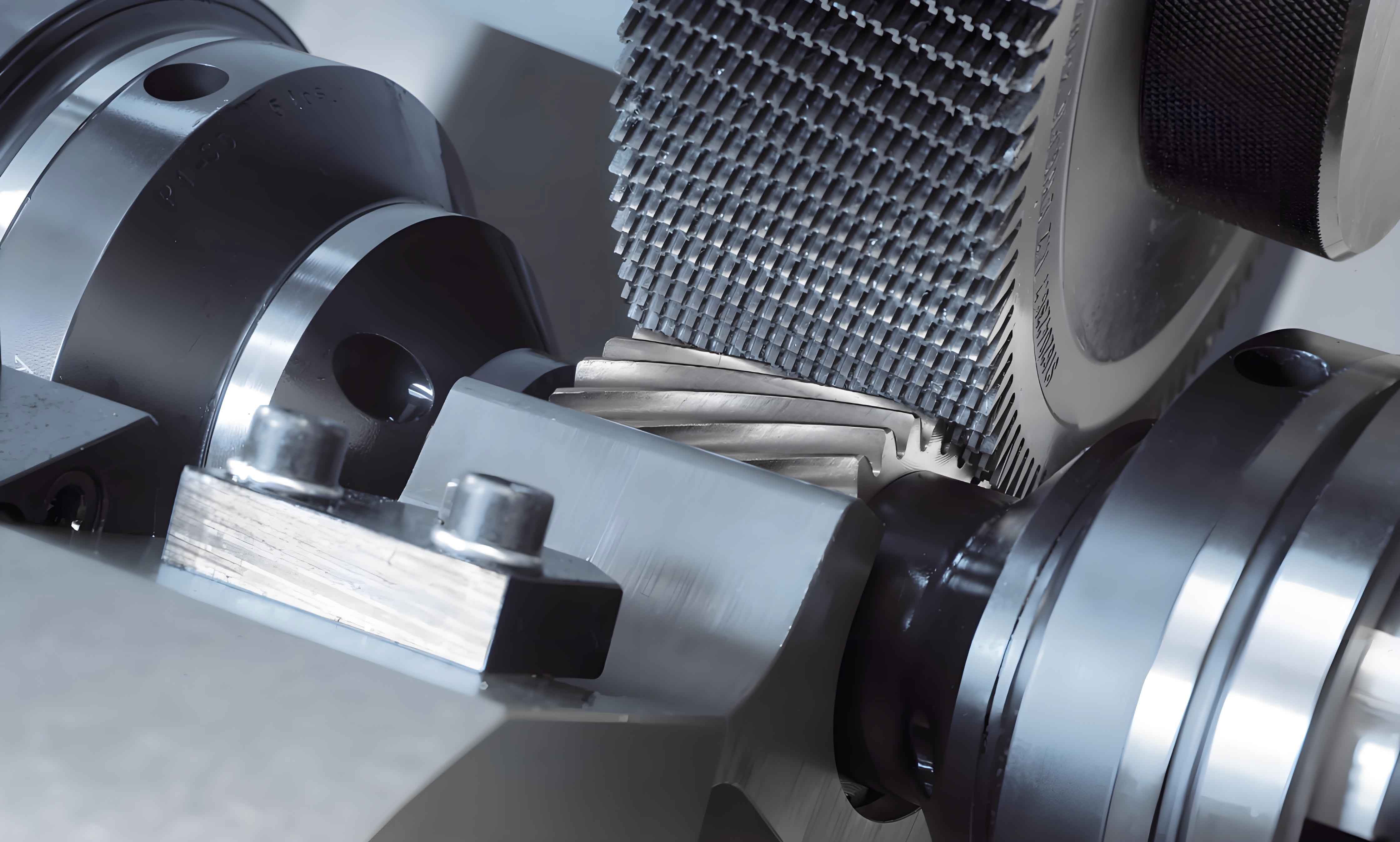
Gear shaving remains a critical finishing process in gear manufacturing, particularly within the automotive industry. A persistent challenge in gear shaving is the occurrence of mid-profile concavity (tooth profile distortion) near the pitch circle of shaved gears. This phenomenon, known as the “tooth profile distortion” problem, necessitates precise modifications to the shaving cutter’s tooth surface. This paper establishes a comprehensive theoretical model for calculating the three-dimensional topographic modification of radial gear shaving cutters, addressing geometric relationships during the gear shaving process and enabling accurate representation of the cutter’s full tooth surface profile.
The modified tooth surface of a shaving cutter is represented through the superposition of a standard involute surface and a normal modification surface. The mathematical representation of the modified gear tooth surface is expressed through position vectors and normal vectors:
$$ \mathbf{R}_{1r}(u_1, l_1) = \delta(u_1, l_1) \mathbf{n}_1(u_1, l_1) + \mathbf{R}_1(u_1, l_1) $$
$$ \mathbf{N}_{1r} = \left( \frac{\partial \mathbf{R}_1}{\partial u_1} + \frac{\partial \delta}{\partial u_1} \mathbf{n}_1 + \frac{\partial \mathbf{n}_1}{\partial u_1} \delta \right) \times \left( \frac{\partial \mathbf{R}_1}{\partial l_1} + \frac{\partial \delta}{\partial l_1} \mathbf{n}_1 + \frac{\partial \mathbf{n}_1}{\partial l_1} \delta \right) $$
where $\mathbf{R}_1$ and $\mathbf{n}_1$ denote the position vector and unit normal vector of the theoretical gear tooth surface, $\mathbf{R}_{1r}$ and $\mathbf{N}_{1r}$ represent the position vector and normal vector of the modified gear tooth surface, $\delta$ is the normal modification amount, and $u_1$, $l_1$ are parameters defining the involute tooth surface.
The mathematical model for generating the conjugate tooth surface of a radial gear shaving cutter involves coordinate transformations between the workpiece and cutter coordinate systems. The transformation matrices are defined as:
$$ \mathbf{M}_{st} = \begin{bmatrix}
\cos \theta_s & -\sin \theta_s & 0 & 1 \\
\sin \theta_s & \cos \theta_s & 0 & 1 \\
0 & 0 & 1 & 0 \\
0 & 0 & 0 & 1
\end{bmatrix}, \quad \mathbf{M}_{tf} = \begin{bmatrix}
1 & 0 & 0 & -E \\
0 & \cos \gamma & -\sin \gamma & 1 \\
0 & \sin \gamma & \cos \gamma & 0 \\
0 & 0 & 0 & 1
\end{bmatrix} $$
$$ \mathbf{M}_{f1} = \begin{bmatrix}
\cos \theta_1 & \sin \theta_1 & 0 & 1 \\
-\sin \theta_1 & \cos \theta_1 & 0 & 1 \\
0 & 0 & 1 & 0 \\
0 & 0 & 0 & 1
\end{bmatrix} $$
The position vector of the shaving cutter tooth surface and the meshing equation are derived as:
$$ \mathbf{R}_s(u_1, l_1, \theta_1) = \mathbf{M}_{st}(\theta_s(\theta_1)) \mathbf{M}_{tf} \mathbf{M}_{f1}(\theta_1) \mathbf{R}_{1r}(u_1, l_1) $$
$$ f(u_1, l_1, \theta_1) = \mathbf{L}_{st}(\theta_s(\theta_1)) \mathbf{L}_{tf} \mathbf{L}_{f1}(\theta_1) \mathbf{N}_{1r}(u_1, l_1) \cdot \frac{\partial \mathbf{R}_s(u_1, l_1, \theta_1)}{\partial \theta_1} = 0 $$
where $\theta_1$ is the workpiece rotation angle, $\theta_s = i\theta_1$ is the cutter rotation angle with transmission ratio $i = N_p / N_s$ (workpiece teeth $N_p$, cutter teeth $N_s$), $E$ is the center distance, $\gamma$ is the shaft angle, and $\mathbf{L}$ matrices represent the normal vector transformation counterparts to the $\mathbf{M}$ position transformation matrices.
The normal modification amount of the radial gear shaving cutter is calculated by comparing the actual cutter surface with a theoretical involute surface:
$$ \delta_s = (\mathbf{R}_s – \mathbf{R}_{ss}) \cdot \mathbf{n}_{ss} $$
where $\delta_s$ is the cutter’s normal modification amount, and $\mathbf{R}_{ss}$, $\mathbf{n}_{ss}$ are the position vector and unit normal vector of the theoretical involute gear surface sharing identical basic parameters with the shaving cutter. Alignment between reference points is achieved through a rotational transformation matrix $\mathbf{M}_0$:
$$ \mathbf{M}_0 = \begin{bmatrix}
\cos \theta_0 & -\sin \theta_0 & 0 & 1 \\
\sin \theta_0 & \cos \theta_0 & 0 & 1 \\
0 & 0 & 1 & 0 \\
0 & 0 & 0 & 1
\end{bmatrix} $$
Tooth contact analysis during gear shaving is performed by solving the contact line distribution equations for any instantaneous rotation angle $\theta_1$:
$$ \sqrt{\mathbf{R}_{sx}^2(u_1, l_1, \theta_1(u_1, l_1)) + \mathbf{R}_{sy}^2(u_1, l_1, \theta_1(u_1, l_1))} = r_i $$
$$ \mathbf{R}_{sz} = l_i $$
where $\mathbf{R}_{sx}$, $\mathbf{R}_{sy}$, $\mathbf{R}_{sz}$ are position vector components along the profile, face, and axial directions of the cutter, respectively, and $r_i$, $l_i$ represent radial and axial position values at point $i$ on the cutter surface.
Parametric analysis reveals significant factors affecting modification in gear shaving operations:
| Parameter | Effect on Modification Amount | Surface Distortion Characteristics |
|---|---|---|
| Cutter Tooth Count (Ns) | Inverse relationship: modification decreases as tooth count increases | Reduced distortion with higher tooth counts |
| Shaft Angle (γ) | Direct relationship: modification increases with shaft angle | Minimal distortion below 10°, significant twisting above 10° |
| Center Distance Error (ΔE) | Low sensitivity: minimal impact on modification | Negligible surface distortion |
| Shaft Angle Error (Δγ) | High sensitivity: significant modification changes | Pronounced surface distortion |
Analysis of modified gear surfaces demonstrates the effectiveness of our gear shaving approach:
| Workpiece Modification Type | Cutter Surface Characteristics | Distortion Features |
|---|---|---|
| Profile Modification | Topographic profile formation | Eliminated axial twist |
| Lead Modification | Anti-crown distortion pattern | Eliminated axial twist |
| 3D Modification | Complex topographic formation | Eliminated axial twist |
Tooth contact patterns during radial gear shaving exhibit critical behavior:
| Shaft Angle Range | Contact Pattern Characteristics | Implications for Gear Shaving |
|---|---|---|
| γ < 10° | Short contact lines at entry/exit, multi-point contact | Stable meshing, minimized mid-profile concavity |
| γ > 10° | Elongated contact lines, uneven load distribution | Increased risk of profile distortion |
The following calculation example demonstrates our gear shaving approach using a standard workpiece-cutter combination:
| Parameter | Workpiece | Radial Shaving Cutter |
|---|---|---|
| Teeth Count | 18 | 137 |
| Module (mm) | 1.75 | 1.75 |
| Pressure Angle (°) | 20 | 20 |
| Helix Angle (°) | 5 | 10 |
| Face Width (mm) | 20 | 22 |
| Hand | Right | Right |
Our analysis confirms that shaft angle exerts the most significant influence on modification characteristics in gear shaving. Below 10° shaft angle, minimal distortion occurs, enabling substitution with modified involute surfaces. Cutter tooth count exhibits lesser impact. The modified cutter surface demonstrates low sensitivity to center distance errors but remains highly sensitive to shaft angle deviations. Workpiece modifications effectively eliminate axial twist distortion when properly implemented. Maintaining shaft angles below 10° ensures stable contact ratio transitions throughout the gear shaving process, effectively mitigating mid-profile concavity. These findings establish a comprehensive theoretical foundation for designing and manufacturing precision radial gear shaving cutters, addressing a critical challenge in gear manufacturing through advanced tooth surface modification techniques.