
In automotive manufacturing, gear honing is a critical finishing process for transmission gears, particularly in high-speed applications like those in Volkswagen’s MQ series. This technique employs an internal meshing mechanism with crossed axes, where the honing wheel applies both radial and axial cutting forces. The axial reciprocating motion combined with radial pressure creates intricate cross-hatched patterns on the gear surface, enhancing meshing stability and extending gear life. The complex interaction generates a net cutting force that can be modeled as: $$F_{net} = F_r + F_a \cdot \cos(\theta)$$ where \(F_r\) is the radial force, \(F_a\) is the axial force, and \(\theta\) is the axis crossing angle. This force distribution ensures uniform material removal but demands precise control to avoid defects. We often visualize this process to better understand its dynamics.
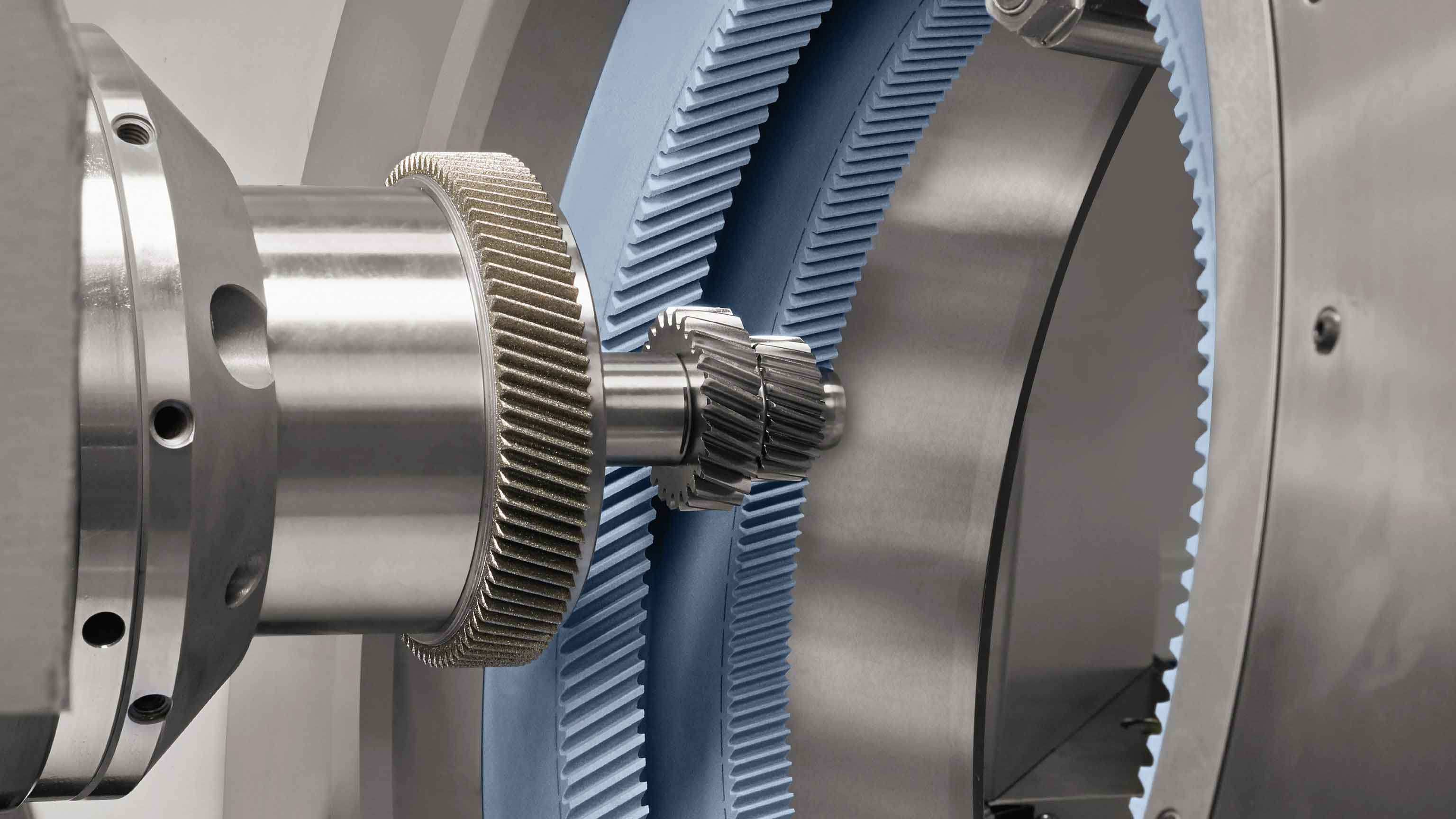
Gear honing is integral to production lines, yet its effectiveness hinges on preceding processes. For instance, in MQ series transmissions, variations in pre-heat treatment steps significantly influence honing outcomes. MQ250 gears undergo separate rough hobbing and deburring, followed by post-heat treatment welding. This sequence isolates processes, easing maintenance but leaving burr peaks on gear flanks due to deburring. In contrast, MQ200 uses integrated hobbing-deburring and pre-heat treatment welding, reducing burrs but increasing interference risks with gear honing wheels. Such interference arises when welded components exceed gear diameters, constraining axial motion and elevating defect rates. The table below summarizes these differences, highlighting how each approach affects gear honing readiness.
| Transmission Model | Pre-Honing Process Flow | Key Characteristics | Impact on Gear Honing |
|---|---|---|---|
| MQ250 | Hobbing → Deburring → Heat Treatment → Hard Turning → Post-HT Welding → Honing | Separate processes; post-HT welding ensures high precision but leaves burr peaks. | Higher pre-inspection failure due to burr peaks; lower interference risk. |
| MQ200 | Integrated Hobbing-Deburring → Pre-HT Welding → Heat Treatment → Honing | Integrated deburring reduces burrs; pre-HT welding lowers cost but risks interference. | Reduced burr-related issues; higher gear honing wheel damage from interference. |
During mass production, gear honing exhibits recurring defects that compromise efficiency and quality. Pre-inspection failures top the list, often triggered by burr peaks from deburring or heat treatment distortions. Wheel damage follows, caused by excessive cutting forces from oversized allowances or internal hard spots. Surface defects like unprocessed areas (black skin) and dimensional inaccuracies stem from insufficient allowances or equipment misalignments. These issues not only halt production but also lead to downstream noise in transmissions. The table quantifies common gear honing defects, their root causes, and frequencies, emphasizing the need for robust solutions.
| Defect Type | Primary Causes | Occurrence Rate in MQ Series | Consequences |
|---|---|---|---|
| Pre-Inspection Failure | Burr peaks, heat treatment distortions, allowance deviations. | ~30% in MQ250 pre-improvement; ~0.2% in MQ200. | Production delays; risk of wheel damage if overlooked. |
| Wheel Damage | High cutting forces (e.g., from large allowances), hard inclusions, equipment issues. | ~30 wheels/year in MQ250; higher in MQ200 due to interference. | Increased downtime (~7,200 min/year); higher maintenance costs. |
| Surface Defects (Black Skin) | Insufficient allowances, sensor errors, uneven heat treatment distortions. | ~0.1% across models. | Potential noise issues in final assemblies; quality escapes. |
| Dimensional Inaccuracy | Equipment inaccuracies, wheel degradation, distortion variations. | ~0.1% across models. | Rejects during noise testing; rework costs. |
To address these gear honing defects, we developed two innovative process improvements. The first method targets pre-inspection failures by incorporating a shaving step before heat treatment to eliminate burr peaks without altering gear dimensions. In this approach, shaving lightly contacts gear flanks to remove deburring-induced peaks at the edges. For example, burr heights of 0.02–0.05 mm are reduced to near zero, as shown by flank line measurements. The improvement can be expressed as a reduction function: $$\Delta B = B_i – k_s \cdot t$$ where \(\Delta B\) is the burr height reduction, \(B_i\) is the initial burr height, \(k_s\) is the shaving coefficient (~0.95 for mild steel), and \(t\) is the shaving time. Implementing this dropped MQ250 pre-inspection failures from 30% to 1%, while preventing secondary defects like wheel wear. This method is cost-effective, utilizing existing shaving equipment with minimal cycle time impact, as dimensional stability avoids reprocessing.
The second method enhances overall gear honing quality by using shaving for preliminary gear shaping before heat treatment, intentionally altering dimensions. This reallocates allowances between shaving and honing, reducing honing allowances by 0.02–0.04 mm per side. The allowance optimization follows: $$A_h = A_t – A_s$$ where \(A_h\) is the honing allowance, \(A_t\) is the total allowance, and \(A_s\) is the shaving allowance (reduced by 0.02–0.05 mm per side). Additionally, shaving pre-corrects for heat treatment distortions by adjusting parameters like crowning or flank angle deviations. The correction model is: $$\Delta D_c = \alpha \cdot \Delta T \cdot d + \beta \cdot S$$ where \(\Delta D_c\) is the distortion compensation, \(\alpha\) is the thermal expansion coefficient, \(\Delta T\) is the temperature delta, \(d\) is the gear diameter, \(\beta\) is the shaving factor, and \(S\) is the applied shaving stress. Results show near-zero black skin and wheel damage rates of 0–5 wheels/year, with honing cycle times improving by ~3 seconds due to lower forces. This method’s effectiveness is validated through noise testing, where defect-free gears meet all specifications.
Comparing both methods reveals distinct advantages tailored to production needs. Method one excels in resolving pre-inspection issues with low cost, while method two offers comprehensive defect reduction but higher investment. The table below evaluates them across key metrics, incorporating gear honing outcomes from batch trials. This helps manufacturers decide based on their quality, efficiency, and cost priorities.
| Evaluation Metric | Method 1: Shaving for Burr Removal | Method 2: Shaving for Preliminary Machining |
|---|---|---|
| Quality Impact | Solves pre-inspection failures and wheel wear; no effect on allowances or black skin. | Eliminates black skin and reduces wheel damage; enables distortion pre-correction. |
| Efficiency Gains | Minimal honing cycle impact; reduces wheel damage-related downtime by ~20%. | Cuts honing cycle by ~3s; slashes downtime to ~1,200 min/year via lower wheel damage. |
| Cost Implications | Low cost (~$0.20/gear for tooling using existing equipment); no major investments. | Higher cost (~$2.10/gear for new shaving and dressing machines); offsets with quality gains. |
| Gear Honing Allowance | Unchanged; remains 0.13–0.16 mm per side. | Reduced by 0.02–0.04 mm per side, easing honing stresses. |
| Best Suited For | Legacy lines with high pre-inspection failures; quick fixes for burr peaks. | New setups seeking holistic improvements; high-volume production with noise sensitivity. |
In conclusion, these gear honing improvements demonstrate significant advancements in transmission manufacturing. Method one efficiently eliminates burr-related pre-inspection issues, safeguarding against wheel degradation. Method two, through allowance optimization and distortion pre-correction, mitigates multiple defects while boosting efficiency. Both methods have proven effective in mass production, enhancing gear honing reliability. Ultimately, selecting between them depends on balancing defect severity with economic constraints, but either choice elevates gear quality and production throughput. As gear honing evolves, such innovations will remain vital for advancing automotive transmission performance.