
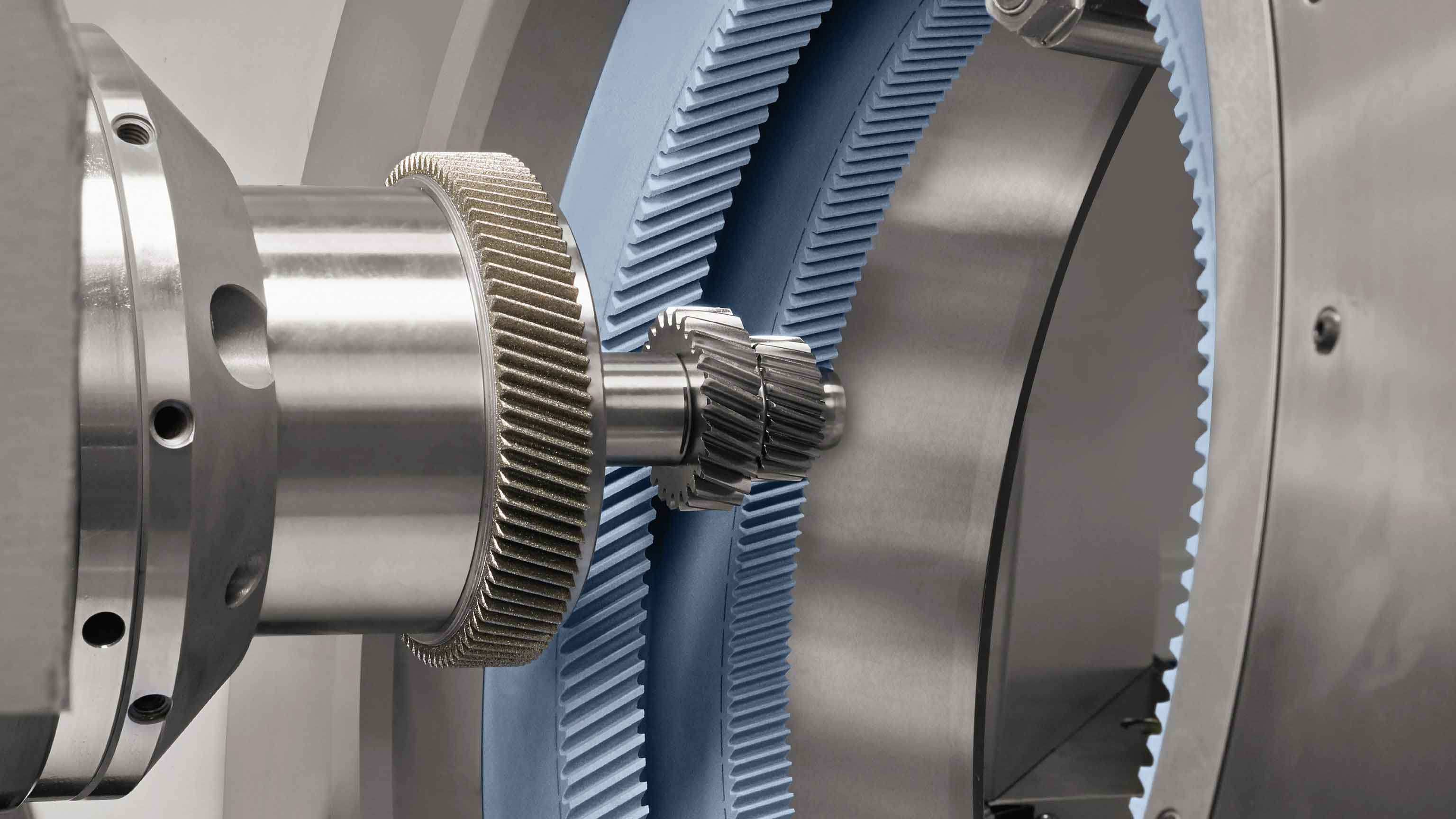
Modern passenger vehicle transmission gears increasingly utilize gear honing as the final machining process to achieve stringent NVH requirements and prevent tooth flank burning. However, limitations in honing efficiency create strict demands on blank conditions and allowance distribution. During gear honing, fluctuations in grinding resistance often induce vibrations that manifest as fixed-order amplitudes on tooth flanks, paradoxically degrading NVH performance and introducing complex quality issues. PRAWEMA gear honing equipment, widely adopted domestically, incorporates the Hybrid Reactive Index (HRI) vibration monitoring system to address these challenges and elevate gear honing quality.
Principles of Online Vibration Monitoring
Accurate vibration data acquisition requires strategic sensor placement on key high-speed components. In PRAWEMA gear honing systems, three primary axes govern motion:
| Axis | Function |
|---|---|
| C-axis | Workpiece clamping and rotation |
| B-axis | Honing wheel clamping and rotation |
| U-axis | Tailstock support and rotation |
Vibration sensors mounted on these axes capture real-time data transmitted via instantaneous measurement devices to a PC for storage and analysis. The core relationship governing frequency (f) and order (O) analysis is defined by:
$$f = \frac{O \times n}{60}$$
where \(n\) represents rotational speed in RPM. This equation underpins spectral analysis during gear honing.
The Gear Honing Process
Power gear honing synchronizes the honing wheel spindle (B-axis) and workpiece spindle (C-axis) via independent electric drives. The process combines axial reciprocation with radial feed motion, leveraging relative sliding at the meshing point under controlled pressure to achieve material removal. Critical process phases include:
| Phase | Code | Description |
|---|---|---|
| Contact | 3, 7 | Initial engagement until full contact |
| Working | 4, 10 | Material removal to target dimension |
| Spark-out | 5 | Dimension-holding polishing |
Low cutting stresses and rates inherent to gear honing make the process susceptible to resonance from periodic stress variations. This resonance generates waviness patterns on gear flanks, directly contributing to transmission noise during meshing.
HRI System Implementation
Spectral Analysis Interface
The HRI interface provides real-time spectral monitoring with frequency (Hz) or order on the x-axis and amplitude (mg) on the y-axis. Color differentiation identifies vibration sources across axes. Known problematic frequencies/orders include:
| Frequency (Hz) | Order | Potential Source |
|---|---|---|
| 240-300 | – | Guideway system resonance |
| 1040 | – | Spindle housing resonance |
| 1050-1850 | – | Fixture system resonance |
| 3000-4000 | – | Clamping system resonance (with tailstock) |
| – | 1 | Rotational unbalance |
| – | 2,3 | Misalignment/incorrect tailstock position |
| – | 3,4 | X/Z-axis guideway wear |
Advanced Data Analysis with HRI analyze+
HRI captures and stores time-stamped vibration data in CSV format. The HRI analyze+ module processes this data, enabling:
- FFT File Identification: Files contain program codes, timestamps, part IDs, axis data, and phase codes.
- Data Filtering: Focus analysis on critical phases (e.g., Working Path: Codes 4/10; Spark-out: Code 5) and influential axes.
- Spectrogram Visualization: Convert tabular data into color-mapped spectrograms where intensity indicates amplitude magnitude, revealing vibration anomalies across batches.
- Slice Analysis: Extract order-specific vibration profiles over time for detailed investigation.
Practical Applications in Gear Honing
Fault Diagnosis through Order Analysis
A case study demonstrated S-shaped tooth flank deviations post-gear honing. Spectrogram analysis revealed elevated vibrations at orders 32-36 during the Working Path phase (Code 4/10), absent in normal production. Converting orders to frequency:
$$f_{32} = \frac{32 \times n}{60}, \quad f_{36} = \frac{36 \times n}{60}$$
yielded 3081-3466 Hz – indicative of tailstock clamping system resonance. Corrective realignment of fixture-to-tailstock coaxiality resolved the issue, underscoring how gear honing vibration diagnostics enable targeted maintenance.
Predictive Quality Control
Proactive vibration thresholding prevents defect propagation. For example, configuring HRI to flag workpieces exceeding 60 mg amplitude on the C-axis during Working Path (Code 10) at orders 2±2 triggers inspection. This is formalized as:
$$\text{If } A_{C,10}(O=2 \pm 2) > 60 \text{ mg} \rightarrow \text{Inspect Part}$$
where \(A\) denotes amplitude. Such rules create statistical process control for gear honing waviness.
Conclusion
Implementing HRI vibration monitoring transforms gear honing from a reactive to proactive process. Spectral analysis identifies resonance sources linked to specific machine components or process phases, while threshold-based screening prevents non-conforming parts from advancing. Mastery requires correlating historical vibration patterns with gear metrology data, but the comparative analysis method delivers rapid diagnostic accuracy. These principles extend beyond gear honing to other finishing processes like gear grinding, establishing vibration monitoring as essential for premium transmission manufacturing.