
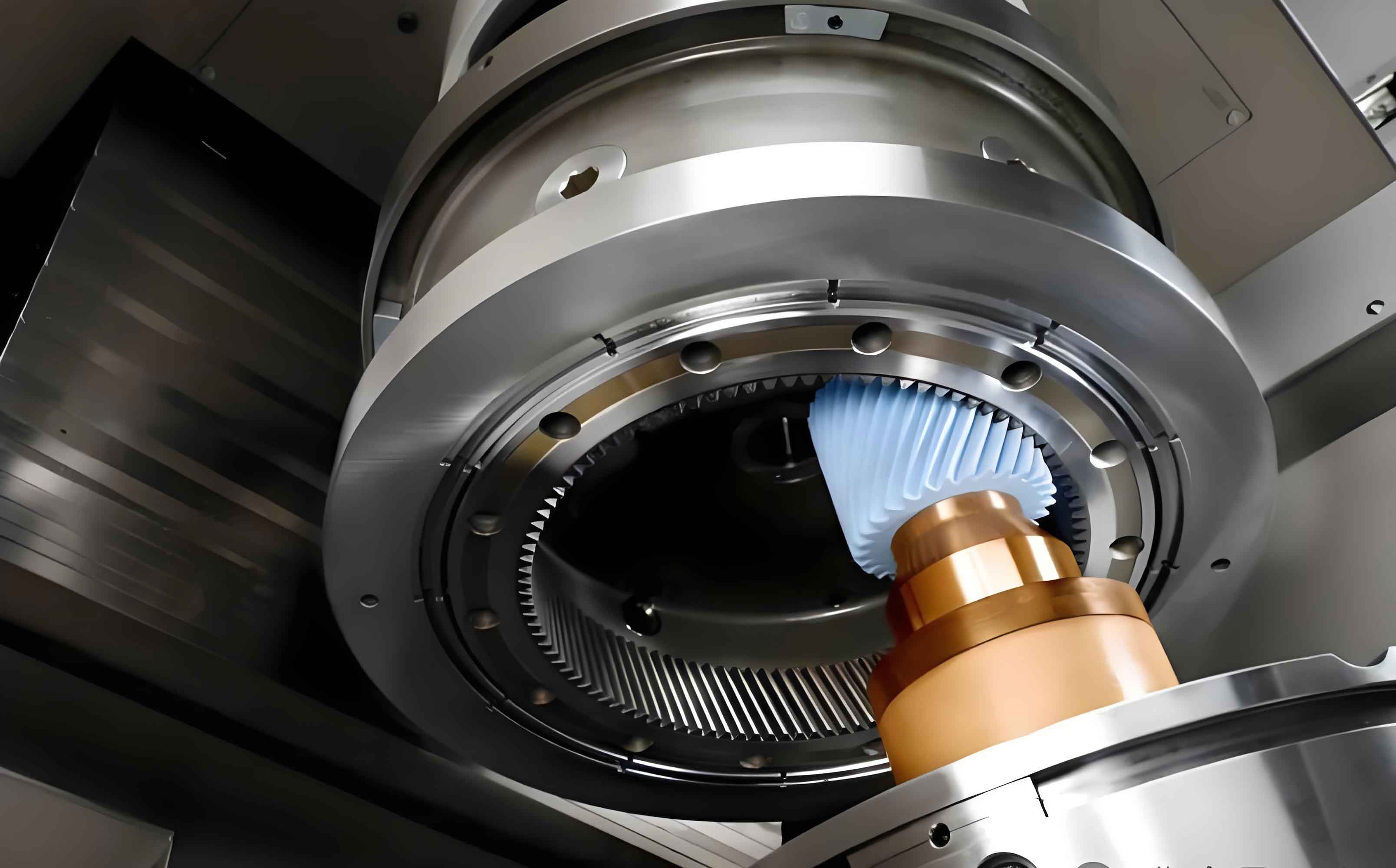
Internal gear power honing offers significant advantages over traditional grinding methods, including higher contact ratios and elimination of tooth surface burns during gear finishing operations. Accurate prediction of honing force is crucial for optimizing surface quality and minimizing production costs in gear manufacturing processes. This research establishes prediction models for radial honing force using both neural networks and empirical approaches.
Mechanics of Internal Gear Honing
The honing process involves crossed-axis helical gear engagement where both work gear and honing wheel maintain forced kinematic coupling. The tangential force component originates from the generating motion, while the radial component relates to material removal depth. The axial force arises from the crossed-axis configuration. These force components are interrelated through:
$$F_s = \frac{F_r \cos\beta}{\tan\alpha_n}$$
$$F_a = \frac{F_r \sin\beta}{\tan\alpha_n}$$
where $F_r$, $F_s$, and $F_a$ represent radial, circumferential, and axial forces respectively, $\beta$ denotes workpiece helix angle, and $\alpha_n$ is normal pressure angle. The radial component $F_r$ predominantly influences material removal efficiency and serves as the primary prediction target.
Experimental Methodology
Honing trials employed a Fassler HMX-400 CNC gear honing machine equipped with Kistler force measurement instrumentation. The workpiece material was 20CrMnTiH alloy steel processed with microcrystalline alumina honing wheels. Key process parameters and their operational ranges included:
| Parameter | Symbol | Range | Levels |
|---|---|---|---|
| Spindle speed | $C_2$ | 800-1800 rpm | 5 |
| Radial feed rate | $f_x$ | 2-8 μm/stroke | 5 |
| Axial feed velocity | $f_z$ | 60-200 mm/min | 5 |
A combined experimental design incorporated orthogonal array L25(5³) with supplementary single-factor trials, totaling 35 test runs that comprehensively covered the parameter space. The experimental matrix and measured radial forces appear below:
| Trial | $C_2$ (rpm) | $f_x$ (μm/stroke) | $f_z$ (mm/min) | Force (N) |
|---|---|---|---|---|
| 1 | 800 | 2.0 | 60 | 81 |
| 2 | 800 | 3.5 | 95 | 119 |
| 3 | 800 | 5.0 | 130 | 158 |
| 4 | 800 | 6.5 | 165 | 199 |
| 5 | 800 | 8.0 | 200 | 242 |
| 6 | 1050 | 2.0 | 95 | 84 |
| 7 | 1050 | 3.5 | 130 | 119 |
| 8 | 1050 | 5.0 | 165 | 156 |
| 9 | 1050 | 6.5 | 200 | 195 |
| 10 | 1050 | 8.0 | 60 | 163 |
| … | … | … | … | … |
| 35 | 1050 | 5.0 | 130 | 145 |
Neural Network Prediction Model
A backpropagation neural network with 3-10-1 architecture (input-hidden-output layers) was developed for gear honing force prediction. Input parameters were normalized to [0,1] range using:
$$y = \frac{(y_{\max} – y_{\min})(x – x_{\min})}{x_{\max} – x_{\min}} + y_{\min}$$
The network was trained using 30 experimental datasets with momentum gradient descent algorithm, achieving convergence at 0.001 error tolerance within 2000 epochs. Prediction accuracy was quantified through coefficient of determination:
$$R = \sqrt{\frac{\sum_{i=1}^{n} (\hat{y}_i – \bar{y})^2}{\sum_{i=1}^{n} (y_i – \bar{y})^2}}$$
The model demonstrated exceptional fitness with training ($R$=0.9804), testing ($R$=0.9741), and overall ($R$=0.9785) datasets, confirming its reliability for gear honing force prediction.
Exponential Prediction Model
An empirical exponential model was formulated considering gear honing as low-speed grinding process:
$$F = k C_2^m f_x^n f_z^p + F_0$$
Logarithmic transformation enabled multivariate linear regression analysis:
$$\lg(F – F_0) = \lg k + m \lg C_2 + n \lg f_x + p \lg f_z$$
The derived honing force model for internal gear power honing was:
$$F = 102.93 \cdot C_2^{-1.195} \cdot f_x^{3.018} \cdot f_z^{0.120} + 80$$
Exponent analysis ($n$=3.018 > $p$=0.120 > $m$=-1.195) confirmed radial feed rate as the dominant parameter affecting honing force in gear honing operations.
Prediction Performance Comparison
Both models were validated against 5 independent honing trials. Prediction accuracy was assessed through relative error analysis:
| Trial | Process Parameters | Radial Force (N) | Relative Error (%) | |||||
|---|---|---|---|---|---|---|---|---|
| $C_2$ (rpm) | $f_x$ (μm/stroke) | $f_z$ (mm/min) | Measured | BPNN | Exponential | BPNN | Exponential | |
| 31 | 1300 | 5.0 | 165 | 145 | 138.34 | 117.53 | 4.59 | 18.94 |
| 32 | 1300 | 5.0 | 95 | 117 | 116.27 | 115.13 | 0.62 | 1.60 |
| 33 | 1300 | 3.5 | 130 | 111 | 107.51 | 92.43 | 3.14 | 16.73 |
| 34 | 1300 | 6.5 | 130 | 152 | 146.66 | 160.52 | 3.52 | 5.60 |
| 35 | 1050 | 5.0 | 130 | 145 | 147.34 | 127.08 | 1.61 | 12.35 |
The neural network demonstrated superior accuracy with maximum error below 5%, significantly outperforming the exponential model which exhibited errors up to 18.94%. This precision advantage makes BPNN particularly valuable for critical gear honing applications demanding tight tolerances.
Conclusions
This research establishes two distinct approaches for predicting radial honing forces in internal gear power honing processes. The neural network model achieves exceptional prediction accuracy with errors consistently below 5%, making it ideal for precision-critical gear honing applications. The exponential model offers implementation simplicity despite higher prediction variance. Radial feed rate exerts the dominant influence on honing forces, followed by axial feed velocity and spindle speed. Both methodologies provide valuable frameworks for optimizing gear honing parameters to enhance surface quality and process efficiency in industrial gear manufacturing.