
Spiral bevel gears represent a specialized category of conical gears where tooth profiles follow circular arcs. During meshing, teeth engage progressively from one end to another, with multiple teeth simultaneously in contact. Compared to straight bevel gears, spiral bevel gears offer superior performance characteristics including higher overlap coefficients, reduced tooth surface pressure, smoother transmission, lower noise and vibration, increased load capacity, and extended service life. These advantages make them indispensable for motion transmission between intersecting axes across automotive, aerospace, machine tool, petroleum, chemical processing, metallurgy, and mining industries.
Complex tooth geometry, intricate manufacturing processes, and challenging installation requirements create significant obstacles for traditional mechanical machine tools. Conventional setups demand numerous adjustments, consuming substantial time and effort while compromising quality consistency. Existing CNC spiral bevel gear milling machines predominantly utilize complex five or six-axis systems, escalating costs and complicating programming, maintenance, and repair procedures.
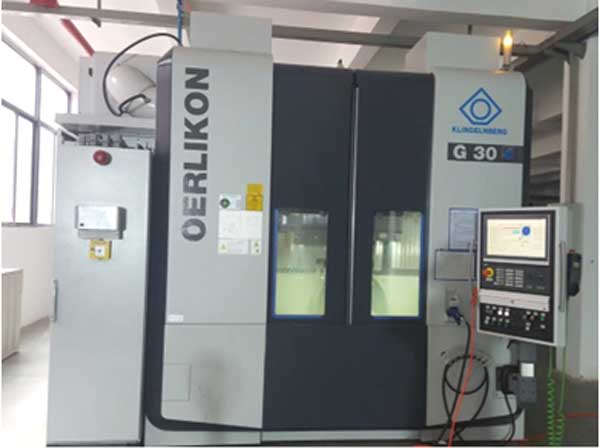
This research introduces an innovative approach where a three-axis CNC system replaces intricate mechanical components while preserving essential adjustments. This hybrid configuration achieves machine tool simplicity, reduced manufacturing costs, and streamlined operation. Furthermore, integrating milling and grinding capabilities expands functionality, broadens process adaptability, and lowers equipment investment expenses for manufacturing enterprises.
Fundamentals of Spiral Bevel Gear Manufacturing
Spiral bevel gear milling employs the generating principle, simulating meshing between the workpiece gear and an imaginary crown gear. The machine’s cradle mechanism replicates this imaginary gear, while the cutting surface of the cutter head mounted on the cradle represents one tooth of this theoretical counterpart. Synchronized rotational motion between the imaginary gear and workpiece results in the cutter head generating a tooth slot on the blank. The cutter’s surface and the generated tooth flank form perfectly conjugate surfaces. This conceptual gear—termed the generating gear—may manifest as either a planar gear or a face gear.
Planar Gear Approach
Figure 1 illustrates a pair of meshing bevel gears where one gear exhibits a pitch cone angle of 90°. Its pitch surface becomes a circular plane centered at the cone apex. The back cone transforms into a cylindrical surface, and its equivalent cylindrical gear resembles a rack with an infinite pitch radius, yielding straight-line tooth profiles.
While straight-line profiles simplify cutter design and enhance precision, practical implementation faces challenges. The crown gear’s apex cone intersects its pitch plane (a flat surface) at the tooth tip angle \( \theta_{\alpha} \). Adjusting cutter blade trajectories for varying \( \theta_{\alpha} \) complicates machine architecture, limiting this method’s adoption.
Face Gear Approach
Figure 2 depicts an alternative setup where the crown gear features a pitch cone angle defined by \( \delta_2/2 = 90^\circ – \theta_{\alpha} \) and a flat apex surface. Its back cone approximates a cylindrical surface, and its equivalent cylindrical gear approaches an infinite pitch radius. Consequently, tooth profiles are treated as approximately linear.
Using a face gear as the generating gear offers significant advantages. Cutter blade trajectories remain parallel to the tooth tip plane, eliminating adjustments for different \( \theta_{\alpha} \) values. This inherent stability fosters simpler, more robust machine tool designs.
Operating Principle
The manufacturing process utilizes the motion path of cutting tools to form an imaginary face gear. During synchronized rotation with the workpiece, this conceptual gear generates the tooth flank geometry. The cutter head—equipped with alternating internal and external blades—creates the crown gear’s virtual tooth profile. As the cradle rotates slowly, a segment of the cutter blade trajectory defines a single tooth flank of the generating gear. Through the generating motion between this virtual gear and the workpiece, both sides of a tooth slot are progressively machined onto the workpiece blank.
Each machining cycle completes only one tooth slot. After each slot is finished, the cutter retracts, the workpiece indexes to the next position, and the process repeats until all teeth are generated.
Kinematic Analysis of Gear Milling Machine
Successful spiral bevel gear milling requires precisely coordinated machine movements:
| Motion Type | Function | Kinematic Chain | Control Method |
|---|---|---|---|
| Primary Motion | Cutter head rotation for material removal | Independent drive | AC variable-frequency motor |
| Generating Motion | Simulated meshing between cutter and workpiece | Synchronized cradle/workpiece rotation | CNC servo coordination (C & A axes) |
| Feed Motion | Progressive engagement depth control | Integrated with generating motion | CNC servo (A axis) |
| Infeed Motion | Radial depth positioning | Linear carriage movement | CNC servo (Z axis) |
| Indexing Motion | Workpiece rotation between tooth slots | Rotary table displacement | CNC servo (A axis) |
| Positioning Motion | Initial machine setup alignment | Manual adjustments | Operator intervention |
Mathematical Representation of Generating Motion
The synchronized rotation between cradle (simulating generating gear) and workpiece must satisfy the gear ratio equation:
$$\frac{\omega_c}{\omega_w} = \frac{N_w}{N_g}$$
Where \( \omega_c \) = cradle angular velocity, \( \omega_w \) = workpiece angular velocity, \( N_w \) = number of workpiece teeth, \( N_g \) = number of generating gear teeth.
Machine Drive System Architecture
Building upon conventional mechanical gear milling machines, this design retains essential mechanical components while implementing CNC control for complex motions. The drive schematic (Figure 4) employs three servo axes:
| Axis | Component | Function | Transmission Mechanism |
|---|---|---|---|
| Spindle | AC variable-frequency motor (1) | Cutter head rotation (Primary motion) | Fixed gear train |
| C-Axis | Servo motor (3) | Cradle rotation (Generating motion) | Worm gear |
| A-Axis | Servo motor (6) | Workpiece rotation (Generating/Indexing) | Worm gear + encoder feedback |
| Z-Axis | Servo motor (7) | Carriage infeeding/retraction | Ball screw |
Motion Synchronization Equations
The CNC system maintains precise coordination between A and C axes using real-time feedback. Positional accuracy is governed by:
$$\theta_c = k \cdot \theta_a + C_0$$
Where \( \theta_c \) = cradle position, \( \theta_a \) = workpiece position, \( k \) = generating ratio, \( C_0 \) = phase compensation. The encoder feedback resolution determines positioning precision \( \Delta \theta \):
$$\Delta \theta = \frac{360^\circ}{N_{enc}}$$
Where \( N_{enc} \) = encoder pulses per revolution.
Structural Configuration
The machine architecture (Figure 5) comprises these critical subsystems:
- Spindle Head (1): Houses the primary drive motor and cutter head mounting interface.
- Cradle Assembly (2): Provides rotational motion for the cutter head, simulating generating gear rotation.
- Cutter Head (3): Holds interchangeable milling cutters or grinding wheels.
- Workpiece Spindle Head (5): Mounts and rotates the gear blank via A-axis servo drive.
- Infeed Carriage (6): Enables radial tool positioning through Z-axis ball screw drive.
The workpiece head features manual swivel adjustment for setting the shaft angle \( \Sigma \) between tool and workpiece axes:
$$\Sigma = 90^\circ \pm \delta$$
Where \( \delta \) = workpiece pitch cone angle.
Integrated Grinding Capability
The machine’s multifunctional design accommodates both gear milling and precision grinding. By substituting the milling cutter head with specialized abrasive tools—cup-shaped or dish-type grinding wheels—identical kinematic principles generate finished tooth flanks. Wheel profiling follows the relationship:
$$R_g = R_c \pm \Delta R_{dress}$$
Where \( R_g \) = grinding wheel active radius, \( R_c \) = nominal cutter radius, \( \Delta R_{dress} \) = dressing compensation. This dual-capability reduces equipment costs and floor space requirements while maintaining process flexibility.
Technical Advantages and Implementation
This integrated mechanical-CNC approach delivers substantial benefits over conventional solutions:
| Parameter | Traditional Mechanical | Full CNC (5/6-Axis) | Hybrid 3-Axis CNC |
|---|---|---|---|
| Adjustment Complexity | High (20+ parameters) | Low (software-controlled) | Moderate (critical adjustments simplified) |
| Machine Cost | Medium | Very High | Low-Medium |
| Programming Complexity | N/A (mechanical setup) | High (multi-axis interpolation) | Low (simple motion coordination) |
| Maintenance Requirements | High (mechanical wear) | High (complex systems) | Low (robust mechanics + simple CNC) |
| Process Flexibility | Single process (milling) | Multi-process | Milling + Grinding |
The hybrid architecture optimizes manufacturing economics through the equation:
$$C_{total} = C_{machine} + C_{tooling} + C_{operation} + C_{maintenance}$$
Where implementation minimizes all cost components compared to alternatives. Production efficiency \( \eta \) improves through reduced setup times \( t_s \) and higher utilization \( u \):
$$\eta = \frac{u \cdot P}{t_c + t_s}$$
Where \( P \) = production rate, \( t_c \) = cutting time.
Conclusion
This research demonstrates a practical methodology for developing cost-effective spiral bevel gear milling and grinding equipment. The three-axis CNC architecture successfully balances performance, precision, and affordability by strategically integrating servo control with optimized mechanical components. Elimination of complex multi-axis systems reduces programming complexity and maintenance demands while retaining essential manufacturing flexibility. The dual milling-grinding functionality further enhances operational economy, making this solution particularly valuable for small-to-medium enterprises requiring versatile gear production capabilities. Future development will focus on adaptive machining algorithms and in-process monitoring to enhance quality control during high-precision gear milling operations.