
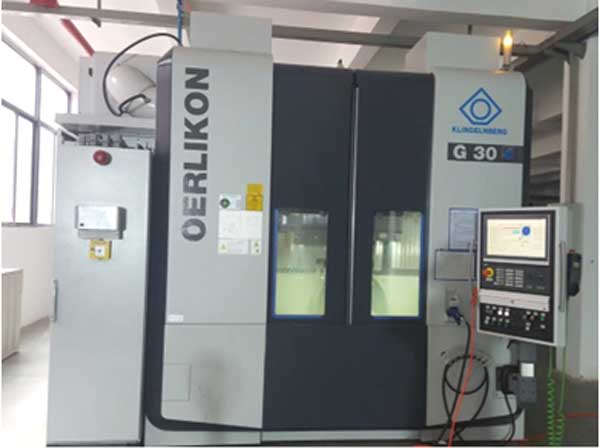
As a key component in spiral bevel gear manufacturing, the spindle system of gear milling machines directly impacts tooth surface quality and machining efficiency. Current research predominantly focuses on general-purpose milling machines, leaving a gap in understanding specialized gear milling equipment. This study establishes a dynamic model of the spindle system using finite element dynamics theory and Timoshenko beam principles:
$$[M]\{\ddot{x}\} + [C]\{\dot{x}\} + [K]\{x\} = \{F\}$$
where $[M]$, $[C]$, and $[K]$ represent the global mass, damping, and stiffness matrices, respectively. The system is discretized into 12 elements with 13 nodes, and bearing stiffness matrices are coupled with the shaft assembly. Table 1 summarizes the discretized shaft parameters.
| Shaft segment | Length (mm) | Diameter (mm) |
|---|---|---|
| l₁ | 18 | 30 |
| l₂ | 38 | 67.5 |
| l₃ | 30 | 105 |
| l₄ | 74 | 105 |
| l₅ | 82 | 105 |
| l₆ | 63 | 105 |
| l₇ | 63 | 105 |
| l₈ | 82 | 105 |
| l₉ | 24 | 105 |
| l₁₀ | 53 | 200 |
| l₁₁ | 15 | 128 |
| l₁₂ | 15 | 56 |
Harmonic response analysis reveals critical resonance frequencies near 78 Hz across all directions. Transient analysis under impact loading (200N X, 500N Y, 200N Z) demonstrates displacement attenuation patterns:
$$|X_{max}| = 0.012 \text{ mm (bearing)} \quad |X_{max}| = 0.035 \text{ mm (shaft end)}$$
$$t_{stable} \approx 1.5 \text{ s (bearing)} \quad t_{stable} \approx 1.2 \text{ s (shaft end)}$$
Cutting forces during gear milling constitute the primary excitation source. A theoretical oblique cutting model predicts directional forces:
$$\begin{bmatrix} F_{xi} \\ F_{yi} \\ F_{zi} \end{bmatrix} = \begin{bmatrix} \cos\phi_{ti} & -\sin\phi_{ti} & 0 \\ \sin\phi_{ti} & \cos\phi_{ti} & 0 \\ 0 & 0 & 1 \end{bmatrix} \begin{bmatrix} F_{ti} \\ F_{ri} \\ F_{ai} \end{bmatrix}$$
where $F_{ti}$, $F_{ri}$, and $F_{ai}$ represent tangential, radial, and axial components. AdvantEdge FEM simulations validate force magnitudes under varying parameters (Table 2). Y-direction forces dominate across all gear milling conditions, confirming their role as principal cutting forces.
| Parameter change | Direction | Amplitude increase (mm/N) |
|---|---|---|
| Δ100N X-force | X-displacement | 0.5×10⁻⁵ |
| Δ200N Y-force | Y-displacement | 1.9×10⁻⁵ |
| Δ50N Z-force | Z-displacement | 1.84×10⁻⁶ |
Experimental validation using Kistler rotating dynamometer confirms optimal gear milling parameters (120 rpm, 0.3 mm feed) minimize vibration amplitudes. Frequency analysis shows spectral components concentrated below 50 Hz, avoiding the critical 78 Hz resonance. Force-adaptive feed rate optimization reduces machining time by 48.9% while maintaining stable cutting forces at 710.7N in the Y-direction.
Bearing stiffness adjustments alter directional sensitivity, enabling strategic vibration control. Reduced stiffness shifts maximum sensitivity from Y to X-direction, benefiting stability in gear milling operations where Y-forces dominate. The methodology enables quantitative matching between dynamic spindle characteristics and gear milling process parameters, significantly improving surface quality while maximizing material removal rates.