
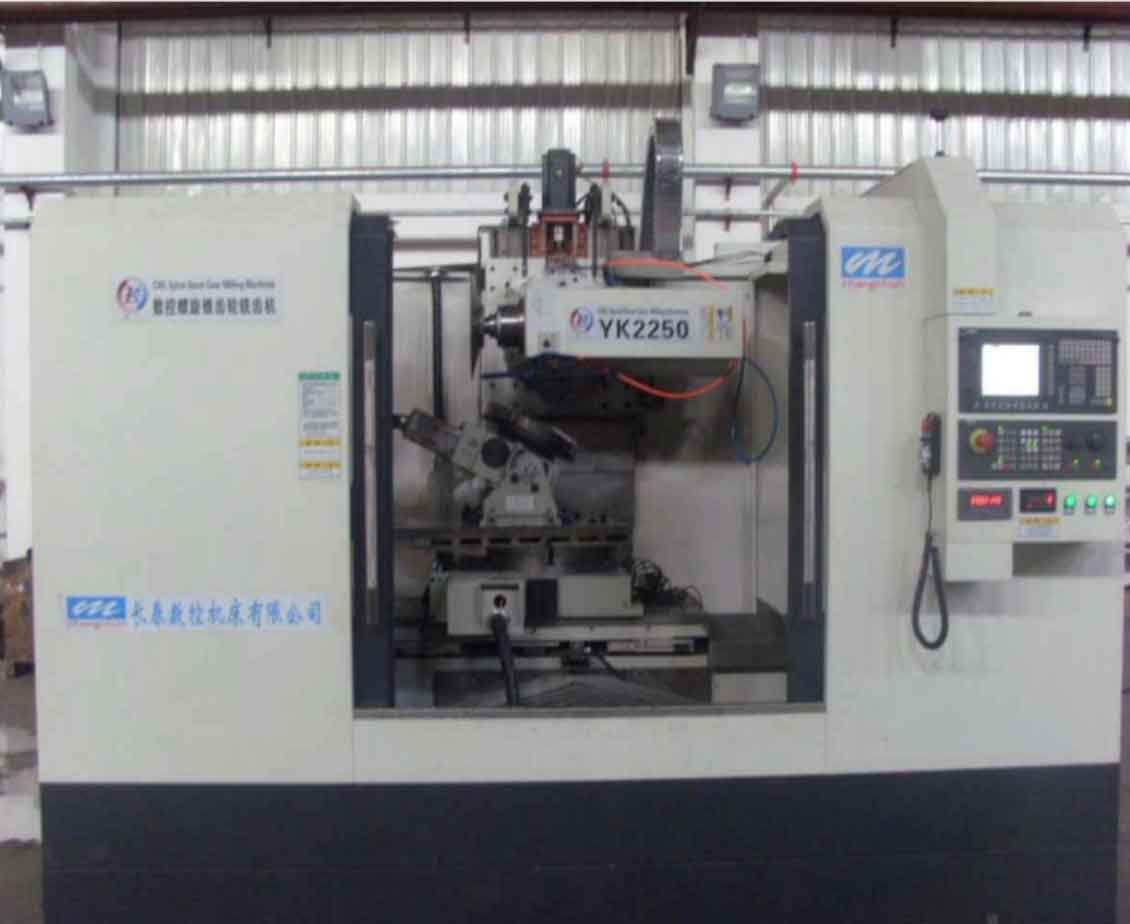
Spiral bevel gears are critical components in aerospace, marine, and automotive transmissions due to their high load capacity and smooth operation. The geometric complexity of these gears necessitates precision manufacturing, where traditional mechanical gear milling machines face limitations in flexibility and accuracy. This research presents a numerical control (NC) transformation solution for GH35 spiral bevel gear milling machines using domestically developed GSK980MDa systems, achieving 3-axis/2-linkage motion control. The approach eliminates complex mechanical transmission chains through electronic gear ratio technology while maintaining structural rigidity.
Generative Principle and Machine-Tool Settings
Spiral bevel gear milling relies on simulating a theoretical generating gear (crown wheel) through coordinated motions between cutter head and workpiece. The fundamental kinematic relationship follows:
$$ \frac{\omega_c}{\omega_w} = i_g $$
where $\omega_c$ is cradle angular velocity, $\omega_w$ is workpiece angular velocity, and $i_g$ is the gear ratio. For GH35 machines, seven essential parameters govern gear milling accuracy:
| Parameter | Symbol | Function |
|---|---|---|
| Radial Tool Position | $S_r$ | Controls cutter center distance |
| Angular Tool Position | $q$ | Determines cutting entry angle |
| Machine Root Angle | $\gamma_m$ | Sets workpiece orientation |
| Blank Offset | $X_b$ | Adjusts tooth depth |
| Velocity Ratio | $i_g$ | Coordinates cradle-workpiece motion |
The phase relationship during gear milling involves four critical positions:
$$ \text{Start point: } (\theta_{c1}, \theta_{w1}) \quad \text{End point: } (\theta_{c1} + \alpha, \theta_{w1} + \beta) $$
$$ \beta = \alpha \cdot i_g \quad \gamma = \frac{360^\circ}{z} \cdot k $$
where $\alpha$ is cradle rotation, $\beta$ is workpiece rotation, $z$ is tooth count, and $k$ is skip-tooth number.
NC Transformation Architecture
The transformation replaces mechanical transmissions with servo systems while retaining the machine’s structural frame. Key modifications include:
Mechanical Reconstruction
Three servo axes replace mechanical linkages:
| Axis | Servo Motor | Transmission Ratio | Resolution |
|---|---|---|---|
| Cradle (X) | 130SJT-M100B | 1:200 | 6.3 arcsec |
| Workpiece (Y) | 175SJT-220B | 1:90 | 6.3 arcsec |
| Feed (Z) | 130SJT-M100B | 1.5:1 | 1μm |
Electronic gear ratios are configured via CNC parameters:
$$ \text{Cradle: } \frac{CMR_X}{CMD_X} = \frac{\alpha \cdot L \cdot Z_D}{360^\circ \cdot \delta \cdot Z_M} = 5.556 \quad \Rightarrow (100:18) $$
$$ \text{Workpiece: } \frac{CMR_Y}{CMD_Y} = 2.5 \quad \Rightarrow (250:100) $$
$$ \text{Feed: } \frac{CMR_Z}{CMD_Z} = 3 \quad \Rightarrow (3:1) $$
where $CMR$ is command multiplier, $CMD$ is command divisor, $\alpha$ is pulse equivalent (0.036°/pulse), $L$ is equivalent lead (360mm for rotary axes), $\delta$ is minimum input unit (0.001mm).
Hydraulic-PLC Integration
The hydraulic system undergoes PLC-controlled automation for table positioning and workpiece clamping. Critical I/O signals include:
| Function | PLC Input | PLC Output | M-Code |
|---|---|---|---|
| Table Forward | X1.2, X1.6 | Y3.4 | M12/M36 |
| Table Backward | X1.1, X1.5 | Y3.5 | M13/M34 |
| Workpiece Clamping | X0.4 | Y3.1 | – |
M-code logic employs DECB binary decoding:
$$ \text{DECB(4, F10, R4)} \quad \Rightarrow \text{M8-M15} $$
$$ \text{DECB(4, F10, R5)} \quad \Rightarrow \text{M29-M36} $$
with execution timing controlled by TMRB instructions for 5-10 second durations.
Gear Milling NC Programming
A parametric macro-programming approach enables flexible gear milling operations. Key variables include:
| Macro Variable | Parameter | Example Value |
|---|---|---|
| #500 | Cradle swing angle | 70° |
| #501 | Initial cradle angle | 72.13° |
| #502 | Workpiece initial angle | 0° |
| #509 | Velocity ratio | 1.413 |
| #508 | Skip-tooth number | 17 |
The gear milling process implements 3-axis interpolation:
O0000 (Main Program)
  G90 G00 X#501 Y#502
  M12 (Approach start position)
  ...
  G65 P0001 L#505 (Depth control macro)

O0001 (Depth Macro)
  G90 G01 Z#515 F400
  G65 P0002 L#507 (Tooth cutting macro)

O0002 (Tooth Cutting Macro)
  M36 (Engage cutting position)
  G91 G01 X-#500 Y[#500*#509] F#510
  M34 (Retract for indexing)
  G91 G01 X#500 Y[360/#507*#508 - #500*#509]
This structure enables multi-pass gear milling with adjustable radial depth (#503) and cutting cycles (#505).
Cutting Experiments and Error Analysis
Gear milling trials employed 35-tooth spiral bevel gears (module 5mm, 35° spiral angle). Post-milling inspection revealed:
Initial Trial Errors
| Error Type | Concave Flank | Convex Flank | Standard |
|---|---|---|---|
| Single Pitch Error | 69μm (Grade 11) | 49μm (Grade 10) | ≤20μm (Grade 7) |
| Accumulated Pitch Error | 171μm (Grade 9) | 77μm (Grade 7) | ≤90μm (Grade 7) |
| Profile Deviation | -0.0792mm | -0.0278mm | ±0.05mm |
Hydraulic positioning inaccuracy caused inconsistent depth cuts. After optimizing dead-stop positioning and flow control valves:
Improved Results
| Performance Metric | Pinion | Gear |
|---|---|---|
| Single Pitch Error | 12.8μm (Grade 6) | 29.4μm (Grade 9) |
| Accumulated Pitch Error | 30.7μm (Grade 5) | 88.8μm (Grade 7) |
| Surface Deviation | -0.0278mm | -0.0558mm |
| Contact Pattern | Elliptical, centered | |
The gear milling stability achieved Grade 7 accuracy consistently after hydraulic optimization. Profile deviations remained within 0.08mm across all teeth.
Conclusions and Outlook
The NC transformation of GH35 gear milling machines using domestic GSK980MDa systems demonstrates:
- Mechanical transmission simplification through 3-axis servo control reduces adjustment complexity while maintaining rigidity
- Electronic gear ratio implementation achieves flexible velocity ratio changes without mechanical replacements
- PLC-integrated hydraulic control enables automated indexing and depth control with 0.01mm positioning accuracy after optimization
- Parametric NC programming accommodates diverse spiral bevel gear designs through macro variables
- Consistent Grade 7 gear milling accuracy validates the transformation approach
Future enhancements should address full-closed loop control for the feed axis to eliminate hydraulic dependence. Implementation of tool compensation algorithms and real-time monitoring systems will further advance domestic NC solutions for precision gear milling applications. The methodology establishes a foundation for modernizing legacy gear manufacturing equipment through cost-effective NC retrofitting.