
Gear manufacturing stands as a pivotal industry with profound implications for national economies and everyday life, serving as a foundational component in sectors like automotive, aerospace, shipbuilding, and consumer tools. As manufacturing undergoes global transformation and upgrading, enterprises are shifting from scale-speed models to innovation-efficiency paradigms. In this context, gear hobbing technology remains indispensable due to its versatility in producing cylindrical gears, helical gears, worms, splines, and other toothed components. This article examines the current state of gear hobbing equipment, addresses critical challenges and technological innovations, and explores future directions, emphasizing how advancements are reshaping precision, efficiency, and sustainability in gear production.
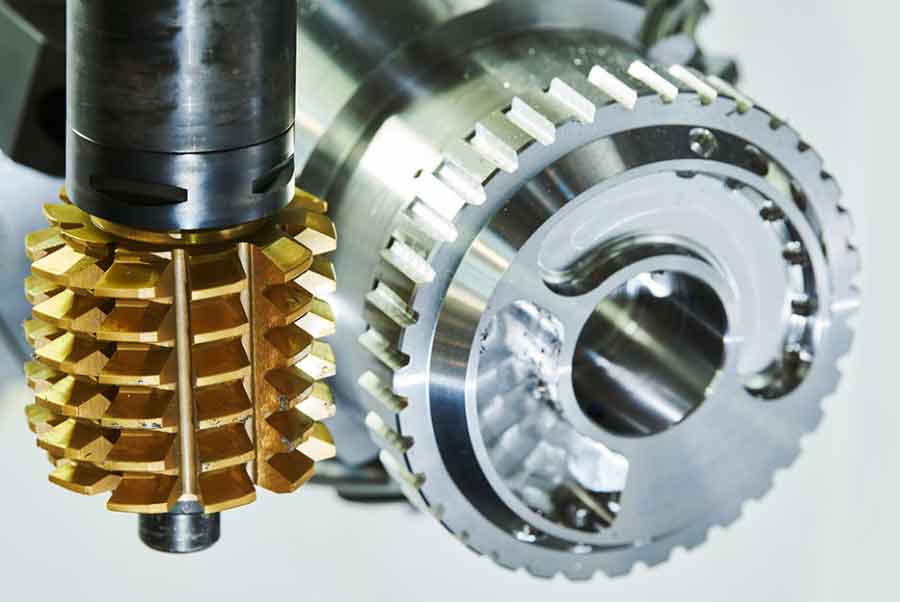
The core principle of gear hobbing relies on the meshing action between a hob and the workpiece, simulating a worm-gear pair. During gear hobbing, three synchronized motions occur: the rotational cutting motion of the hob, the generating (indexing) motion that ensures the correct tooth profile through relative speed ratios, and the axial feed motion along the gear blank’s axis. The generating motion is critical for accuracy and can be expressed mathematically. For instance, the speed ratio between the hob and workpiece defines the tooth generation process:
$$ \frac{N_h}{N_w} = \frac{Z_w}{K} $$
where \( N_h \) is the hob rotational speed, \( N_w \) is the workpiece rotational speed, \( Z_w \) is the number of teeth on the workpiece, and \( K \) is the number of threads on the hob. This equation ensures the hob envelops the correct involute profile. Deviations in this ratio lead to profile errors, underscoring the need for precise control in gear hobbing operations. Additionally, the axial feed rate \( F_a \) influences surface finish and is optimized using:
$$ F_a = v \times f_z \times Z_w $$
where \( v \) is the cutting speed and \( f_z \) is the feed per tooth. These dynamics highlight why gear hobbing dominates gear production, accounting for 45-50% of all gear machining equipment due to its adaptability and cost-effectiveness.
The global landscape of gear hobbing technology reveals stark contrasts in capabilities and adoption. Internationally, manufacturers like Germany’s Liebherr, Japan’s Mitsubishi, and the US-based Gleason-Pfauter-Hurth lead with high-speed, high-precision machines featuring innovations such as direct drives, dry cutting, and advanced CNC systems. For example, Liebherr’s LC series achieves hob speeds up to 3000 rpm and precision grades of 3-4 (per ISO 1328), while Mitsubishi’s GD models emphasize energy efficiency. In contrast, domestic producers, though making strides with models like the YS3120CNC6, lag in areas like dynamic rigidity and reliability, often equivalent to international standards from the late 1990s. The following table summarizes key comparisons, illustrating technological disparities and highlighting areas for domestic advancement in gear hobbing.
| Region/Manufacturer | Representative Models | Max Hob Speed (rpm) | Precision Grade (ISO 1328) | Key Technological Features | Typical Applications |
|---|---|---|---|---|---|
| Europe (e.g., Liebherr) | LC82, LC282, LC1000 | 2500-3000 | 3-4 | Thermal compensation, full CNC, high rigidity | Automotive, aerospace, heavy machinery |
| Asia (e.g., Mitsubishi) | GD20CNC, GD100CNC | 2000-2500 | 3-4 | Dry cutting, integrated IoT for predictive maintenance | Electric vehicles, robotics, precision instruments |
| Americas (e.g., Gleason) | GP200S, PE500 | 2200-2800 | 3-4 | Direct-drive spindles, zero-lubrication systems | Renewable energy gearboxes, defense systems |
| Domestic (e.g., Chinese manufacturers) | YS3120CNC6, YGS3608CNC6 | 1000-1200 | 6-7 | Basic CNC, limited thermal management, retrofit designs | General machinery, entry-level automotive |
Despite progress, gear hobbing faces persistent challenges such as short tool life, reliability issues, and structural inefficiencies, which stem from mechanical errors, thermal distortions, and control limitations. Profile and helix deviations during gear hobbing are primary concerns, often arising from backlash in drive systems or thermal expansion. For instance, thermal error accounts for approximately 45% of total inaccuracies in CNC gear hobbing machines, modeled as:
$$ \Delta L = \alpha \times L_0 \times \Delta T $$
where \( \Delta L \) is the dimensional change, \( \alpha \) is the coefficient of thermal expansion, \( L_0 \) is the initial length, and \( \Delta T \) is the temperature variation. To mitigate this, real-time compensation algorithms are being developed, such as:
$$ \Delta E_c = k_1 T + k_2 T^2 + k_3 \dot{T} $$
where \( \Delta E_c \) is the compensated error, \( T \) is temperature, \( \dot{T} \) is the rate of change, and \( k_n \) are calibration coefficients. Key research areas include:
- Error Control Systems: Advanced CNC systems incorporate electronic gearboxes (EGB) for backlash compensation, improving generating motion accuracy. For example, modifying the indexing motion ratio dynamically minimizes cumulative pitch errors in gear hobbing.
- Zero-Programming Technology: Eliminating manual G-code generation, this approach uses parametric inputs (e.g., module, pressure angle) to auto-generate NC programs, enhancing efficiency and reducing human error in gear hobbing setups.
- Intelligent CNC Development: Open-architecture systems based on PC-PMAC configurations enable customizable control for gear hobbing, facilitating features like adaptive feed optimization and vibration damping.
These innovations address core gear hobbing challenges but require further refinement for widespread industrial adoption.
Looking ahead, gear hobbing technology is poised for transformative shifts driven by digitalization, material science, and sustainability imperatives. Design informatization will leverage 3D modeling and digital twins to simulate gear hobbing processes, reducing prototyping costs and predicting lifecycle performance. Equipment intelligence will dominate, with smart gear hobbing machines featuring AI-driven optimizations for real-time error correction and predictive maintenance, aligning with initiatives like Industry 4.0. For instance, embedded sensors could continuously monitor hob wear, adjusting parameters using:
$$ V_c’ = V_c \times e^{-k_w t} $$
where \( V_c’ \) is the optimized cutting speed, \( V_c \) is the initial speed, \( k_w \) is the wear coefficient, and \( t \) is time. Additionally, new materials like high-performance polymers are emerging, enabling plastic gears via injection molding for noise reduction and weight savings. This shift demands parallel advances in mold technology for gear hobbing-inspired tooling. Crucially, global harmonization with standards like ISO 1328:2013 will elevate quality benchmarks, pushing gear hobbing toward ultra-precision (grade 2-3) and eco-friendly dry machining. Such trends underscore a future where gear hobbing integrates seamlessly with automated, flexible manufacturing cells, reducing waste and energy consumption.
In summary, gear hobbing technology is evolving rapidly, with international leaders setting high standards in speed, precision, and intelligence. Domestic efforts must prioritize breakthroughs in CNC systems, thermal management, and material innovations to close the gap. The future of gear hobbing lies in intelligent, sustainable solutions that enhance productivity while meeting stringent global standards, ultimately supporting broader industrial advancements.