
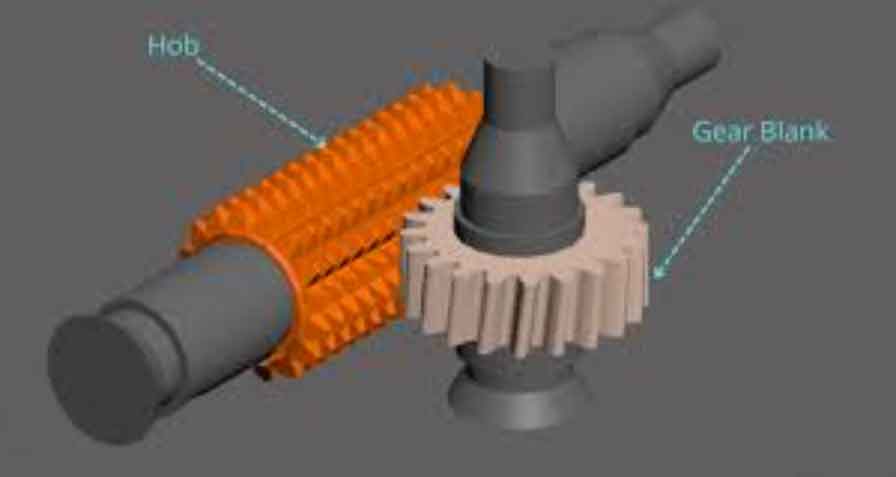
High-speed dry hobbing represents an advanced manufacturing process for cylindrical and helical gears, yet its precision is challenged by speed fluctuations, especially during helical gear processing which requires dual electronic gearboxes for multi-axis synchronization. We present a wavelet packet decomposition approach to address synchronization error compensation in helical gear hobbing, enhancing machining accuracy without increasing hardware costs. For helical gears, the synchronization error originates from the linear superposition of linkage errors between the hob rotation (B-axis), workpiece rotation (C-axis), and axial feed (Z-axis):
$$n_C = K_B \frac{Z_B}{Z_C} \cdot n_B + K_Z \frac{360 \sin \beta}{\pi m_z} \cdot v_Z$$
where \(n_C\) and \(n_B\) denote rotational speeds (r/min), \(v_Z\) is axial feed rate (mm/min), \(\beta\) is helix angle, \(m\) is module, \(z\) is tooth count, and \(K_B\), \(K_Z\) are directional coefficients. Table 1 details typical helical gear hobbing parameters.
| Parameter | Value | Parameter | Value |
|---|---|---|---|
| Normal module (mm) | 3 | Number of teeth | 59 |
| Hob starts | 3 | Feed per revolution (mm/rev) | 1.5 |
| Pressure angle (°) | 20 | Depth of cut (mm) | 6.45 |
| Hob direction | Right-hand | Hob speed (r/min) | 680 |
| Gear direction | Right-hand | Cutting method | Climb hobbing |
Synchronization error \(\Delta \phi_{sync}\) is defined as the discrepancy between the theoretical C-axis displacement (from B and Z axes) and actual displacement. We acquire this error signal at 1,000 Hz using HNC-SSTT software via the D50 register on a YK3126 CNC hobbing machine. The raw signal contains compounded noise from mechanical vibrations and environmental disturbances:
$$S(k) = f(k) + \varepsilon \cdot e(k)$$
where \(S(k)\) is the noisy signal, \(f(k)\) is the true error, \(e(k)\) is noise, and \(\varepsilon\) is noise intensity. Figure 1 illustrates the 6,944-sample raw signal over four C-axis rotation cycles.
Wavelet packet decomposition isolates error components across frequency bands. Using a db1 basis, we decompose the signal into eight 62.5 Hz sub-bands (\(S_{3,0}\) to \(S_{3,7}\)) through three-level binary partitioning:
$$S = S_{3,0} + S_{3,1} + S_{3,2} + S_{3,3} + S_{3,4} + S_{3,5} + S_{3,6} + S_{3,7}$$
Analysis reveals dominant error features in nodes [3,0] and [3,3] (Figure 2). We reconstruct the denoised synchronization error \(D’_{50}\) using these nodes, reducing peak error from 0.0514° to 0.0292° (43% decrease).
| Metric | Original Signal | Reconstructed Signal |
|---|---|---|
| Peak error (°) | 0.0514 | 0.0292 |
| Noise reduction | – | 43% |
Decoupling \(D’_{50}\) into B-axis (\(\Delta \phi_{B-C}\)) and Z-axis (\(\Delta \phi_{Z-C}\)) contributions follows:
$$\Delta \phi_{B-C} = \frac{Z_B}{Z_C} \cdot \Delta \delta_B$$
$$\Delta \phi_{Z-C} = \frac{360 \sin \beta}{\pi m z} \cdot \Delta \delta_Z$$
$$D’_{50,(B-C)} = \frac{\Delta \phi_{B-C}}{\Delta \phi_{B-C} + \Delta \phi_{Z-C}} \cdot D’_{50}$$
$$D’_{50,(Z-C)} = \frac{\Delta \phi_{Z-C}}{\Delta \phi_{B-C} + \Delta \phi_{Z-C}} \cdot D’_{50}$$
These terms are compensated through NC code modification in electronic gearbox parameters (Table 3). G146 command configures real-time phase synchronization:
G146 Q={4, #101, #102, #103, #104, #105, #106, #107, #108}
| Parameter | Function | Value |
|---|---|---|
| #101 | Phase sync enable | 1 |
| #102 | Phase deviation (°) | 0 |
| #103 | C-axis follow mode | 1 |
| #104 | Master axis (B) | 5 |
| #105 | B-axis coefficient | 19.6664543 |
| #106 | Secondary master (Z) | 1 |
| #107 | Z-axis coefficient | 2 |
| #108 | C-axis coefficient | 4.51617739 |
Post-compensation gear inspection (Klingelnberg P26) confirms accuracy improvements. Table 4 demonstrates reduced profile (\(F_\alpha\)) and helix (\(F_\beta\)) deviations across tooth flanks.
| Error | Left Flank | Right Flank | ||
|---|---|---|---|---|
| Pre-comp | Post-comp | Pre-comp | Post-comp | |
| \(F_\alpha\) | 17.8 | 8.9 | 23.0 | 9.3 |
| \(F_\beta\) | 12.1 | 11.5 | 18.0 | 15.3 |
| \(F_\alpha\) | 8.3 | 10.4 | 17.0 | 15.1 |
| \(F_\beta\) | 7.7 | 5.4 | 10.0 | 6.2 |
| \(F_\alpha\) | 7.1 | 8.1 | 5.8 | 4.8 |
| \(F_\beta\) | 13.0 | 6.2 | 12.9 | 4.5 |
This wavelet packet approach effectively isolates synchronization errors inherent to helical gear hobbing. By decomposing, identifying, and reconstructing critical error components while rejecting noise, we achieve one-grade improvement in gear accuracy without hardware modifications. The method provides a robust software-based solution for precision enhancement in high-speed dry gear hobbing applications.