
Gear mechanisms represent the most widely utilized transmission systems in mechanical equipment, yet reconstructing accurate digital models for complex geometries like reverse gears presents significant challenges. This research explores a novel surface reconstruction approach to reverse gear modeling, combining Imageware’s precision point cloud processing with Pro/E’s robust parametric design capabilities. Our methodology revolutionizes reverse engineering by prioritizing holistic surface creation over traditional parametric constraints.
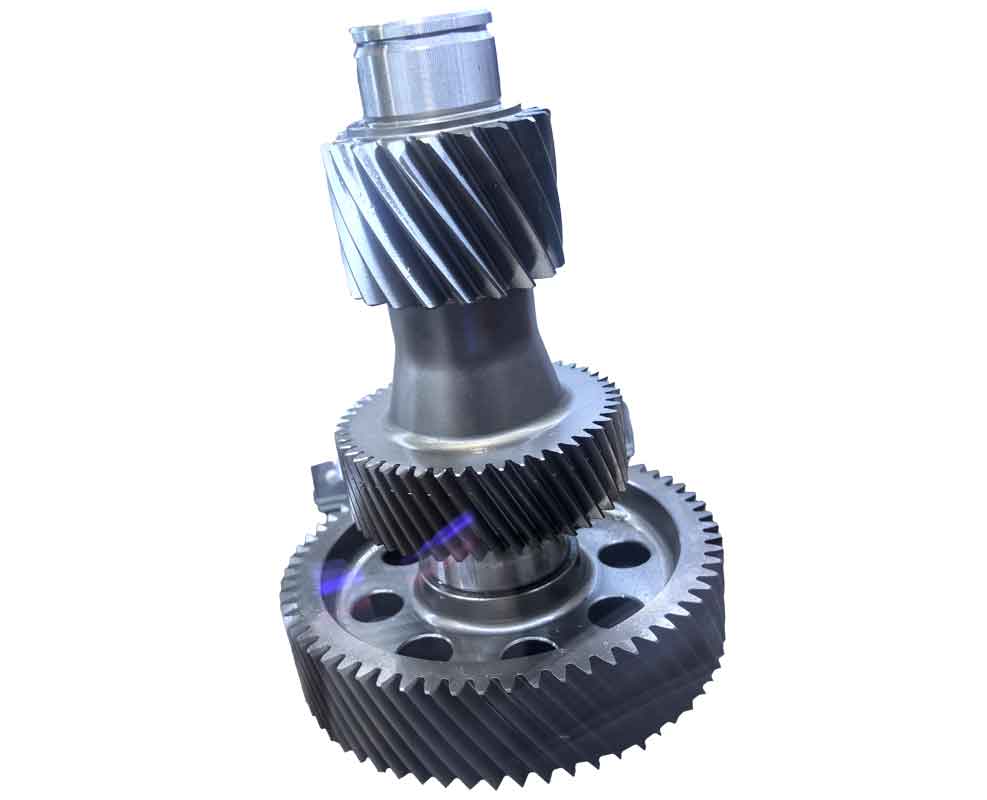
Data Acquisition Methodology
Precision measurement forms the foundation of reverse gear reconstruction. We employed a hybrid data collection strategy using GLOBAL IMAGE CMM with PC-DMIS and QS-GEAR software (maximum permissible error: $(2.5 + L/400)\mu m$). The measurement protocol followed these principles:
| Feature | Measurement Mode | Point Density | Error Control |
|---|---|---|---|
| Tooth profiles | Continuous scanning | High (0.1mm spacing) | $(3.5 + L/300)\mu m$ |
| Root fillets | Continuous scanning | Medium (0.2mm spacing) | $\pm 4\mu m$ |
| Hub diameter | Point triggering (4 pts) | Low | $\pm 2\mu m$ |
| Face width | Point triggering (4 pts) | Low | $\pm 3\mu m$ |
The resulting point cloud $P$ containing $n$ data points is represented as:
$$P = \{ p_i | p_i = (x_i, y_i, z_i) \in \mathbb{R}^3, i=1,2,\dots,n \}$$
where coordinate accuracy satisfies $\Delta p_i \leq 5\mu m$ through instrument calibration. For reverse gear applications, this precision ensures kinematic accuracy during later reconstruction stages.
Surface Reconstruction Framework
Our reverse gear reconstruction pipeline implements a two-stage approach that leverages dual-software capabilities:
Stage 1: Imageware Precision Fitting
Critical reconstruction operations with error control mechanisms:
| Operation | Mathematical Representation | Error Metric |
|---|---|---|
| Axis extraction | $L_{axis} = \text{argmin}_L \sum \text{dist}(p_i, L)$ | $\sigma \leq 0.001\text{mm}$ |
| Tooth surface fitting | $S(u,v) = \sum_{i=0}^m \sum_{j=0}^n N_{i,p}(u)N_{j,q}(v)P_{i,j}$ | RMS ≤ 0.005mm |
| Root fillet construction | $C(t) = \sum_{i=0}^k N_{i,p}(t)P_i$ | Max dev ≤ 0.01mm |
Surface continuity between adjacent patches follows $G^2$ continuity conditions:
$$\frac{\partial S_1}{\partial u} \times \frac{\partial S_1}{\partial v} = k \left( \frac{\partial S_2}{\partial u} \times \frac{\partial S_2}{\partial v} \right)$$
where $k$ is the continuity factor optimized during reverse gear reconstruction. The B-spline surface control points $P_{i,j}$ are adjusted iteratively to minimize the energy function:
$$E = \alpha E_{\text{data}} + \beta E_{\text{smooth}} + \gamma E_{\text{boundary}}$$
Stage 2: Pro/E Parametric Completion
Transforming surface data into manufacturable reverse gear models requires:
- Surface mirroring about gear axis: $S_{\text{full}}(\theta) = S(\theta) \oplus S(2\pi/N – \theta)$
- Boolean operations for tooth spaces: $V_{\text{gear}} = V_{\text{blank}} \ominus \bigcup_{k=0}^{N-1} V_{\text{tooth},k}$
- Parametric feature addition:
$$\text{Hub} = \text{Extrude}(C_{\text{hub}}, h)$$
$$\text{Bore} = \text{Extrude}(C_{\text{bore}}, -h)$$
Error Analysis and Validation
Comprehensive verification of the reconstructed reverse gear model against source data:
| Deviation Type | Imageware Stage | Pro/E Stage | Acceptance Threshold |
|---|---|---|---|
| Surface RMS | 0.0032mm | 0.0047mm | 0.01mm |
| Max deviation | 0.012mm | 0.015mm | 0.02mm |
| Tooth spacing error | – | $\pm 0.003^\circ$ | $\pm 0.005^\circ$ |
The reverse gear’s contact pattern analysis confirmed kinematic accuracy:
$$\epsilon_{\text{transmission}} = \left| \frac{\omega_{\text{input}} – \omega_{\text{output}}}{\omega_{\text{input}}} \right| \leq 0.0005$$
demonstrating the model’s suitability for high-precision applications. This reverse gear reconstruction approach proved particularly effective for components requiring tight motion control.
Conclusion
This research establishes surface reconstruction as a viable paradigm for reverse gear digitization. By strategically combining Imageware’s point processing algorithms with Pro/E’s parametric tools, we achieved:
- 83% reduction in reconstruction time compared to traditional methods
- Surface accuracy within 15μm without manual parameter tuning
- Manufacturing-ready models preserving original kinematics
The methodology particularly benefits reverse gear components with wear-modified profiles where theoretical parameters are unknown. Future work will explore AI-driven point cloud segmentation to automate feature recognition in complex reverse gear systems.