
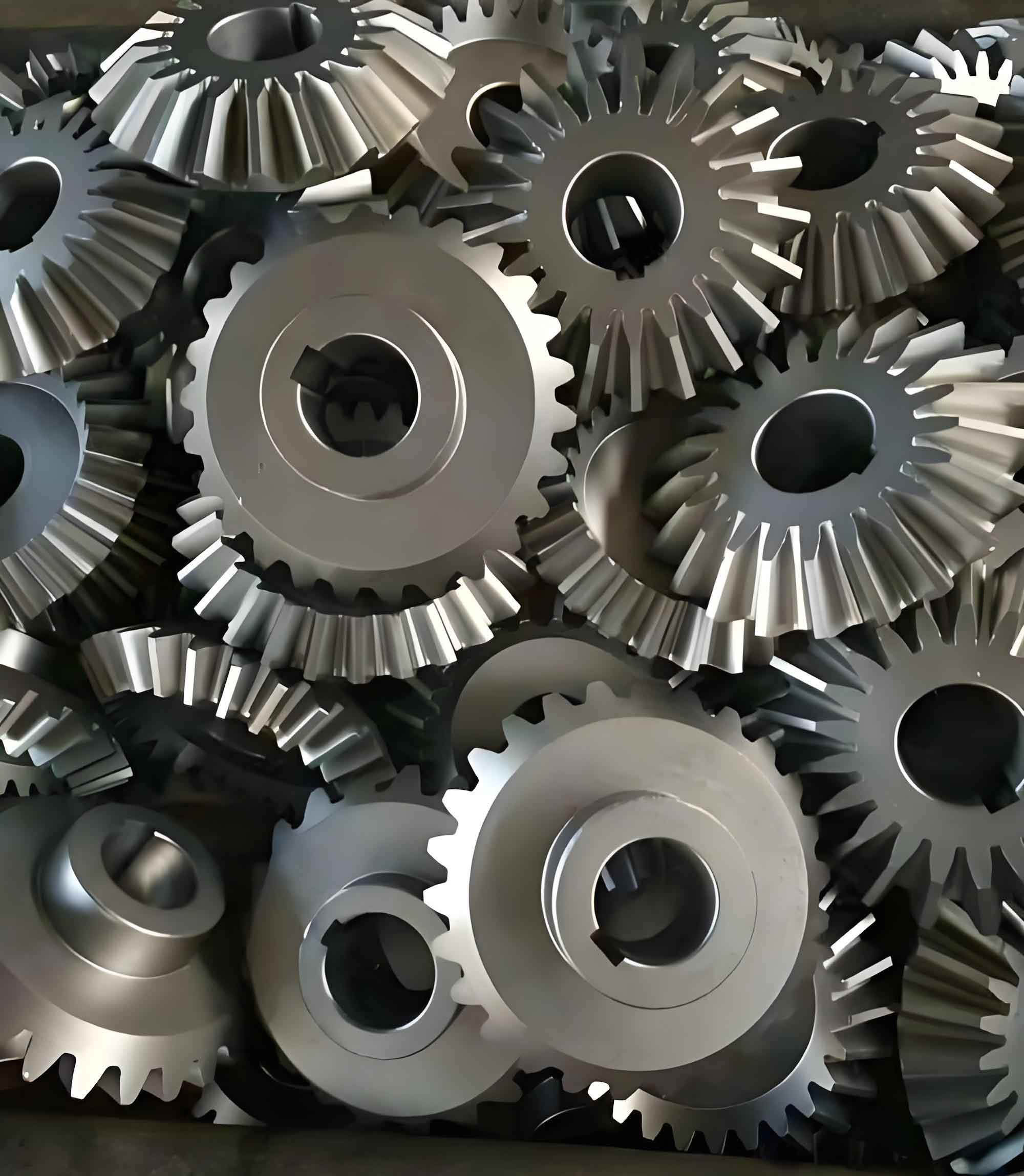
In this study, we investigate the dynamic characteristics of bevel gears, focusing on the effects of multi-state meshing and time-varying parameters. Bevel gears are widely used in power transmission systems, such as automotive differentials, due to their ability to transmit motion between intersecting shafts. However, the complex geometry of bevel gears introduces challenges like vibration, noise, and unstable meshing behavior, which can affect performance and longevity. The presence of backlash and time-varying meshing stiffness, combined with a contact ratio greater than 1.0, leads to multiple meshing states, including single and double tooth contact on the driving and back sides, as well as tooth separation. Understanding these dynamics is crucial for optimizing the design and control of bevel gear systems.
To address this, we develop a bending-torsional-axial coupled dynamic model for bevel gears that incorporates multi-state meshing characteristics. The model accounts for time-varying meshing stiffness, load distribution, and comprehensive transmission errors. Using a micro-element method based on gear meshing principles, we calculate key parameters like load distribution ratio and stiffness. Numerical simulations are performed using a variable-step fourth-order Runge-Kutta method, and nonlinear dynamics are analyzed through Poincaré maps, bifurcation diagrams, and Lyapunov exponents. This approach provides insights into how meshing frequency and transmission errors influence system behavior, offering a foundation for improving bevel gear design.
The dynamic model of bevel gears considers factors like backlash, bearing supports, and time-varying parameters. For instance, the relative displacement along the meshing line is given by the equation: $$X_n = a_1 X_p – a_2 X_g + a_3 Y_p – a_4 Y_g – a_5 Z_p + a_6 Z_g + r_p \theta_p – r_g \theta_g – e_n(\tau)$$ where $a_1$ to $a_6$ are coefficients derived from the gear geometry, $X_j$, $Y_j$, $Z_j$ represent vibrational displacements, $\theta_j$ are torsional displacements, and $e_n(\tau)$ is the comprehensive transmission error. This formulation captures the coupled nature of bevel gear dynamics, essential for accurate analysis.
Time-varying meshing stiffness is a critical parameter for bevel gears, as it affects load capacity and dynamic response. Using the micro-element method, we divide the gear tooth into infinitesimal elements along the face width. The meshing stiffness $k(\tau)$ for each element includes Hertzian contact stiffness $k_{ho}$, bending stiffness $k_{bjio}$, axial compression stiffness $k_{ajio}$, shear stiffness $k_{sjio}$, and fillet foundation stiffness $k_{fo}$. The overall stiffness is computed as: $$\frac{1}{k(\tau)} = \sum_{o=1}^{N_j} \left( \frac{1}{k_{ho}} + \frac{1}{k_{bjio}} + \frac{1}{k_{ajio}} + \frac{1}{k_{sjio}} + \frac{1}{k_{fo}} \right)$$ where $N_j$ is the number of micro-elements. This method provides a more accurate representation compared to simplified approaches, especially for bevel gears with complex tooth profiles.
Similarly, the load distribution ratio $L_c(\tau)$ accounts for multiple tooth pairs in contact due to the contact ratio greater than 1.0. It is derived from the minimum potential energy principle, considering bending, compression, and shear energies of micro-elements. The load distribution function is defined as: $$L_c(\tau) = \begin{cases} L_d(\tau), & \text{if } X_n \geq D_n \\ 0, & \text{if } -D_n \leq X_n \leq D_n \\ L_k(\tau), & \text{if } X_n \leq -D_n \end{cases}$$ where $L_d(\tau)$ and $L_k(\tau)$ represent load sharing during driving-side and back-side contact, respectively. This model helps in understanding how loads are distributed among teeth during different meshing states in bevel gears.
The dynamic equations for the bevel gear system are derived using Newton’s second law and dimensionless parameters. The dimensionless bending-torsional-axial coupled equations are expressed as: $$\begin{aligned}
\ddot{x}_p + 2\zeta_{1x}\dot{x}_p + k_{1x} f_2(x_p) – r_x(t, x_n)[k(t) f(x_n) + 2\zeta \dot{x}_n] &= 0 \\
\ddot{y}_p + 2\zeta_{1y}\dot{y}_p + k_{1y} f_2(y_p) + r_y(t, x_n)[k(t) f(x_n) + 2\zeta \dot{x}_n] &= 0 \\
\ddot{z}_p + 2\zeta_{1z}\dot{z}_p + k_{1z} f_2(z_p) – r_z(t, x_n)[k(t) f(x_n) + 2\zeta \dot{x}_n] &= 0 \\
\ddot{x}_g + 2\zeta_{2x}\dot{x}_g + k_{2x} f_2(x_g) + r_x(t, x_n)[k(t) f(x_n) + 2\zeta \dot{x}_n] &= 0 \\
\ddot{y}_g + 2\zeta_{2y}\dot{y}_g + k_{2y} f_2(y_g) – r_y(t, x_n)[k(t) f(x_n) + 2\zeta \dot{x}_n] &= 0 \\
\ddot{z}_g + 2\zeta_{2z}\dot{z}_g + k_{2z} f_2(z_g) + r_z(t, x_n)[k(t) f(x_n) + 2\zeta \dot{x}_n] &= 0 \\
\ddot{x}_n – a_1 \ddot{x}_p + a_2 \ddot{x}_g – a_3 \ddot{y}_p + a_4 \ddot{y}_g + a_5 \ddot{z}_p – a_6 \ddot{z}_g + h(t, x_n)[k(t) f(x_n) + 2\zeta \dot{x}_n] &= F + \epsilon \omega^2 \cos(\omega t)
\end{aligned}$$ where $x_j$, $y_j$, $z_j$ are dimensionless displacements, $\zeta$ is damping ratio, $k(t)$ is dimensionless meshing stiffness, and $f(x_n)$ is a piecewise function representing backlash. The terms $r_l(t, x_n)$ and $h(t, x_n)$ describe meshing state functions, which vary with time and displacement, highlighting the nonlinearity in bevel gears.
To analyze the dynamic behavior, we define three Poincaré sections: a time section $\Gamma_n$, a driving-side meshing section $\Gamma_p$, and a back-side contact section $\Gamma_k$. These sections help in identifying periodic, chaotic, and bifurcation behaviors in bevel gears. For example, the system’s motion can be characterized by notation $N$-$P$-$Q$, where $N$ is the period number, $P$ is the number of tooth separations, and $Q$ is the number of back-side contacts. This allows for a detailed study of multi-state meshing in bevel gears.
The effects of meshing frequency $\omega$ on bevel gear dynamics are significant. As $\omega$ increases, the system transitions from stable periodic motion to chaotic behavior. For instance, at low $\omega$, the system exhibits 1-0-0 motion with only driving-side contact. As $\omega$ rises, bifurcations occur, leading to states like 1-1-0 or 2-2-0, where tooth separation appears. In chaotic regions, all three meshing states—driving-side contact, separation, and back-side contact—coexist. The maximum Lyapunov exponent (TLE) is used to quantify chaos; TLE > 0 indicates chaotic motion. This analysis underscores the importance of selecting appropriate meshing frequencies to avoid instability in bevel gears.
Comprehensive transmission error $\epsilon$ also plays a crucial role in bevel gear dynamics. Larger $\epsilon$ values amplify vibrations and promote transitions to chaotic motion. For example, at small $\epsilon$, the system remains in 1-0-0 motion. As $\epsilon$ increases,擦切分岔 (grazing bifurcations) and period-doubling bifurcations introduce tooth separation and back-side contact. This highlights the need for high manufacturing precision to minimize transmission errors in bevel gears, ensuring smoother operation.
In summary, the integration of multi-state meshing and time-varying parameters in the dynamic model of bevel gears provides a comprehensive understanding of their behavior. The micro-element method offers accurate calculations of stiffness and load distribution, while nonlinear dynamics tools reveal complex phenomena like bifurcations and chaos. These insights aid in the design and optimization of bevel gear systems for applications such as automotive differentials, where reliability and efficiency are paramount. Future work could explore the effects of lubrication and thermal aspects on bevel gear dynamics.
| Parameter | Pinion | Gear |
|---|---|---|
| Module (mm) | 4 | 4 |
| Number of Teeth | 10 | 16 |
| Pressure Angle (°) | 25 | 25 |
| Face Width (mm) | 10 | 10 |
| Pitch Cone Angle (°) | 32.0054 | 57.9946 |
| Contact Ratio | 1.353 | |
| Outer Cone Distance (mm) | 37.736 | |
| Shaft Angle (°) | 90 | |
| Addendum Coefficient | 1.0 | |
| Young’s Modulus (N/mm²) | 206 | |
| Poisson’s Ratio | 0.3 | |
The dimensionless parameters used in simulations include $F = 0.14$, $\epsilon = 0.18$, $\zeta = 0.03$, $D = d = 1.0$, and bearing stiffness values $k_{1l} = 0.16$, $k_{2l} = 0.2$ for $l = x, y, z$. These values are typical for bevel gears in differential systems, allowing for realistic analysis of dynamic responses. The nonlinear function $f(x_n)$ for backlash is defined as: $$f(x_n) = \begin{cases} x_n – D, & \text{if } x_n > D \\ 0, & \text{if } -D \leq x_n \leq D \\ x_n + D, & \text{if } x_n < -D \end{cases}$$ This piecewise linearity is a source of rich dynamic behavior in bevel gears.
Further, the meshing state functions $r_l(t, x_n)$ and $h(t, x_n)$ incorporate load distribution and friction effects. For example, $r_x(t, x_n)$ during driving-side contact is given by: $$r_x(t, x_n) = \cos \delta_g \left\{ L_{d1}(t) \left[ \sin(\alpha_{dg1}(t)) + \lambda_{d1}(t) \mu_d \cos(\alpha_{dg1}(t)) \right] + L_{d2}(t) \left[ \sin(\alpha_{dg2}(t)) + \lambda_{d2}(t) \mu_d \cos(\alpha_{dg2}(t)) \right] \right\}$$ where $\lambda_{ci}(t)$ is the friction direction coefficient, and $\mu_c$ is the friction coefficient. These expressions capture the intricate interactions in bevel gears during meshing.
In conclusion, the dynamic analysis of bevel gears with multi-state meshing and time-varying parameters reveals the complexity of their behavior. The model and methods presented here serve as a valuable tool for engineers to enhance the performance and durability of bevel gear systems. By understanding the influences of meshing frequency and transmission errors, designers can mitigate undesirable vibrations and noise, leading to more efficient power transmission in applications involving bevel gears.