
In mechanical transmission systems, gears play a pivotal role across various industries such as aerospace, automotive, and robotics. Traditional bevel gears face limitations in adjustable shaft angles and high-speed applications, often requiring complex multi-stage setups. To address these challenges, hemispherical bevel gears have emerged as a innovative solution, enabling arbitrary shaft angles and continuous rotational motion. In this study, I develop a comprehensive dynamic model and perform flexible multi-body dynamics simulations to analyze the transmission performance of hemispherical bevel gears. By investigating parameters like gear size and shaft angle, I aim to optimize their design for enhanced accuracy, stability, and strength.
The foundation of this analysis lies in establishing a precise mathematical model for hemispherical bevel gears. Based on the lumped mass method, I derive the dynamic equations that govern the gear pair’s behavior. The tooth surface geometry is described using spherical involute principles, where the parametric equations define the弧形齿面. For a gear pair with a 1:1 transmission ratio, the pure rolling motion between the pitch cones corresponds to the engagement of spherical involute surfaces. The tooth surface equation in the coordinate system (O1, x1, y1, z1) is given by:
$$ \mathbf{r}^{(1)}(\beta, \phi) = \begin{bmatrix} 1 & 0 & 0 & 0 \\ 0 & -1 & 0 & 0 \\ 0 & 0 & -1 & 0 \\ 0 & 0 & 0 & 1 \end{bmatrix} \mathbf{r}_s^{(p)} = \rho \begin{bmatrix} \cos \psi \sin \phi – \sin \psi \cos \phi \sin \gamma_b \\ -\sin \psi \sin \phi – \cos \psi \cos \phi \sin \gamma_b \\ -\cos \phi \cos \gamma_b + L \\ 1 \end{bmatrix} $$
Here, $\rho$ represents the length of the pitch cone generatrix, $L$ is the distance from point $O_s$ to $O_1$, $\phi$ is the rolling angle in the spherical involute formation, $\psi$ is the spherical involute roll angle, $\gamma_b$ is the base cone angle, and $\beta$ is the pitch cone’s pitch angle, determined by the number of teeth and the gear’s hemispherical design. The conjugate meshing equation, derived from prior work, relates the angles as follows:
$$ \phi_1 = \phi_p(\beta) \psi $$
$$ \phi_p(\beta) = \arccos\left(\frac{\tan \gamma_b}{\tan \gamma_p}\right) $$
where $\gamma_p$ is the pitch cone angle. This equation ensures proper meshing between the gear teeth during operation.
To analyze the dynamic behavior, I construct a flexible multi-body dynamics model of the hemispherical bevel gear system. The gear pair consists of an input gear (gear 2) fixed to the input shaft and an output gear (gear 1) connected to the output shaft. Using a centralized mass approach, I consider vibrations in transverse, axial, and torsional directions, ignoring shaft elastic deformations for simplicity. The dynamic model incorporates stiffness and damping elements, with $k_n$ and $c_n$ representing the meshing stiffness and damping, respectively, and $k_{ix}$, $k_{iy}$, $k_{iz}$, $c_{ix}$, $c_{iy}$, $c_{iz}$ denoting the stiffness and damping along the X, Y, and Z axes for each gear ($i=1,2$). The shaft angle is defined as $2\gamma_p = \pi – \beta$, where $\beta$ ranges from $0^\circ$ to $80^\circ$. The generalized displacement array is expressed as:
$$ \mathbf{X} = \{X_1, Y_1, Z_1, \theta_1, X_2, Y_2, Z_2, \theta_2\}^T $$
with $X_1 = X_P + P_x = X_P + Y_P \cos(2\gamma_p)$ and $Y_1 = P_y = Y_P \sin(2\gamma_p)$. The normal meshing force $F_n$ is calculated as:
$$ F_n = k_n \lambda_n + c_n \dot{\lambda}_n $$
where $\lambda_n$ is the relative displacement in the normal direction due to vibrations and errors. The differential equations of motion for the system are:
$$ \begin{aligned}
m_i \ddot{X}_i + c_{ix} \dot{X}_i + k_{ix} X_i &= -F_x \\
m_i \ddot{Y}_i + c_{iy} \dot{Y}_i + k_{iy} Y_i &= -F_y \\
m_i \ddot{Z}_i + c_{iz} \dot{Z}_i + k_{iz} Z_i &= -F_z \\
I_i \ddot{\theta}_i &= T_i – F_n r_i
\end{aligned} $$
for $i=1,2$, where $F_x$, $F_y$, $F_z$ are the components of $F_n$ along the coordinate axes, $I_i$ is the moment of inertia, $T_i$ is the torque, and $r_i$ is the pitch radius. Eliminating the torsional displacements $\theta_1$ and $\theta_2$, the equation simplifies to:
$$ -m_e c_1 \ddot{X}_1 + m_e c_2 \ddot{Y}_1 + m_e c_3 \ddot{Z}_1 + m_e c_1 \ddot{X}_2 – m_e c_2 \ddot{Y}_2 – m_e c_3 \ddot{Z}_2 + m_e \ddot{\lambda}_n + c_n c_1 \dot{\lambda}_n + k_n c_n \lambda_n = F_p + m_e \ddot{e}_n(t) $$
Here, $m_e$ is the equivalent mass of the gear pair, $F_p$ is the circumferential force on the driving gear, and $e_n(t)$ accounts for errors. This equation is normalized and solved using the Runge-Kutta method to obtain dynamic responses, which are validated against simulation results.
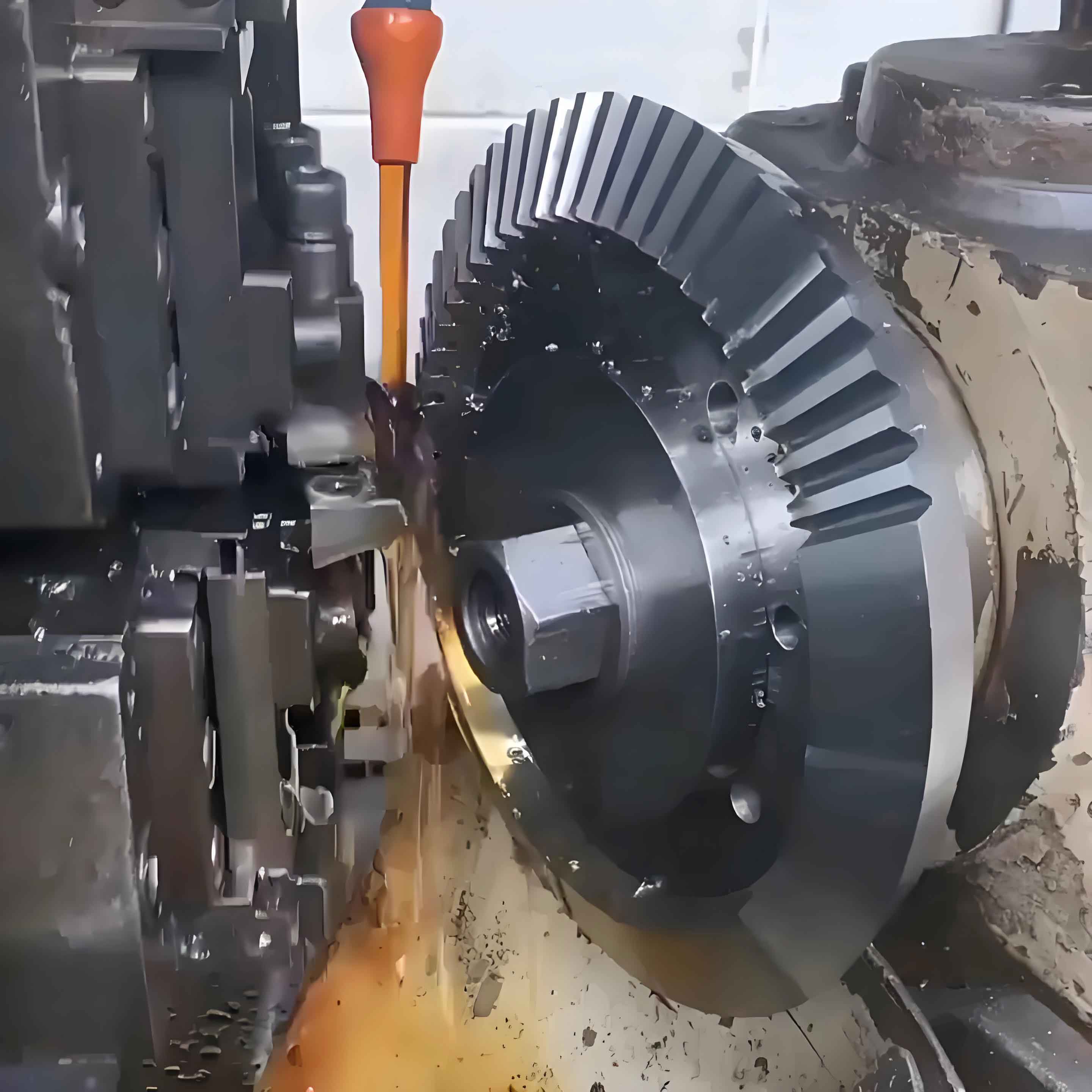
For the flexible dynamics simulation, I employ a rigid-flexible coupling approach. The hemispherical bevel gears are discretized using finite element methods, with hexahedral elements of size 1 mm for the tooth surfaces and root areas to capture contact stresses accurately, and tetrahedral elements of size 2 mm for non-contact regions. The material properties and design parameters are summarized in the table below:
| Parameter | Value |
|---|---|
| Number of Teeth, z | 12 |
| Normal Pressure Angle, α (°) | 20 |
| Addendum Coefficient | 1 |
| Dedendum Coefficient | 0.25 |
| Pitch Radius, r_p (mm) | 25–40 |
| Pitch Angle, β (°) | 0–80 |
| Material | Structural Steel |
| Elastic Modulus (N/mm²) | 2.1 × 10^11 |
| Poisson’s Ratio | 0.3 |
| Output Load Torque (N·m) | 50–500 |
| Contact Stiffness (N/mm^{1.5}) | 7.2 × 10^5 |
| Input Speed (r/min) | 60 |
The simulation process involves importing mesh files, defining contacts, and solving the dynamics equations using an LMS solver. The rigid-flexible coupling model accurately represents the gear system, allowing for analysis of dynamic transmission performance under varying parameters.
To evaluate the dynamic characteristics, I focus on three key aspects: transmission accuracy, stability, and strength. Transmission accuracy is assessed through the maximum angular error, stability via the meshing duration (indicating overlap ratio), and strength using the maximum contact force. The optimization criteria are defined as minimizing angular error and contact force while maximizing meshing duration. The objective functions can be expressed as:
$$ \begin{aligned}
f(x, y)_{\text{angular error}} &\rightarrow \min \\
f(x, y)_{\text{meshing duration}} &\rightarrow \max \\
f(x, y)_{\text{contact force}} &\rightarrow \min
\end{aligned} $$
where $x$ represents the pitch diameter and $y$ the shaft angle. Simulations are conducted for different combinations of pitch diameters (30 mm to 150 mm) and shaft angles (50° to 80°). The results for maximum angular error are tabulated below:
| Shaft Angle (°) | 30 mm | 45 mm | 60 mm | 75 mm | 90 mm | 120 mm | 150 mm |
|---|---|---|---|---|---|---|---|
| 50 | 0.561 | 0.594 | 0.666 | 0.794 | 0.786 | 1.260 | 3.723 |
| 55 | 0.453 | 0.511 | 0.549 | 0.549 | 0.549 | 1.231 | 3.432 |
| 60 | 1.157 | 0.431 | 0.463 | 0.522 | 0.651 | 1.063 | 3.264 |
| 65 | 1.082 | 0.608 | 0.412 | 0.494 | 0.612 | 1.097 | 3.113 |
| 70 | 1.017 | 1.057 | 0.539 | 0.432 | 0.442 | 0.937 | 3.006 |
| 75 | 1.104 | 1.098 | 1.037 | 0.382 | 0.438 | 0.991 | 2.855 |
| 80 | 0.840 | 0.937 | 0.792 | 0.395 | 0.439 | 0.646 | 2.779 |
Fitting this data to a surface model, the maximum angular error $f(x, y)$ is described by the polynomial:
$$ f(x, y) = 13.23 + 0.1035x – 0.7188y – 8.321 \times 10^{-4}x^2 – 1.555 \times 10^{-3}xy + 0.0123y^2 + 4.375 \times 10^{-6}x^3 + 1.126 \times 10^{-6}x^2y + 7.203 \times 10^{-6}xy^2 – 6.5559 \times 10^{-5}y^3 $$
This equation shows that angular error generally increases with larger shaft angles and pitch diameters, particularly beyond 90°, indicating a trade-off in accuracy for larger bevel gears. The error ranges from 0.35° to 3.5°, with smaller diameters and angles yielding better precision.
For stability analysis, the meshing duration between adjacent teeth is critical, as it reflects the overlap ratio. The simulation results for meshing duration are as follows:
| Shaft Angle (°) | 30 mm | 45 mm | 60 mm | 75 mm | 90 mm | 120 mm | 150 mm |
|---|---|---|---|---|---|---|---|
| 50 | 0.008 | 0.013 | 0.019 | 0.030 | 0.046 | 0.064 | 0.116 |
| 55 | 0.004 | 0.007 | 0.014 | 0.014 | 0.014 | 0.068 | 0.112 |
| 60 | 0.004 | 0.003 | 0.009 | 0.017 | 0.030 | 0.071 | 0.112 |
| 65 | 0.003 | 0.003 | 0.005 | 0.013 | 0.024 | 0.069 | 0.103 |
| 70 | 0.003 | 0.003 | 0.004 | 0.008 | 0.020 | 0.067 | 0.096 |
| 75 | 0.003 | 0.003 | 0.003 | 0.005 | 0.015 | 0.061 | 0.061 |
| 80 | 0.002 | 0.002 | 0.003 | 0.003 | 0.012 | 0.057 | 0.060 |
The meshing duration $f(x, y)$ is fitted to the equation:
$$ f(x, y) = 0.5875 + 5.556 \times 10^{-3}x + 2.111 \times 10^{-2}y + 3.248 \times 10^{-5}x^2 + 1.076 \times 10^{-4}xy + 2.62 \times 10^{-4}y^2 – 6.973 \times 10^{-8}x^3 – 1.117 \times 10^{-6}x^2y – 7.597 \times 10^{-7}xy^2 – 1.048 \times 10^{-6}y^3 $$
This indicates that meshing duration decreases with increasing pitch diameter but shows a complex relationship with shaft angle, initially decreasing then increasing for larger angles. The duration is always positive, confirming continuous meshing with an overlap ratio greater than 1, essential for stable operation of bevel gears.
Strength evaluation is based on the maximum contact force on the tooth surface, which affects durability. The results for contact force are summarized below:
| Shaft Angle (°) | 30 mm | 45 mm | 60 mm | 75 mm | 90 mm | 120 mm | 150 mm |
|---|---|---|---|---|---|---|---|
| 50 | -3650 | -4049 | -4206 | -4648 | -5701 | -5773 | -6592 |
| 55 | -3309 | -3520 | -3715 | -3712 | -3716 | -5474 | -5546 |
| 60 | -3135 | -3236 | -3382 | -3595 | -4044 | -4953 | -6183 |
| 65 | -2762 | -2864 | -3139 | -3253 | -3766 | -4528 | -5700 |
| 70 | -2554 | -2666 | -2817 | -3054 | -3490 | -4128 | -5346 |
| 75 | -2433 | -2443 | -2661 | -2875 | -3231 | -4225 | -4225 |
| 80 | -2247 | -2345 | -2495 | -2672 | -2991 | -3594 | -4118 |
The contact force $f(x, y)$ is modeled as:
$$ f(x, y) = 3.875 \times 10^4 – 72.9x – 1452y + 0.4129x^2 + 1.955xy + 19.62y^2 – 1.374 \times 10^{-3}x^3 + 6.786 \times 10^{-4}x^2y – 0.01787xy^2 – 0.08841y^3 $$
This equation reveals that contact force increases with shaft angle due to reduced contact area but decreases with larger pitch diameters because of increased surface area. The negative correlation between stability and strength highlights a design compromise for hemispherical bevel gears.
In conclusion, my analysis demonstrates that hemispherical bevel gears can achieve continuous and accurate meshing across various shaft angles. The dynamic model and simulations confirm that smaller pitch diameters and shaft angles improve transmission accuracy, while larger parameters enhance stability but reduce strength. The optimal configuration, balancing all factors, is identified at a pitch diameter of 65 mm and a shaft angle of 120°. This study provides valuable insights for designing high-performance hemispherical bevel gears, emphasizing the importance of flexible dynamics in optimizing gear systems for industrial applications. Future work could explore additional parameters like tooth profile modifications or material variations to further enhance the performance of these innovative bevel gears.