
In this comprehensive study, we investigate the root causes of surface circumferential cracking in bevel gears used in mining reducers. These bevel gears, fabricated from 18CrNiMo7-6 low-carbon alloy carburizing steel, are critical components in heavy-duty applications such as wind turbine gearboxes and mining equipment. The failure manifested as ring-shaped fractures on the gear surface, with cracks extending approximately 30 mm inward from depths of 17 mm and 45 mm, indicating a sudden stress release. Our analysis integrates macroscopic observations, chemical composition assessments, residual gas measurements, hardness testing, magnetic particle inspections, and metallographic examinations to identify the contributing factors. We emphasize that the primary issues stem from suboptimal heat treatment processes and operational errors during manufacturing, rather than inherent material defects. Through this first-person perspective, we detail our methodologies, findings, and recommendations to prevent future failures in bevel gears.
The failure of the bevel gears occurred during service, with cracks appearing as large arcs along the peripheral surface. Approximately one-third of the crack was located on the upper convex plane, while the remaining two-thirds extended across the outer arc. The cracks exhibited a straight, rigid pattern, characteristic of quenching stress-induced fractures. To preserve the crack origins, we carefully selected samples using wire cutting from the crack tail junction, avoiding any alteration to the critical areas. This approach allowed for an unbiased analysis of the failure mechanisms in these bevel gears.
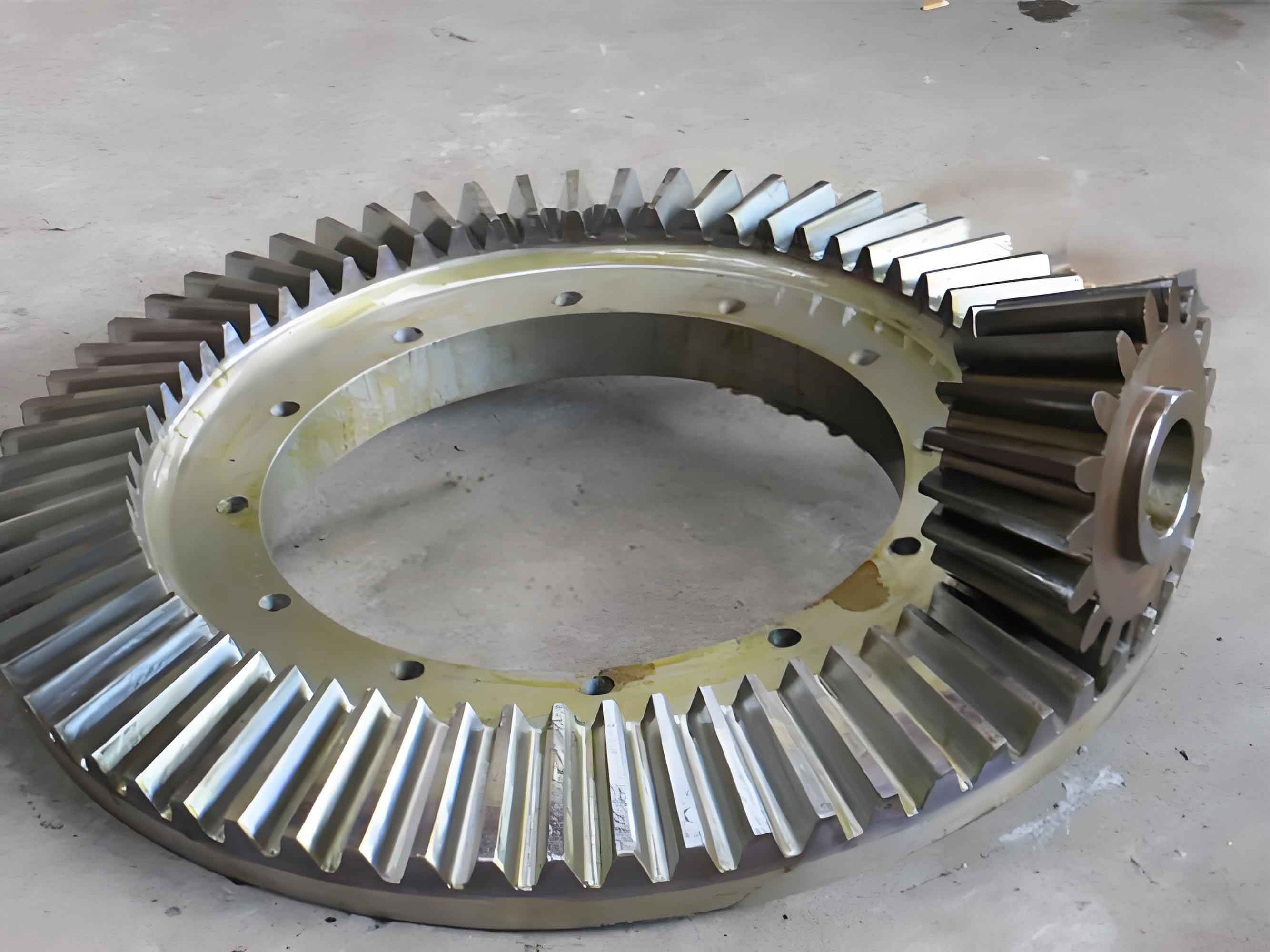
We began our investigation with chemical composition analysis using a SPECTROMAXx spark optical emission spectrometer. The results, compared against standard requirements, confirmed that the material composition of the bevel gears adhered to specifications. The table below summarizes the elemental composition in weight percentage, demonstrating compliance with GB/T 3077-2015 standards for alloy structural steel. This ruled out material incompatibility as a cause for the cracking in the bevel gears.
| Element | C | Si | Mn | P | S | Cr | Ni | Mo | Cu |
|---|---|---|---|---|---|---|---|---|---|
| Sample Analysis | 0.19 | 0.26 | 0.86 | 0.016 | 0.001 | 1.68 | 1.60 | 0.26 | 0.04 |
| Standard Requirement | 0.19 | 0.25 | 0.85 | 0.018 | 0.001 | 1.66 | 1.65 | 0.26 | 0.04 |
Residual gas content and hardness were evaluated to assess potential embrittlement or strength issues in the bevel gears. Using an Hon-2000 gas analyzer, we measured hydrogen, oxygen, and nitrogen levels, with results showing minimal deviation from production records, as detailed in the table below. This indicated that gas inclusions did not contribute to the failure. Hardness testing, conducted according to GB/T 230.1-2009, revealed surface hardness values between 52 and 58 HRC and core hardness ranging from 31 to 44 HRC. Although some surface points were slightly below the specified 58-62 HRC, the overall hardness profile met design requirements for the bevel gears, suggesting that material strength was not the primary issue.
| Gas Type | [H] (×10⁻⁶) | [O] (×10⁻⁶) | [N] (×10⁻⁶) |
|---|---|---|---|
| Sample Analysis | 1.6 | 8 | 82 |
| Production Record | 1.7 | 7.3 | 77 |
Magnetic particle inspection using a CDX-III instrument, following JB/T 5000.15-2007 standards, detected no surface or near-surface defects such as cracks, seams, or white spots in the bevel gears. This further confirmed the absence of pre-existing flaws in the material. Metallographic examination at 100× magnification assessed non-metallic inclusions and microstructure. The inclusions were rated as A0.5, B0.5, C0.5, and D0.5, with no Ds types, indicating a clean material base. The microstructure near the cracks showed uniform carbides without abnormal clustering, but excessive retained austenite was observed at level 6 in both the failed bevel gears and reference samples. This high retained austenite content, resulting from improper heat treatment, reduced surface compressive stress and contributed to microcrack initiation.
Field investigations revealed critical operational errors during the heat treatment of the bevel gears. The process involved carburizing at 925°C, followed by oil draining for 4553 seconds, washing, and tempering at 170°C. However, the bevel gears were processed alongside 20CrMnTi steel components using a unified protocol, leading to suboptimal conditions for 18CrNiMo7-6 steel. The extended oil draining time and delayed tempering (over 2 hours post-quench) promoted retained austenite accumulation. The volume fraction of retained austenite, \( V_{\gamma} \), can be estimated using the equation: $$ V_{\gamma} = k \cdot \exp\left(-\frac{Q}{RT}\right) $$ where \( k \) is a material constant, \( Q \) is the activation energy, \( R \) is the gas constant, and \( T \) is the temperature. In this case, inadequate cooling rates and tempering delays increased \( V_{\gamma} \), lowering the fatigue resistance of the bevel gears.
To quantify the stress concentration effects, we applied the stress intensity factor formula for surface cracks in bevel gears: $$ K_I = \sigma \sqrt{\pi a} \cdot f\left(\frac{a}{t}\right) $$ Here, \( K_I \) is the mode I stress intensity factor, \( \sigma \) is the applied stress, \( a \) is the crack depth, and \( f(a/t) \) is a geometric correction factor. For the observed cracks with depths around 30 mm, the stress intensity exceeded the material’s fracture toughness, leading to rapid propagation. The residual stress, \( \sigma_r \), after quenching can be modeled as: $$ \sigma_r = E \cdot \alpha \cdot \Delta T $$ where \( E \) is Young’s modulus, \( \alpha \) is the thermal expansion coefficient, and \( \Delta T \) is the temperature gradient. Improper heat treatment induced high \( \sigma_r \), which, combined with operational stresses, caused instantaneous cracking in the bevel gears.
Our conclusions indicate that the cracking in the bevel gears was primarily due to heat treatment deficiencies and human errors, rather than material defects. The excessive retained austenite, resulting from mixed-material processing and incorrect cooling rates, created stress concentration zones. Operational mishandling, such as prolonged oil draining and delayed tempering, exacerbated these issues, leading to crack initiation and propagation. To mitigate future failures in bevel gears, we recommend implementing cryogenic treatment post-quenching to reduce retained austenite, segregating heat treatment batches by material type, and standardizing operational procedures. These measures will enhance the durability and reliability of bevel gears in mining applications, ensuring compliance with performance standards.
In summary, this analysis underscores the importance of precise heat treatment control and operational discipline in manufacturing bevel gears. By addressing these factors, manufacturers can prevent similar failures and extend the service life of critical components. Further research could explore advanced non-destructive testing methods for real-time monitoring of bevel gears during production, potentially integrating mathematical models for predictive maintenance. The insights gained from this study contribute to the broader understanding of failure mechanisms in bevel gears, promoting safer and more efficient mining operations.