
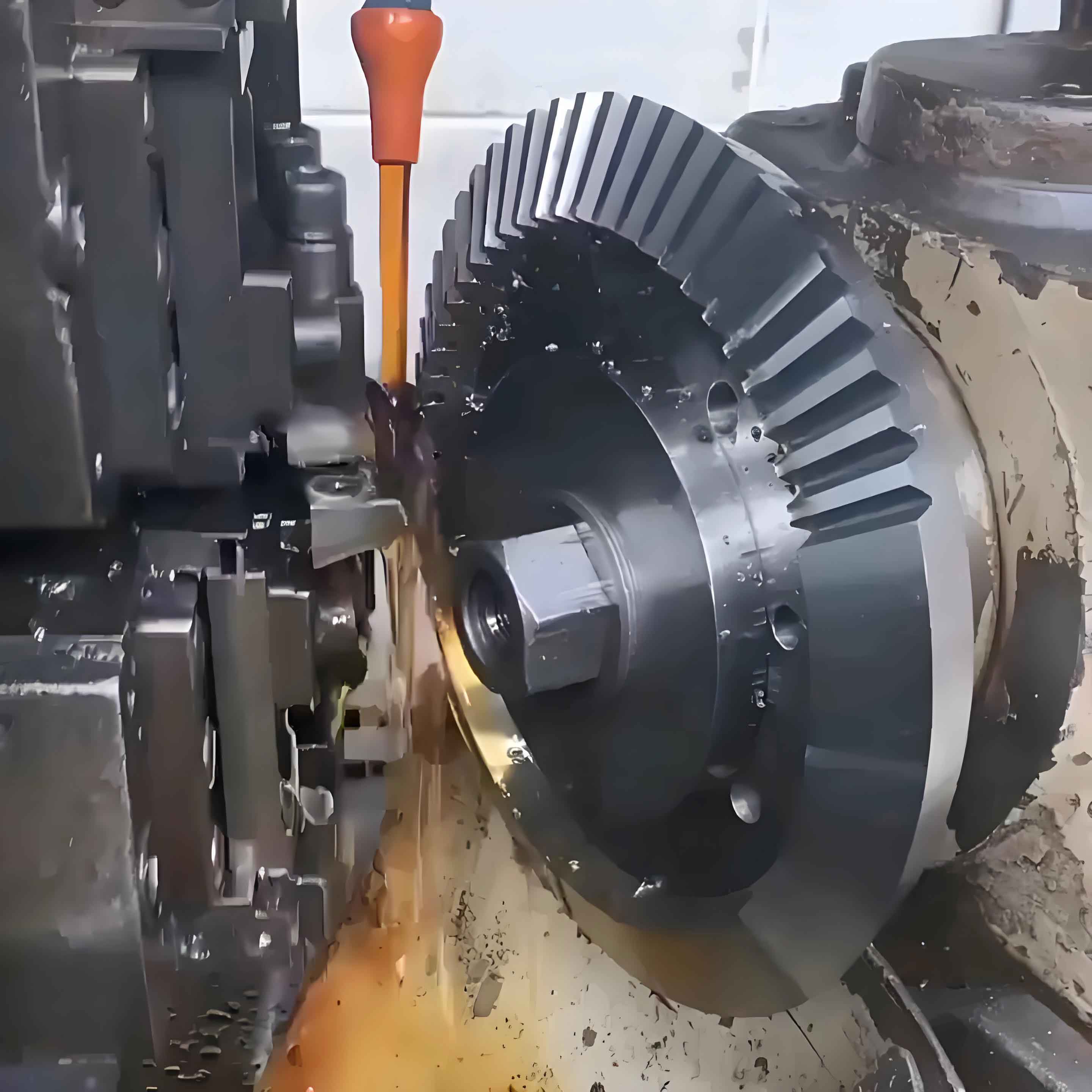
As a critical component in aero-engine systems, central bevel gears play a vital role in transmitting rotational speed and power from the engine main shaft to accessory devices at specific ratios and directions. Failures in these bevel gears can lead to severe accidents, with statistical data indicating that most faults in aero-engine central bevel gears result from resonance-induced nodal diameter-type fractures. Therefore, investigating the dynamic characteristics of aero-engine central bevel gears is essential, as it significantly contributes to the design and manufacturing of highly reliable bevel gears and helps prevent such failures. In this study, I focus on analyzing the dynamic behavior of a specific type of aero-engine central bevel gear, considering factors such as natural frequencies, traveling wave vibrations, and time-varying meshing stiffness. The research employs finite element methods and dynamic modeling to provide insights into the vibration characteristics and potential resonance risks, ultimately aiming to enhance the safety and performance of aero-engine transmission systems.
The gear transmission system in aero-engines operates under high-speed, high-load conditions, making the dynamic analysis of bevel gears crucial. Bevel gears, particularly spiral bevel gears, are favored for their high load-carrying capacity and smooth transmission. However, their complex geometry and operating environment introduce challenges in dynamic behavior prediction. The dynamic excitations in gear systems can be categorized into internal and external sources. Internal excitations include stiffness variations, transmission errors, and meshing impacts, while external excitations stem from unstable input torques and load fluctuations. Among these, the time-varying meshing stiffness of bevel gears is a primary internal excitation that significantly influences the system’s dynamic response. This stiffness variation arises from the alternating engagement of single and double tooth pairs during meshing, leading to periodic changes in the overall meshing stiffness. For bevel gears, the meshing process involves complex contact patterns, and the stiffness can be modeled as a function of the engagement angle. The general expression for time-varying meshing stiffness \( k(t) \) is given by:
$$ k(t) = k_m + \sum_{n=1}^{\infty} k_n \cos(n\omega t + \phi_n) $$
where \( k_m \) is the average meshing stiffness, \( k_n \) represents the amplitude of the n-th harmonic, \( \omega \) is the meshing frequency, and \( \phi_n \) is the phase angle. In practical applications, the first few harmonics often dominate the dynamic response. The calculation of meshing stiffness for bevel gears typically involves finite element analysis due to their intricate tooth profiles. For instance, using ANSYS software, I performed contact analysis to determine the discrete stiffness values at various engagement points. These values were then processed through Fourier transformation to obtain a continuous stiffness function. A sample of the calculated stiffness values is summarized in Table 1, which illustrates the variation over different engagement angles.
| Engagement Angle (°) | Meshing Stiffness (N/m) |
|---|---|
| 0.0 | 8.85 × 10⁷ |
| 0.2 | 9.02 × 10⁷ |
| 0.4 | 9.06 × 10⁷ |
| 0.6 | 9.18 × 10⁷ |
| 0.8 | 9.35 × 10⁷ |
| 1.0 | 9.61 × 10⁷ |
The dynamic model of the bevel gear transmission system is established based on torsional vibration theory. Considering the connections between the driving bevel gear, driven bevel gear, input shaft, and central transmission rod, a four-degree-of-freedom torsional vibration model is developed. The equations of motion are derived as follows:
$$ I_1 \ddot{\theta}_1 + c_1 (\dot{\theta}_1 – \dot{\theta}_2) + k_1 (\theta_1 – \theta_2) = T_1 $$
$$ I_2 \ddot{\theta}_2 + c_1 (\dot{\theta}_2 – \dot{\theta}_1) + k_1 (\theta_2 – \theta_1) + c_m (\dot{\theta}_2 – \dot{\theta}_3) + k_m(t) (\theta_2 – \theta_3) = 0 $$
$$ I_3 \ddot{\theta}_3 + c_m (\dot{\theta}_3 – \dot{\theta}_2) + k_m(t) (\theta_3 – \theta_2) + c_2 (\dot{\theta}_3 – \dot{\theta}_4) + k_2 (\theta_3 – \theta_4) = 0 $$
$$ I_4 \ddot{\theta}_4 + c_2 (\dot{\theta}_4 – \dot{\theta}_3) + k_2 (\theta_4 – \theta_3) = -T_2 $$
where \( I_1, I_2, I_3, I_4 \) are the moments of inertia of the input shaft, driving bevel gear, driven bevel gear, and central transmission rod, respectively; \( c_1, c_2, c_m \) are the damping coefficients of the input shaft, output shaft, and meshing interface; \( k_1, k_2 \) are the torsional stiffnesses of the shafts; \( k_m(t) \) is the time-varying meshing stiffness; and \( T_1, T_2 \) are the input and output torques. The natural frequencies of the system are determined by solving the eigenvalue problem of the homogeneous equations, ignoring damping and time-varying terms. For the specific aero-engine bevel gear system, the calculated natural frequencies are listed in Table 2.
| Mode | Frequency (Hz) |
|---|---|
| 1st | 786 |
| 2nd | 1289 |
| 3rd | 19555 |
| 4th | 110462 |
Traveling wave vibration, particularly nodal diameter-type vibration, is a critical phenomenon in bevel gears. When the excitation frequency matches the natural frequency of a specific mode, resonance occurs, leading to high stress concentrations at the tooth root and potential failure. The condition for traveling wave resonance is given by:
$$ f_e = |f_n \pm n_d \Omega| $$
where \( f_e \) is the excitation frequency, \( f_n \) is the natural frequency, \( n_d \) is the number of nodal diameters, and \( \Omega \) is the rotational speed. For the aero-engine bevel gears, I calculated the natural frequencies using finite element analysis under appropriate boundary conditions. The results show that the natural frequencies are sensitive to boundary constraints, with higher modes being less affected. The vibration stress distributions indicate that maximum stresses occur at the tooth root fillets, making these areas prone to crack initiation. The resonance analysis reveals that both driving and driven bevel gears are at risk of 2-nodal diameter and 4-nodal diameter resonances within the operating speed range. For example, the driven bevel gear exhibits 2-nodal diameter resonance at speeds around 17187 rpm for forward traveling waves and 15784 rpm for backward traveling waves.
The dynamic response of the bevel gear system is analyzed by solving the nonlinear differential equations using numerical methods, such as the adaptive Runge-Kutta algorithm. The equations are normalized to avoid numerical issues due to large variations in parameter magnitudes. The dimensionless time \( \tau \) is defined as \( \tau = \omega_n t \), where \( \omega_n \) is the natural frequency, and the dimensionless displacements are introduced as \( x_i = \theta_i / \theta_0 \), with \( \theta_0 \) being a characteristic angle. The dimensionless equations are solved with initial conditions based on static deformation to capture steady-state responses. The time history of dimensionless displacements and velocities for various components, such as the input shaft and bevel gears, are obtained. Phase plane plots and Fast Fourier Transform (FFT) analysis are used to interpret the results. The FFT spectrum of the driven bevel gear’s response shows multiple peaks at frequencies such as 206 Hz, 2360 Hz, 9716 Hz, and 12380 Hz. Among these, 206 Hz corresponds to the rotational frequency, 9716 Hz to the meshing frequency, and 2360 Hz and 12380 Hz align with the 1st and 2nd order natural frequencies of the 2-nodal diameter mode of the driven bevel gear, indicating a high resonance risk.
To investigate the effect of input torque on the dynamic response, simulations are conducted under different torque levels. The results demonstrate that while higher torque increases the response amplitude slightly, it does not alter the fundamental vibration characteristics. This suggests that the input torque magnitude is not the primary factor influencing bevel gear vibration; instead, the inherent dynamic properties, such as meshing stiffness and natural frequencies, play a more significant role. Therefore, design improvements should focus on avoiding resonance by adjusting the bevel gear’s structural parameters to shift critical frequencies away from excitation ranges.
In conclusion, this research provides a comprehensive analysis of the dynamic characteristics of aero-engine central bevel gears. The finite element method effectively calculates natural frequencies and identifies resonance risks associated with traveling wave vibrations. The time-varying meshing stiffness, derived from contact analysis, is incorporated into a dynamic model to simulate the system’s response. The findings highlight the importance of resonance avoidance in bevel gear design, particularly for nodal diameter modes. Future work should consider additional nonlinear factors, such as tooth backlash and manufacturing errors, and validate the results through experimental studies to further enhance the reliability of aero-engine transmission systems. The insights gained from this study can guide the development of more robust bevel gears, contributing to the advancement of aviation technology.