
In modern aircraft engines, the transmission systems often operate under extreme conditions of high speed and heavy load. Among these, spiral bevel gears play a critical role due to their high load-carrying capacity and transmission stability. These bevel gears are commonly employed in accessory gearboxes for power extraction and distribution. However, the operational environment poses significant challenges, particularly in lubrication and thermal management. Oil jet lubrication is typically used for these bevel gears, but at high linear velocities, issues such as jet breakup, oil starvation, and abnormal temperature rise can occur, leading to failures like scuffing and pitting. This study focuses on investigating the effects of linear velocity on the lubrication flow field and temperature distribution in high-speed aeronautical bevel gears, utilizing a coupled thermal-fluid analysis model.
The primary objective is to analyze how linear velocities up to 160 m/s influence the oil distribution, convective heat transfer, windage losses, and resulting temperature fields in bevel gears. Traditional lubrication design methods, such as empirical formulas, often overlook the dynamic effects of gear rotation on oil jet behavior. By employing computational fluid dynamics (CFD) and finite volume methods, this research provides a detailed understanding of the multiphase flow phenomena and thermal characteristics. The model incorporates realistic conditions, including gear speed, oil jet velocity, and spray angle, to simulate the lubrication and cooling processes accurately. Key parameters like oil volume fraction on tooth surfaces, wall heat transfer coefficients, and power losses are evaluated to assess lubrication effectiveness and thermal performance.
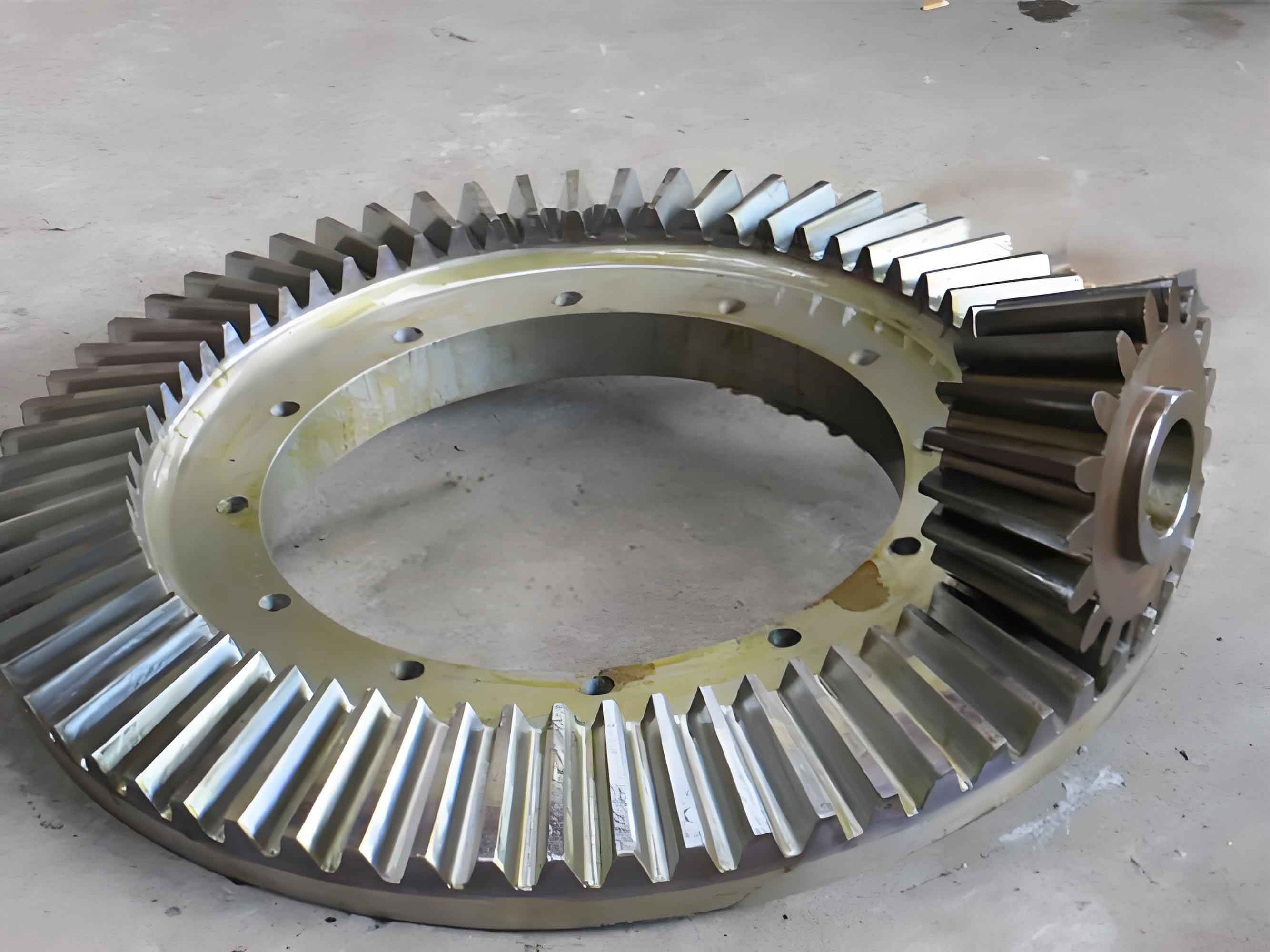
The analysis begins with the development of a thermal-fluid coupling model for spiral bevel gears. The fluid domain is based on a high-speed gear test rig, with geometric parameters detailed in Table 1. The bevel gears have specific tooth numbers, modules, and helix angles, which are essential for accurate simulation. The mesh generation involves tetrahedral elements on tooth surfaces and polyhedral cells in the jet encryption zone to balance computational accuracy and cost. A grid independence study ensures that the results are reliable, with the number of elements set to 332,000 after verification. The multiphase flow is modeled using the Volume of Fluid (VOF) method, with air as the primary phase and aviation oil (4106) as the secondary phase. The RNG $k-\epsilon$ turbulence model is employed to handle high rotational flows, and dynamic meshing techniques simulate gear rotation.
| Parameters | Pinion | Gear |
|---|---|---|
| Number of teeth | 32 | 43 |
| Normal module | 3.25 mm | 3.25 mm |
| Face width | 17 mm | 17 mm |
| Helix angle at reference circle | 35° (right) | 35° (left) |
| Pressure angle at normal section | 20° | |
| Pitch angle | 36.7° | 53.3° |
The physical properties of the 4106 aviation lubricating oil at 140°C are critical for the simulation and are listed in Table 2. The oil’s viscosity, density, thermal conductivity, and specific heat capacity influence the flow behavior and heat transfer. The simulation accounts for various linear velocities ranging from 40 m/s to 160 m/s, corresponding to pinion rotational speeds from 6017.2 rpm to 24068.8 rpm. The oil jet is injected through a 3 mm nozzle at a velocity of 20 m/s, positioned at the pitch circle tangent point between the gears. The outlet is set as a pressure outlet with a 2 bar differential to mimic the oil return system in aircraft gearboxes.
| Parameters | Specifications |
|---|---|
| Viscosity (mm²/s) | 2.6 |
| Density (kg/m³) | 682.79 |
| Thermal conductivity (W/(m·K)) | 0.1331 |
| Specific heat capacity (J/(kg·°C)) | 2280 |
For the flow field analysis, the VOF model tracks the interface between oil and air. The governing equations for multiphase flow include the continuity and momentum equations. The continuity equation for phase $q$ is given by:
$$ \frac{\partial}{\partial t} (\alpha_q \rho_q) + \nabla \cdot (\alpha_q \rho_q \vec{v}_q) = 0 $$
where $\alpha_q$ is the volume fraction of phase $q$, $\rho_q$ is the density, and $\vec{v}_q$ is the velocity. The momentum equation accounts for turbulent effects and is expressed as:
$$ \frac{\partial}{\partial t} (\rho \vec{v}) + \nabla \cdot (\rho \vec{v} \vec{v}) = -\nabla p + \nabla \cdot \left[ \mu \left( \nabla \vec{v} + \nabla \vec{v}^T \right) \right] + \rho \vec{g} + \vec{F} $$
Here, $\rho$ is the mixture density, $\mu$ is the dynamic viscosity, $p$ is pressure, $\vec{g}$ is gravity, and $\vec{F}$ represents external forces. The RNG $k-\epsilon$ model equations for turbulence kinetic energy $k$ and dissipation rate $\epsilon$ are:
$$ \frac{\partial}{\partial t} (\rho k) + \nabla \cdot (\rho k \vec{v}) = \nabla \cdot \left( \alpha_k \mu_{\text{eff}} \nabla k \right) + G_k – \rho \epsilon $$
$$ \frac{\partial}{\partial t} (\rho \epsilon) + \nabla \cdot (\rho \epsilon \vec{v}) = \nabla \cdot \left( \alpha_\epsilon \mu_{\text{eff}} \nabla \epsilon \right) + C_{1\epsilon} \frac{\epsilon}{k} G_k – C_{2\epsilon} \rho \frac{\epsilon^2}{k} $$
where $\mu_{\text{eff}}$ is the effective viscosity, $G_k$ represents the generation of turbulence kinetic energy, and $\alpha_k$, $\alpha_\epsilon$, $C_{1\epsilon}$, $C_{2\epsilon}$ are model constants.
The thermal part of the model involves calculating the temperature field of the bevel gears. Heat sources include frictional losses from gear meshing and windage losses. The frictional heat generation is derived from the average sliding power loss $P_a$, given by:
$$ P_a = \frac{f F_n v_s}{1000} $$
where $f$ is the friction coefficient, $F_n$ is the average normal load, and $v_s$ is the average sliding velocity. The friction coefficient $f$ is modified to account for the oil-air mixture on the tooth surfaces using a comprehensive viscosity $\mu$:
$$ \mu = q \mu_{\text{oil}} + (1 – q) \mu_{\text{air}} $$
Here, $q$ is the oil volume fraction, $\mu_{\text{oil}}$ is the oil viscosity, and $\mu_{\text{air}}$ is the air viscosity. The friction coefficient is then calculated as:
$$ f = 0.0127 \log \left( \frac{29.66 \mu \cos \beta_b}{F_n b / (v_s v_t)} \right) $$
where $\beta_b$ is the base helix angle, $b$ is the face width, and $v_t$ is the average rolling velocity. The heat flux distribution between the pinion and gear is determined by:
$$ \gamma_1 = \beta \cdot \frac{P T_1}{T_{m1}} \quad \text{and} \quad \gamma_2 = (1 – \beta) \cdot \frac{P T_2}{T_{m2}} $$
where $\gamma_1$ and $\gamma_2$ are the heat fluxes for the pinion and gear, respectively, $\beta$ is the heat partition coefficient, $T_1$ and $T_2$ are the times for half engagement, and $T_{m1}$ and $T_{m2}$ are the rotational periods.
Windage losses arise from the interaction between the gears and the surrounding fluid, leading to increased turbulent kinetic energy and temperature. The windage power loss $P_w$ is computed from the torque obtained in the CFD simulation. The total power loss $P_{\text{total}}$ is the sum of frictional and windage losses. The convective heat transfer coefficients extracted from the flow field are applied as boundary conditions in the thermal analysis. The energy equation for the solid gear domains is:
$$ \rho c_p \frac{\partial T}{\partial t} = \nabla \cdot (k \nabla T) + \dot{q} $$
where $\rho$ is density, $c_p$ is specific heat, $k$ is thermal conductivity, $T$ is temperature, and $\dot{q}$ is the heat generation rate per unit volume.
The results from the flow field simulation reveal significant changes in oil distribution with increasing linear velocity. At 40 m/s, the oil jet remains intact, effectively reaching the meshing zone. However, at 160 m/s, the jet breaks up and shifts towards the pinion, resulting in oil starvation in the meshing region. The average oil volume fraction on the tooth surfaces decreases by 83.5% as the velocity increases from 40 m/s to 160 m/s, as shown in Table 3. This reduction impairs lubrication and cooling, increasing the risk of gear failures.
| Linear Velocity (m/s) | Average Oil Volume Fraction | Tooth Surface HTC (W/m²·K) | End Surface HTC (W/m²·K) | Meshing Zone HTC (W/m²·K) |
|---|---|---|---|---|
| 40 | 0.01275 | 450 | 150 | 500 |
| 60 | 0.00980 | 520 | 180 | 580 |
| 80 | 0.00720 | 600 | 220 | 650 |
| 100 | 0.00510 | 680 | 260 | 700 |
| 120 | 0.00350 | 750 | 300 | 720 |
| 140 | 0.00270 | 800 | 340 | 690 |
| 160 | 0.00209 | 850 | 380 | 660 |
The convective heat transfer coefficients (HTC) on tooth and end surfaces increase with velocity due to enhanced air flow. However, in the meshing zone, the HTC peaks at 120 m/s and then declines, indicating deteriorated lubrication conditions. This trend is critical for thermal management in high-speed bevel gears. The windage losses exhibit an exponential growth with velocity, surpassing frictional losses at 80 m/s and accounting for over 80% of total losses at 160 m/s. The power loss components are summarized in Table 4.
| Linear Velocity (m/s) | Frictional Loss (kW) | Windage Loss (kW) | Total Loss (kW) | Efficiency (%) |
|---|---|---|---|---|
| 40 | 1.12 | 0.58 | 1.70 | 99.47 |
| 60 | 1.15 | 1.20 | 2.35 | 99.26 |
| 80 | 1.18 | 2.50 | 3.68 | 99.02 |
| 100 | 1.22 | 4.80 | 6.02 | 98.70 |
| 120 | 1.25 | 8.50 | 9.75 | 98.35 |
| 140 | 1.28 | 14.00 | 15.28 | 97.95 |
| 160 | 1.32 | 22.00 | 23.32 | 98.35 |
The temperature field analysis shows that the maximum temperature on the pinion tooth surface rises from 169.7°C at 40 m/s to 293.7°C at 160 m/s. The temperature difference across the gear body also increases, leading to higher thermal stresses and potential distortions. For instance, the temperature difference on the pinion increases by 60°C, and on the gear by 70°C, at 160 m/s compared to 40 m/s. This exacerbates the risk of scuffing and pitting in bevel gears. The steady-state temperature distributions are influenced by the heat generation from windage and friction, as well as the cooling from convective heat transfer. The results underscore the importance of optimizing oil jet parameters and gear design to mitigate thermal issues in high-speed applications.
In conclusion, this study demonstrates that linear velocity significantly affects the lubrication flow field and temperature distribution in aeronautical bevel gears. As velocity increases, oil jet breakup and shift lead to reduced oil coverage on tooth surfaces, impairing lubrication and heat transfer. Windage losses become the dominant source of power loss at high speeds, contributing to efficiency reduction and temperature rise. The thermal analysis reveals substantial increases in gear temperatures and temperature gradients, which can lead to mechanical failures. These findings provide valuable insights for designing high-speed bevel gear transmissions with improved reliability and power density. Future work should explore methods to enhance oil jet penetration and reduce windage effects, such as optimized nozzle designs and flow guides.
The comprehensive model developed here integrates fluid dynamics and thermal analysis, offering a robust tool for evaluating bevel gear performance under extreme conditions. By considering multiphase flow phenomena and real-world operational parameters, this approach advances the understanding of high-speed gear lubrication and cooling. The repeated emphasis on bevel gears throughout this study highlights their critical role in aerospace transmissions and the need for continued research to address the challenges posed by increasing operational speeds and loads.