
In modern electric vehicles, helical gears are widely adopted due to their high load-carrying capacity, smooth operation, and efficiency. However, meshing impacts during gear engagement can significantly influence the dynamic behavior of the transmission system, leading to vibrations and potential failures. This study focuses on analyzing the dynamic characteristics of a two-stage helical gear transmission system under meshing impact conditions. We derive the meshing impact force equations, establish a 16-degree-of-freedom dynamic model using the lumped mass method, and solve the coupled bending-torsional-axial differential equations using the Runge-Kutta method. By examining the effects of varying input speeds on the gear pairs’ dynamic responses, we aim to provide insights into optimizing helical gear designs for electric vehicle applications.
The importance of helical gears in transmission systems cannot be overstated, as they offer advantages like reduced noise and higher durability compared to spur gears. Despite this, meshing impacts—arising from factors such as manufacturing errors, tooth deformations, and sudden changes in engagement—can induce severe vibrations. Previous research has primarily concentrated on single-stage helical gears or simplified models, leaving a gap in understanding multi-stage systems. Our work addresses this by incorporating meshing impact forces into a comprehensive dynamic model for a two-stage helical gear transmission, commonly used in electric vehicles for torque multiplication and speed reduction.
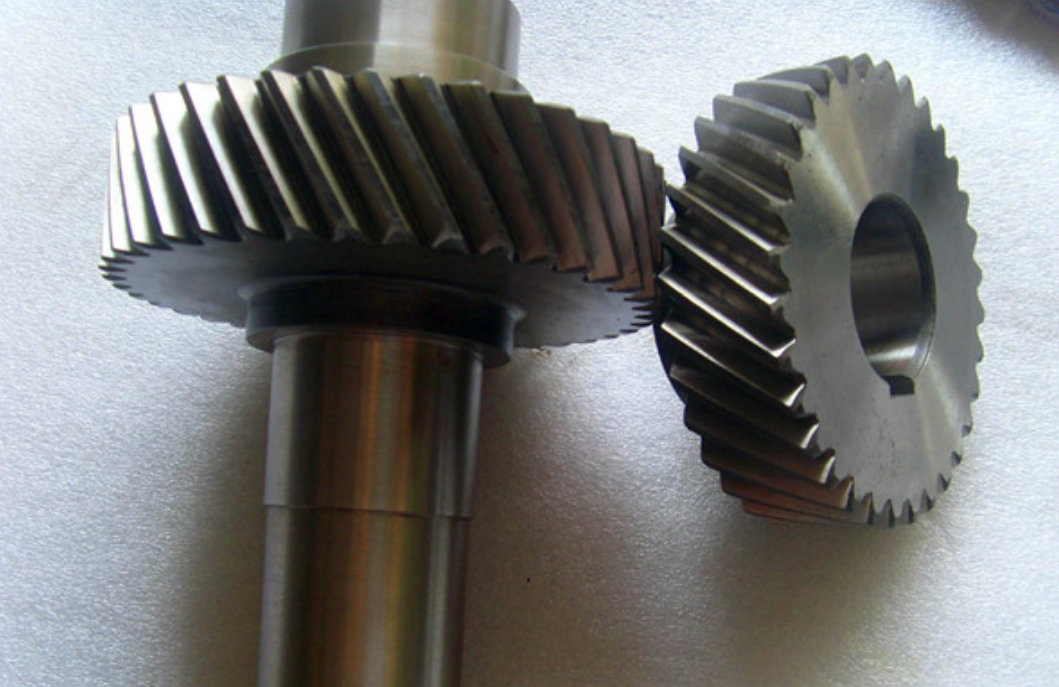
To quantify meshing impacts, we start by calculating the meshing impact force. For helical gears, the impact primarily occurs during meshing-in due to deviations in the tooth profile and elastic deformations. The instantaneous rotational inertia for the driving and driven gears is given by:
$$J_n = \pi \rho b^2 (r_{bn}^4 – r_{hn}^4), \quad n = 1, 2$$
where \(J_n\) represents the rotational inertia, \(\rho\) is the density of the helical gears, \(b\) is the face width, \(r_{bn}\) is the base circle radius, and \(r_{hn}\) is the hub radius. The equivalent mass on the meshing line is derived as:
$$m_n = \frac{J_n}{r_{bn}^2}, \quad n = 1, 2$$
The kinetic energy associated with the meshing impact is expressed as:
$$E_k = \frac{1}{2} \cdot \frac{J_1 J_2}{J_1 r_{b2}^{\prime 2} + J_2 r_{b1}^2} v_s^2$$
Here, \(v_s\) is the velocity at the initial meshing point outside the line of action, and \(r_{b2}^{\prime}\) is the instantaneous base circle radius of the driven gear during off-line meshing. The angle \(\theta\) is calculated using geometric relationships:
$$\theta = \arccos \frac{r_{b2}^{\prime}}{r_{O_2 D}} – \angle P O_2 D – \alpha$$
where \(\alpha\) is the pressure angle. The maximum meshing impact force \(F_s\) is then:
$$F_s = v_s \sqrt{\frac{J_1 J_2}{J_1 r_{b2}^{\prime 2} + J_2 r_{b1}^2} (q_s + \cos^2 \theta \cdot q_q)}$$
In this equation, \(q_s\) denotes the single-tooth-pair compliance at the initial meshing point, and \(q_q\) represents the comprehensive compliance of other tooth pairs during meshing-in. These parameters are critical for accurately capturing the dynamic response of helical gears under impact conditions.
Moving to the dynamic modeling, we consider a two-stage helical gear transmission system with four gears: an input gear (Gear 1), an intermediate gear (Gear 2) connected to another intermediate gear (Gear 3) via an elastic shaft, and an output gear (Gear 4). The system is modeled with 16 degrees of freedom, including translational displacements in the x, y, and z directions and rotational displacements around the gear axes for each gear. The generalized displacement vector is defined as:
$$U = [x_1, y_1, z_1, \phi_1, x_2, y_2, z_2, \phi_2, x_3, y_3, z_3, \phi_3, x_4, y_4, z_4, \phi_4]$$
where \(x_i\), \(y_i\), and \(z_i\) are the translational degrees of freedom, and \(\phi_i\) is the rotational degree of freedom for gear \(i\) (i = 1, 2, 3, 4). The supporting stiffness and damping in each direction are represented by \(K_{xi}\), \(K_{yi}\), \(K_{zi}\) and \(C_{xi}\), \(C_{yi}\), \(C_{zi}\), respectively. The time-varying meshing stiffness and damping for the gear pairs (12 and 34) are denoted as \(K_{12}\), \(K_{34}\) and \(C_{12}\), \(C_{34}\), while the torsional stiffness and damping of the intermediate shaft (23) are \(K_{23}\) and \(C_{23}\).
The relative displacement along the meshing line for each helical gear pair, accounting for vibrations and errors, is given by:
$$\delta_{12} = (\phi_1 r_{b1} – \phi_2 r_{b2}) \cos \beta_{12} – (y_1 – y_2 + \Delta y_1 – \Delta y_2) \sin \zeta_{12} \cos \beta_{12} – (z_1 – z_2 + \Delta z_1 – \Delta z_2) \cos \zeta_{12} \cos \beta_{12} – (x_1 – x_2 + \Delta x_1 – \Delta x_2) \sin \beta_{12}$$
$$\delta_{34} = (\phi_3 r_{b3} – \phi_4 r_{b4}) \cos \beta_{34} + (y_3 – y_4 + \Delta y_3 – \Delta y_4) \sin \zeta_{34} \cos \beta_{34} – (z_3 – z_4 + \Delta z_3 – \Delta z_4) \cos \zeta_{34} \cos \beta_{34} + (x_3 – x_4 + \Delta x_3 – \Delta x_4) \sin \beta_{34}$$
Here, \(\beta_{12}\) and \(\beta_{34}\) are the helix angles, and \(\zeta_{12}\) and \(\zeta_{34}\) are the angles between the meshing line and the z-axis for the respective helical gear pairs. The elastic meshing force \(P_{jk}\) and damping force \(D_{jk}\) for gear pair \(jk\) are:
$$P_{jk} = K_{jk} \delta_{jk}$$
$$D_{jk} = C_{jk} \dot{\delta}_{jk}$$
where \(\dot{\delta}_{jk}\) is the relative velocity along the meshing line. The total dynamic meshing force \(F_{jk}\) is then:
$$F_{jk} = P_{jk} + D_{jk}$$
The equations of motion for the entire system are derived as a set of coupled differential equations. For Gear 1:
$$M_1 \ddot{x}_1 + C_{x1} \dot{x}_1 + K_{x1} x_1 = F_{12} \sin \beta_{12}$$
$$M_1 \ddot{y}_1 + C_{y1} \dot{y}_1 + K_{y1} y_1 = F_{12} \cos \beta_{12} \sin \zeta_{12}$$
$$M_1 \ddot{z}_1 + C_{z1} \dot{z}_1 + K_{z1} z_1 = F_{12} \cos \beta_{12} \cos \zeta_{12}$$
$$I_1 \ddot{\phi}_1 = T_1 – F_{12} \cos \beta_{12} r_{b1} – F_{s12} r_{b1}$$
For Gear 2:
$$M_2 \ddot{x}_2 + C_{x2} \dot{x}_2 + K_{x2} x_2 = -F_{12} \sin \beta_{12}$$
$$M_2 \ddot{y}_2 + C_{y2} \dot{y}_2 + K_{y2} y_2 = -F_{12} \cos \beta_{12} \sin \zeta_{12}$$
$$M_2 \ddot{z}_2 + C_{z2} \dot{z}_2 + K_{z2} z_2 = -F_{12} \cos \beta_{12} \cos \zeta_{12}$$
$$I_2 \ddot{\phi}_2 + C_{23} (\dot{\phi}_2 – \dot{\phi}_3) + K_{23} (\phi_2 – \phi_3) = F_{12} \cos \beta_{12} r_{b2} + F_{s12} r_{b2}$$
For Gear 3:
$$M_3 \ddot{x}_3 + C_{x3} \dot{x}_3 + K_{x3} x_3 = -F_{34} \sin \beta_{34}$$
$$M_3 \ddot{y}_3 + C_{y3} \dot{y}_3 + K_{y3} y_3 = -F_{34} \cos \beta_{34} \sin \zeta_{34}$$
$$M_3 \ddot{z}_3 + C_{z3} \dot{z}_3 + K_{z3} z_3 = F_{34} \cos \beta_{34} \cos \zeta_{34}$$
$$I_3 \ddot{\phi}_3 + C_{23} (\dot{\phi}_3 – \dot{\phi}_2) + K_{23} (\phi_3 – \phi_2) = -F_{34} \cos \beta_{34} r_{b3} + F_{s34} r_{b3}$$
For Gear 4:
$$M_4 \ddot{x}_4 + C_{x4} \dot{x}_4 + K_{x4} x_4 = F_{34} \sin \beta_{34}$$
$$M_4 \ddot{y}_4 + C_{y4} \dot{y}_4 + K_{y4} y_4 = F_{34} \cos \beta_{34} \sin \zeta_{34}$$
$$M_4 \ddot{z}_4 + C_{z4} \dot{z}_4 + K_{z4} z_4 = -F_{34} \cos \beta_{34} \cos \zeta_{34}$$
$$I_4 \ddot{\phi}_4 = F_{34} \cos \beta_{34} r_{b4} + F_{s34} r_{b4} – T_4$$
In these equations, \(M_i\) and \(I_i\) are the mass and moment of inertia of gear \(i\), \(T_1\) is the input torque, \(T_4\) is the output torque, and \(F_{s12}\) and \(F_{s34}\) are the meshing impact forces for the respective helical gear pairs. To solve these equations, we apply the Runge-Kutta method after eliminating rigid body displacements and normalizing the equations to avoid numerical issues. The relative accelerations along the meshing line are computed as:
$$a_{12} = [(\ddot{\phi}_1 r_{b1} – \ddot{\phi}_2 r_{b2}) – (\ddot{y}_1 – \ddot{y}_2) \sin \zeta_{12} – (\ddot{z}_1 – \ddot{z}_2) \cos \zeta_{12}] \cos \beta_{12} – (\ddot{x}_1 – \ddot{x}_2) \sin \beta_{12}$$
$$a_{34} = [(\ddot{\phi}_3 r_{b3} – \ddot{\phi}_4 r_{b4}) – (\ddot{y}_3 – \ddot{y}_4) \sin \zeta_{34} – (\ddot{z}_3 – \ddot{z}_4) \cos \zeta_{34}] \cos \beta_{34} + (\ddot{x}_3 – \ddot{x}_4) \sin \beta_{34}$$
For the case study, we analyze a two-stage helical gear transmission system from an electric vehicle with the parameters listed in Table 1. The input torque is set to 100 N·m, and we investigate the system’s behavior at input speeds of 3000, 6000, and 12000 r/min.
| Parameter | Gear | Handedness | Module m (mm) | Number of Teeth z | Pressure Angle α (°) | Helix Angle β (°) | Addendum h_a (mm) | Dedendum h_f (mm) | Face Width b (mm) | Radial Support Stiffness (y, z) (N/m) | Axial Support Stiffness (x) (N/m) |
|---|---|---|---|---|---|---|---|---|---|---|---|
| Stage 1 | 1 | Left | 4 | 23 | 20 | 20 | 4 | 5 | 33 | 2.0850×10^9 | 2.2159×10^9 |
| 2 | Right | 4 | 80 | 20 | 20 | 4 | 5 | 31.5 | 1.8269×10^9 | 1.9949×10^9 | |
| Stage 2 | 3 | Left | 4 | 22 | 20 | 20 | 4 | 5 | 40 | 1.8569×10^9 | 1.9949×10^9 |
| 4 | Right | 4 | 87 | 20 | 20 | 4 | 5 | 38 | 2.3698×10^9 | 1.4097×10^9 |
Using the derived equations, we compute the meshing impact forces for the helical gear pairs at different speeds, as summarized in Table 2. These forces are essential for understanding the dynamic interactions between the gears.
| Input Speed (r/min) | Gear Pair 12 Meshing Impact Force F_{s12} (N) | Gear Pair 34 Meshing Impact Force F_{s34} (N) |
|---|---|---|
| 3000 | 1245.94 | 89.21 |
| 6000 | 2419.89 | 178.41 |
| 12000 | 4983.77 | 357.21 |
The acceleration along the meshing line for each helical gear pair is analyzed under meshing-in impact conditions. At 3000 r/min, the acceleration peak for Gear Pair 12 is 686.21 m/s², while for Gear Pair 34, it is 223.35 m/s². This indicates that the input-stage helical gears experience higher dynamic effects due to their direct connection to the high-speed input shaft. As the speed increases to 6000 r/min, the acceleration peaks rise to 1135.75 m/s² for Gear Pair 12 and 500.58 m/s² for Gear Pair 34. At 12000 r/min, these values further increase to 2291.61 m/s² and 1131.77 m/s², respectively. The escalation in acceleration with speed underscores the heightened instability in the system, particularly for the input-stage helical gears.
Notably, the influence of Gear Pair 12 on Gear Pair 34 is more pronounced than vice versa. For instance, at the same speed, the acceleration due to meshing impact from Gear Pair 12 on Gear Pair 34 is significantly higher, highlighting the cascading effect in multi-stage helical gear systems. The frequency of this mutual influence corresponds to the meshing frequency of each helical gear pair, emphasizing the importance of considering inter-stage interactions in design. The results demonstrate that meshing impacts in helical gears are critical drivers of dynamic behavior, and their effects amplify with rotational speed, necessitating careful optimization in electric vehicle transmissions.
In conclusion, this study provides a detailed analysis of the dynamic characteristics of a two-stage helical gear transmission under meshing impact. The derived models and equations offer a foundation for improving the design and performance of helical gears in electric vehicles, ensuring smoother operation and enhanced reliability. Future work could explore the effects of different helix angles or material properties on meshing impacts to further refine helical gear applications.