
Helical gears are widely used in transmission systems across various industries, such as petrochemical machinery, due to their advantages in smooth operation and high load-bearing capacity. However, these gears often operate under complex conditions involving alternating loads, strong nonlinear interactions, and fluctuating temperatures, making them susceptible to failures like cracks. The localized reduction in stiffness caused by cracks can induce impact effects, compromising the lifespan of equipment and other components, and posing significant risks to production safety. Therefore, analyzing the dynamic characteristics and evolution patterns of faults in helical gear transmission systems is crucial for effective fault feature extraction, identification, and ensuring operational safety.
Existing research has focused on various aspects of gear fault diagnosis and optimization. For instance, studies have analyzed manufacturing processes to reduce faults in helical gears used in equipment like pumping units, while others have developed fusion models combining Long Short-Term Memory (LSTM) and Random Forest (RF) algorithms to enhance diagnostic accuracy and efficiency, achieving rates as high as 98.33%. Additionally, optimizations in helical gear transmission systems have led to improved energy-saving mechanisms in machinery. Despite these advances, accurately capturing fault features and enabling efficient diagnosis remains essential. Current methodologies primarily employ phenomenological models and dynamic models to investigate fault mechanisms. Phenomenological models simplify the analysis of interaction forces between gear pairs or components, offering clear modulation components and carrier frequencies. For example, such models have been used to analyze modulation mechanisms and response behaviors in planetary gears, as well as to study crack fault mechanisms and secondary modulation phenomena caused by transmission paths. In contrast, dynamic models emphasize the calculation of time-varying meshing stiffness (TVMS) as a key excitation source, where precise computation is vital for realistic simulations. Techniques like the finite element method and potential energy method have been applied to calculate TVMS for helical gears, incorporating it into dynamic simulations to explore system-level responses. The selection of sensitive failure features is a critical step in fault diagnosis, underscoring the importance of studying their sensitivity and quantitative screening. Thus, this article adopts a dynamics-based approach, utilizing the potential energy method and micro-element analysis to establish a dynamic model of helical gear systems with crack faults via Lagrange equations, aiming to investigate system responses and sensitive features.
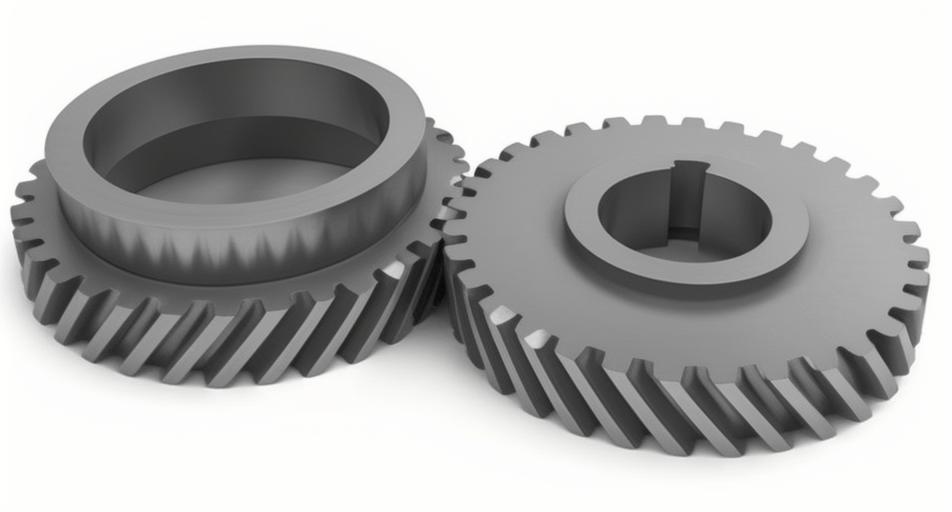
The calculation of time-varying meshing stiffness for helical gears with root crack faults is complex due to the presence of a helix angle, which necessitates discretization along the helix for summation. In this study, the potential energy method and micro-element method are employed to derive an analytical model for TVMS in helical gears with root cracks. The gear pair considered includes a large gear with 100 teeth and a small gear with 13 teeth. The emergence of root cracks and changes in geometric parameters primarily affect the cross-sectional moment \(A_x\) and moment of inertia \(I_x\), which in turn alter the load-bearing capacity of the cantilever structure in the tooth micro-element model, impacting bending stiffness \(k_b\) and axial compression stiffness \(k_a\). However, since root cracks do not significantly alter the gear profile initially, the Hertzian contact stiffness \(k_h\) remains unchanged. For a helical gear with a root crack, the structural variations in \(A_x\) and \(I_x\) are expressed as:
$$ A_{xc} = \begin{cases}
(h + h_x) B, & h_x \leq h_c \\
(h + h_c) B, & h_x > h_c
\end{cases} $$
$$ I_{xc} = \begin{cases}
\frac{1}{12} (h + h_x)^3 B, & h_x \leq h_c \\
\frac{1}{12} (h + h_c)^3 B, & h_x > h_c
\end{cases} $$
Here, \(h_c\) represents the crack length, \(h_x\) is the distance from the crack tip to the centerline in the micro-element structure, \(h\) is the distance from the top of the micro-element to the profile, and \(B\) is the gear width. Depending on the crack type, the crack length \(q(x)\) is computed differently; for non-penetrating cracks, it is given by:
$$ q(x) = \begin{cases}
q_s \sqrt{\frac{w_c – x}{w_c}}, & w_c > x \\
0, & w_c \leq x
\end{cases} $$
where \(q_s\) is the initial crack depth, \(w_c\) is the effective crack width, and \(x\) is the position parameter from the root to the top. The resulting changes in TVMS due to the crack are:
$$ k_b = \sum_{i=1}^{N} \Delta y \int_{\alpha_y}^{\alpha_2} \frac{ \left\{ 1 + (\alpha_2 – \alpha_y’) \sin \alpha – \cos \alpha \cos \alpha_y \right\}^2 (\alpha_2 – \alpha) \cos \alpha }{ 2E \left[ \sin \alpha_2 – \frac{q(y)}{R_b} \sin \alpha_c + \sin \alpha + \cos \alpha (\alpha_2 – \alpha) \right]^3 } \, d\alpha $$
$$ k_s = \sum_{i=1}^{N} \Delta y \int_{\alpha_y}^{\alpha_2} \frac{ \cos \alpha (\alpha_2 – \alpha) \cos \alpha \cos^2 \alpha_y’ }{ 1.2(1 + \nu) E \left[ \sin \alpha_2 – \frac{q(y)}{R_b} \sin \alpha_c + \sin \alpha + \cos \alpha (\alpha_2 – \alpha) \right] } \, d\alpha $$
In these equations, \(k_b\) and \(k_s\) denote bending and shear stiffness, respectively, \(\alpha\) is the angle between the centerline and radius, \(R_b\) is the base circle radius, and other physical parameters are detailed in relevant literature. The comprehensive TVMS is then:
$$ k_t = \sum_{i=1}^{N} \frac{1}{ \frac{1}{k_{f1,i}} + \frac{1}{k_{b1,i}} + \frac{1}{k_{s1,i}} + \frac{1}{k_{a1,i}} + \frac{1}{k_{f2,i}} + \frac{1}{k_{b2,i}} + \frac{1}{k_{s2,i}} + \frac{1}{k_{a2,i}} + \frac{1}{k_h} } $$
A comparison of TVMS curves for healthy and cracked helical gears reveals significant differences, as illustrated in the derived models.
To establish the dynamic model of the helical gear transmission system, considerations include the axial vibrations induced by the helix angle. The model incorporates three translational and one rotational degree of freedom, with generalized displacements \(q = \{x_p, y_p, z_p, \theta_p, x_g, y_g, z_g, \theta_g\}\) and generalized velocities \(\dot{q} = \{\dot{x}_p, \dot{y}_p, \dot{z}_p, \dot{\theta}_p, \dot{x}_g, \dot{y}_g, \dot{z}_g, \dot{\theta}_g\}\), where subscripts \(p\) and \(g\) denote the driving and driven gears, respectively. Using the principle of least action, the Lagrange function is formulated as:
$$ L = K.E. – P = \frac{1}{2} \tilde{q} M \dot{q} – \frac{1}{2} \tilde{q} K q $$
Here, \(K.E.\) and \(P\) represent kinetic and potential energy, \(M\) is the mass matrix, and \(K\) is the stiffness matrix. To account for dissipative effects such as lubrication, the Rayleigh dissipation function \(D\) is introduced:
$$ D = \frac{1}{2} \tilde{q} C \dot{q} $$
where \(C\) is the damping coefficient. The Lagrange equation with dissipation is then:
$$ \frac{d}{dt} \left( \frac{\partial L}{\partial \dot{q}} \right) – \frac{\partial L}{\partial q} + \frac{\partial D}{\partial q} = Q $$
with \(Q\) being the generalized external force, defined as \(Q = \{F_m, F_f, T_p, T_g\}\), where \(F_m\) is the meshing force, \(F_f\) is the friction force, and \(T_p\) and \(T_g\) are the driving and load torques. The dynamic transmission error (DTE) and its first derivative are expressed as:
$$ \text{DTE} = \frac{\text{DTE}_t}{\cos \beta_b} $$
$$ \text{DTE\_1st} = \frac{\text{DTE}_{t\_1st}}{\cos \beta_b} $$
where:
$$ \text{DTE}_t = R_{b,p} \beta_p – R_{b,g} \beta_g + (x_p – x_g) \cos \alpha + (y_p – y_g) \sin \alpha – e(t) $$
$$ \dot{\text{DTE}}_t = R_{b,p} \dot{\beta}_p – R_{b,g} \dot{\beta}_g + (\dot{x}_p – \dot{x}_g) \cos \alpha + (\dot{y}_p – \dot{y}_g) \sin \alpha – \dot{e}(t) $$
and \(e(t)\) is the static transmission error. The meshing force \(F_m\) and friction force \(F_f\) are given by:
$$ F_m = k_m \times \text{DTE} + c_m \times \text{DTE\_1st} $$
$$ F_f = -\mu F_m $$
with \(\mu\) as the friction coefficient, \(k_m\) as the comprehensive meshing stiffness, and \(c_m\) as the meshing damping coefficient, calculated by \(c_m = 2\xi \sqrt{\bar{k}_m m}\), where \(m = \frac{m_p m_g}{m_p + m_g}\) is the equivalent mass and \(\xi\) is the damping ratio. The components of \(F_m\) along the x, y, and z axes are:
$$ F_{mx} = F_m \cos \beta_b \cos \alpha $$
$$ F_{my} = F_m \cos \beta_b \sin \alpha $$
$$ F_{mz} = F_m \sin \beta_b $$
The system of differential equations of motion is derived as:
$$ m_p \ddot{x}_p + c_{bx} \dot{x}_p + k_{bx} x_p = -F_{mx} – F_f $$
$$ m_p \ddot{y}_p + c_{by} \dot{y}_p + k_{by} y_p = -F_{my} $$
$$ m_p \ddot{z}_p + c_{bz} \dot{z}_p + k_{bz} z_p = -F_{mz} $$
$$ I_p \ddot{\beta}_p = F_{my} R_{b,p} – T_p $$
$$ m_g \ddot{x}_g + c_{bx} \dot{x}_g + k_{bx} x_g = F_{mx} + F_f $$
$$ m_g \ddot{y}_g + c_{by} \dot{y}_g + k_{by} y_g = F_{my} $$
$$ m_g \ddot{z}_g + c_{bz} \dot{z}_g + k_{bz} z_g = F_{mz} $$
$$ I_g \ddot{\beta}_g = -F_{my} R_{b,g} + T_g $$
In these equations, \(c\) and \(k\) terms represent bearing damping and stiffness, respectively.
The dynamic characteristics of helical gear systems with crack faults are analyzed by examining the influence of geometric parameters, particularly crack depth. Under a rotational speed of 2920 rpm and a crack angle of 45 radians, the responses for different crack depths are evaluated. Time-domain analyses of the driving gear’s vertical acceleration reveal amplitude modulation effects; for instance, at a crack depth of 5 mm, an impact period \(T_{cp}\) of 0.0016 s is observed, which becomes more pronounced at 7 mm depth. The kurtosis values of vertical acceleration increase from 3.9498 at 5 mm to 4.0667 at 7 mm, indicating enhanced non-Gaussian behavior and reduced waveform asymmetry with deeper cracks. Frequency-domain analyses show modulation components and carrier frequencies, with the meshing frequency \(f_m\) at 631.89 Hz acting as the carrier. Sidebands around this frequency, particularly in the 1700–2500 Hz resonance band, exhibit clear fault modulation frequencies, facilitating techniques like resonance demodulation for feature extraction.
To construct a feature space for fault diagnosis, 33 statistical indicators are employed to characterize the vibration signals of helical gear systems. These indicators help in visualizing the evolution of faults under varying severity levels, such as crack depths of 1 mm, 3 mm, 5 mm, and 7 mm. The statistical representations in the horizontal and vertical directions demonstrate different sensitivities; for example, in the vertical direction, features like Feature 20 show the highest rate of change, while others exhibit increasing or decreasing trends. A quantitative assessment using the ReliefF algorithm, which assigns weights to indicate feature importance, reveals that time-domain representations in both horizontal and vertical directions are highly sensitive to crack faults. This analysis provides a basis for selecting optimal features in complex operating environments.
| Indicator Number | Description | Sensitivity to Crack Depth |
|---|---|---|
| 1 | Mean | Moderate |
| 2 | Root Mean Square | High |
| 3 | Variance | High |
| 4 | Skewness | Low |
| 5 | Kurtosis | High |
| 6 | Peak Value | High |
| 7 | Crest Factor | Moderate |
| 8 | Impulse Factor | Moderate |
| 9 | Shape Factor | Low |
| 10 | Clearance Factor | Moderate |
| 11 | Energy | High |
| 12 | Entropy | Moderate |
| 13 | Standard Deviation | High |
| 14 | Median | Low |
| 15 | Range | High |
| 16 | Minimum | Moderate |
| 17 | Maximum | High |
| 18 | Sum | Moderate |
| 19 | Product | Low |
| 20 | Logarithmic Energy | Very High |
| 21 | Zero-Crossing Rate | Low |
| 22 | Autocorrelation Peak | Moderate |
| 23 | Harmonic Mean | Low |
| 24 | Geometric Mean | Low |
| 25 | Quadratic Mean | High |
| 26 | Trimmed Mean | Moderate |
| 27 | Winsorized Mean | Moderate |
| 28 | Interquartile Range | Moderate |
| 29 | Mean Absolute Deviation | High |
| 30 | Median Absolute Deviation | Moderate |
| 31 | Coefficient of Variation | High |
| 32 | Signal-to-Noise Ratio | Moderate |
| 33 | Dynamic Range | High |
The evolution of statistical representations with crack depth is further illustrated through feature mapping, which reduces dimensionality while enhancing fault characteristics. For vertical acceleration, most indicators show increasing trends, with Feature 20 exhibiting the largest change rate. In contrast, horizontal acceleration indicators display varied sensitivities, such as Feature 21 decreasing while others increase. The ReliefF algorithm quantifies these differences, highlighting that time-domain features in both directions are critical for crack detection in helical gears.
In summary, this study utilizes the potential energy method and micro-element analysis to compute the time-varying meshing stiffness of helical gears with crack faults. By applying the principle of least action and Lagrange equations, a dynamic model with dissipation terms is derived. Analyses in time, frequency, and statistical domains reveal that crack and spalling faults induce noticeable modulation effects in acceleration responses, with clear fault modulation frequencies near resonance bands. Statistical representations of vibration signals exhibit direction-dependent sensitivities, with time-domain features in horizontal and vertical directions being particularly sensitive, as quantified by the ReliefF algorithm. These findings provide theoretical support for fault diagnosis in helical gear transmission systems, enabling better monitoring and identification of anomalies in complex operational conditions.
The implications of this research extend to practical applications in industries reliant on helical gears, such as petrochemical and mechanical engineering. Future work could explore additional fault types, such as pitting or wear, and incorporate real-world data validation to enhance model accuracy. Moreover, integrating machine learning techniques with the derived statistical features could lead to more robust diagnostic systems. Overall, the dynamic analysis of helical gears under crack faults underscores the importance of comprehensive modeling and feature selection for maintaining system integrity and safety.