
In mechanical transmission systems, straight bevel gears play a critical role in transferring motion and power between intersecting shafts. However, excessive friction power losses during meshing can lead to reduced efficiency, thermal deformation, and even gear failure, especially under inadequate lubrication. Accurately predicting the meshing efficiency of straight bevel gears is essential for optimizing design and improving system reliability. This study focuses on developing a theoretical model to analyze the transient meshing efficiency of straight bevel gears by considering complex lubrication states, including boundary, elastohydrodynamic (EHL), and mixed lubrication. The approach involves simplifying the straight bevel gear into an equivalent spur gear based on the principle of equivalent gear theory, enabling a more straightforward analysis of friction losses.
The equivalent gear transformation allows for the treatment of straight bevel gears as virtual spur gears, facilitating the calculation of key parameters such as relative sliding velocity, normal load, and friction coefficient. These parameters vary with the meshing position, influencing the lubrication state and overall efficiency. By determining the film thickness ratio, the lubrication regime is classified, and corresponding friction factor models are established. The total power loss, comprising sliding and rolling friction losses, is computed using double integration over a meshing cycle, with variables including pressure angle and pitch radius. This comprehensive model accounts for the time-varying effects of operational conditions, providing a robust framework for efficiency prediction.
To validate the model, simulations are conducted using MATLAB, analyzing parameters like sliding velocity, load distribution, oil film thickness, and friction factors under different lubrication states. The results demonstrate the model’s accuracy in estimating power losses and efficiency, highlighting its practical relevance for gear design and thermal management. This research not only advances the understanding of straight bevel gear dynamics but also offers insights into optimizing lubrication systems to minimize energy losses.
Theoretical Framework for Straight Bevel Gear Analysis
The analysis begins with the transformation of straight bevel gears into equivalent spur gears using the back-cone method. This simplification reduces the complexity of gear geometry, allowing the application of standard gear theory to straight bevel gears. The equivalent spur gear has a pitch radius derived from the bevel gear’s back-cone distance, enabling the calculation of meshing characteristics such as contact points and load distribution. The key parameters include the equivalent base circle radius, pitch radius, and pressure angle, which are essential for determining the kinematics and dynamics of meshing.
The meshing process of straight bevel gears involves multiple tooth pairs engaging simultaneously due to the contact ratio being greater than one. The meshing line is divided into single and double tooth contact regions, affecting the load distribution and friction losses. The pressure angle at various points along the meshing line, such as the start and end of engagement, is calculated to define the instantaneous contact conditions. For instance, the pressure angle at the beginning of engagement (\(\alpha_{B1}\)) and at the end (\(\alpha_{B2}\)) can be expressed as functions of the base circle radii and gear geometry.
The relative motion between gear teeth generates sliding and rolling velocities, which are critical for friction analysis. The sliding velocity (\(V_S\)) and rolling velocity (\(V_R\)) at any contact point depend on the angular velocities and curvature radii of the mating gears. These velocities vary along the meshing path, influencing the lubrication regime and friction coefficients. The equations for sliding and rolling velocities are derived based on the equivalent gear parameters, incorporating the gear ratio and pressure angle.
The load distribution model considers both the axial and circumferential directions. The normal load per unit length (\(w(r)\)) is assumed to vary linearly from the gear’s large end to the small end, accounting for elastic deformation. This distribution is integrated over the contact line to obtain the total normal force. The load sharing between single and double tooth contact regions is modeled using stiffness coefficients, ensuring accurate representation of real-world conditions.
Lubrication state determination is based on the film thickness ratio (\(\lambda\)), calculated as the ratio of average oil film thickness to composite surface roughness. The minimum oil film thickness (\(h_{\min}\)) is computed using the Dowson-Higginson formula, which considers parameters like lubricant viscosity, pressure-viscosity coefficient, and equivalent radius. Depending on \(\lambda\), the lubrication regime is classified as boundary lubrication (\(\lambda \leq 0.9\)), EHL (\(\lambda \geq 3\)), or mixed lubrication (\(0.9 < \lambda < 3\)). Each regime has a distinct friction factor model, affecting the overall friction losses.
The friction power losses comprise sliding and rolling components. Sliding friction power (\(P_S\)) is proportional to the friction factor, normal load, and sliding velocity, while rolling friction power (\(P_R\)) depends on the oil film thickness and rolling velocity. The total power loss (\(P_t\)) is the sum of these components, and the meshing efficiency (\(\eta\)) is derived as the ratio of output power to input power, adjusted for losses. The models for friction factors in different lubrication regimes are based on empirical relationships, ensuring practical applicability.
Mathematical Modeling of Straight Bevel Gear Dynamics
The equivalent radius of curvature (\(R_v\)) for straight bevel gears is derived from the equivalent spur gear geometry. It is a function of the pressure angle (\(\phi\)) and pitch radius (\(r\)), expressed as:
$$R_v = r_{vb1} \tan \phi – \frac{r_{vb1} \tan^2 \phi}{(1 + i) \tan \alpha’}$$
where \(r_{vb1}\) is the base circle radius of the equivalent gear, \(i\) is the gear ratio, and \(\alpha’\) is the operating pressure angle. This curvature radius influences the oil film thickness and contact stress.
The sliding velocity (\(V_S\)) and rolling velocity (\(V_R\)) are given by:
$$V_S(\phi, r) = \frac{\pi \cos \alpha’}{30 \cos \delta_1} n_1 r \left[ \left(1 + \frac{1}{i}\right) \tan \phi – \left(1 + \frac{1}{i}\right) \tan \alpha’ \right] \times 10^{-3}$$
$$V_R(\phi, r) = \frac{\pi \cos \alpha’}{30 \cos \delta_1} n_1 r \left[ \left(1 – \frac{1}{i}\right) \tan \phi + \left(1 + \frac{1}{i}\right) \tan \alpha’ \right] \times 10^{-3}$$
Here, \(n_1\) is the rotational speed of the driving gear, and \(\delta_1\) is the pitch cone angle. These equations highlight the dependence of velocities on gear geometry and operating conditions.
The load distribution model assumes a linear variation along the tooth width. The normal load per unit length (\(w(r)\)) is:
$$w(r) = \frac{3T \sin \delta_1}{(r_1^3 – r_1’^3) \cos \alpha’} r$$
where \(T\) is the input torque, \(r_1\) and \(r_1’\) are the large and small end pitch radii, respectively. This model simplifies the complex load distribution while maintaining accuracy.
The minimum oil film thickness (\(h_{\min}\)) is calculated using the Dowson-Higginson formula:
$$h_{\min}(\phi, r) = \frac{2.65 \alpha^{0.54} (\eta_0 U)^{0.7} R(\phi, r)^{0.43}}{E’^{0.03} w(\phi, r)^{0.13}}$$
where \(\alpha\) is the pressure-viscosity coefficient, \(\eta_0\) is the dynamic viscosity, \(U\) is the entraining velocity, \(R(\phi, r)\) is the equivalent radius, and \(E’\) is the combined elastic modulus. The entraining velocity \(U\) is:
$$U = \frac{\pi}{60} n_1 r_{vb1} \left[ \left(1 + \frac{1}{i}\right) \tan \alpha’ + \left(1 – \frac{1}{i}\right) \tan \phi \right]$$
The film thickness ratio (\(\lambda\)) is then:
$$\lambda = \frac{h_{\text{av}}}{\sqrt{\sigma_1^2 + \sigma_2^2}}$$
where \(h_{\text{av}} = \frac{4}{3} h_{\min}\) is the average film thickness, and \(\sigma_1\), \(\sigma_2\) are the surface roughness values.
Friction factors for different lubrication regimes are defined as follows. For boundary lubrication, the friction factor \(f_b = 0.15\). For EHL, the friction factor \(f_e\) is:
$$f_e(\phi, r) = 0.0127 \left( \frac{50}{50 – 39.37\delta} \right) \lg \left( \frac{29.66 w(\phi, r)}{\rho V_S(\phi, r) V_R^2(\phi, r)} \right)$$
where \(\delta\) is the surface roughness and \(\rho\) is the lubricant density. For mixed lubrication, the friction factor \(f_m\) is a combination of \(f_e\) and \(f_b\):
$$f_m = f_\lambda^{1.2} f_e + (1 – f_\lambda) f_b$$
with \(f_\lambda\) being the load-sharing ratio:
$$f_\lambda = \frac{1.21 \lambda^{0.64}}{1 + 0.37 \lambda^{1.26}}$$
The sliding friction power (\(P_S\)) and rolling friction power (\(P_R\)) are:
$$P_S(\phi, r) = f(\phi, r) F_n(\phi, r) V_S(\phi, r) \times 10^{-3}$$
$$P_R(\phi, r) = 90 h(\phi, r) V_R(\phi, r) b \times 10^{-3}$$
where \(F_n(\phi, r)\) is the normal force, and \(b\) is the face width. The total power loss \(P_t\) is the sum of \(P_S\) and \(P_R\) over the meshing cycle, and efficiency \(\eta\) is:
$$\eta = \frac{P – P_t}{P}$$
where \(P\) is the input power.
Simulation Parameters and Results for Straight Bevel Gears
To illustrate the application of the model, simulations are performed using parameters typical of straight bevel gears. The gear parameters include number of teeth, module, pressure angle, and material properties. Lubricant properties such as viscosity and pressure-viscosity coefficient are also defined. The input conditions include torque and rotational speed.
| Parameter | Driving Gear | Driven Gear |
|---|---|---|
| Number of Teeth | 24 | 48 |
| Module (mm) | 5 | 5 |
| Pressure Angle (°) | 25 | 25 |
| Pitch Circle Diameter (mm) | 121 | 242 |
| Base Circle Diameter (mm) | 110 | 220 |
| Face Width (mm) | 100 | 100 |
| Input Torque (N·m) | 200 | – |
| Rotational Speed (r/min) | 3000 | – |
| Surface Roughness (μm) | 0.4 | 0.4 |
| Combined Elastic Modulus (N/m²) | 2.3 × 10¹¹ | 2.3 × 10¹¹ |
| Lubricant Viscosity (Pa·s) | 0.075 | 0.075 |
| Pressure-Viscosity Coefficient (m²/N) | 2.2 × 10⁻⁸ | 2.2 × 10⁻⁸ |
Based on these parameters, derived values such as theoretical center distance, normal pitch, and pressure angles at key meshing points are computed. These values are essential for the subsequent analysis of velocities, loads, and lubrication states.
| Parameter | Value |
|---|---|
| Theoretical Center Distance (mm) | 90.85 |
| Normal Pitch (mm) | 11.2466 |
| Operating Pressure Angle (°) | 0.4363 |
| Pressure Angle at Start of Engagement (°) | 0.2723 |
| Pressure Angle at End of Single Tooth Contact (°) | 0.3829 |
| Pressure Angle at Start of Single Tooth Contact (°) | 0.4743 |
| Pressure Angle at End of Engagement (°) | 0.5671 |
The simulation results provide insights into the behavior of straight bevel gears under various conditions. The relative sliding and rolling velocities are analyzed across the tooth profile, showing that sliding velocity is minimal near the pitch point and increases towards the tooth tips and roots. Rolling velocity, however, remains relatively constant along the profile but varies with the pitch radius. These velocity distributions directly impact the lubrication regime and friction losses.
Load distribution analysis reveals that the normal load decreases from the large end to the small end of the tooth, following a near-parabolic trend due to elastic deformation. This distribution affects the oil film thickness, which is thicker at the large end and thinner at the small end. The film thickness ratio λ ranges from 0.9124 to 4.8565, indicating the presence of both mixed and EHL regimes. Specifically, EHL dominates at the large end, especially during tooth exit, while mixed lubrication occurs towards the small end.
Friction factors vary significantly with the lubrication state. In EHL regions, friction factors are lower due to full film lubrication, whereas in mixed lubrication, they increase due to asperity contact. The sliding friction power loss is highest at the tooth tips and roots, where sliding velocity is maximal, and negligible at the pitch point. Rolling friction power loss, though smaller in magnitude, is influenced by oil film thickness and is prominent at the large end.
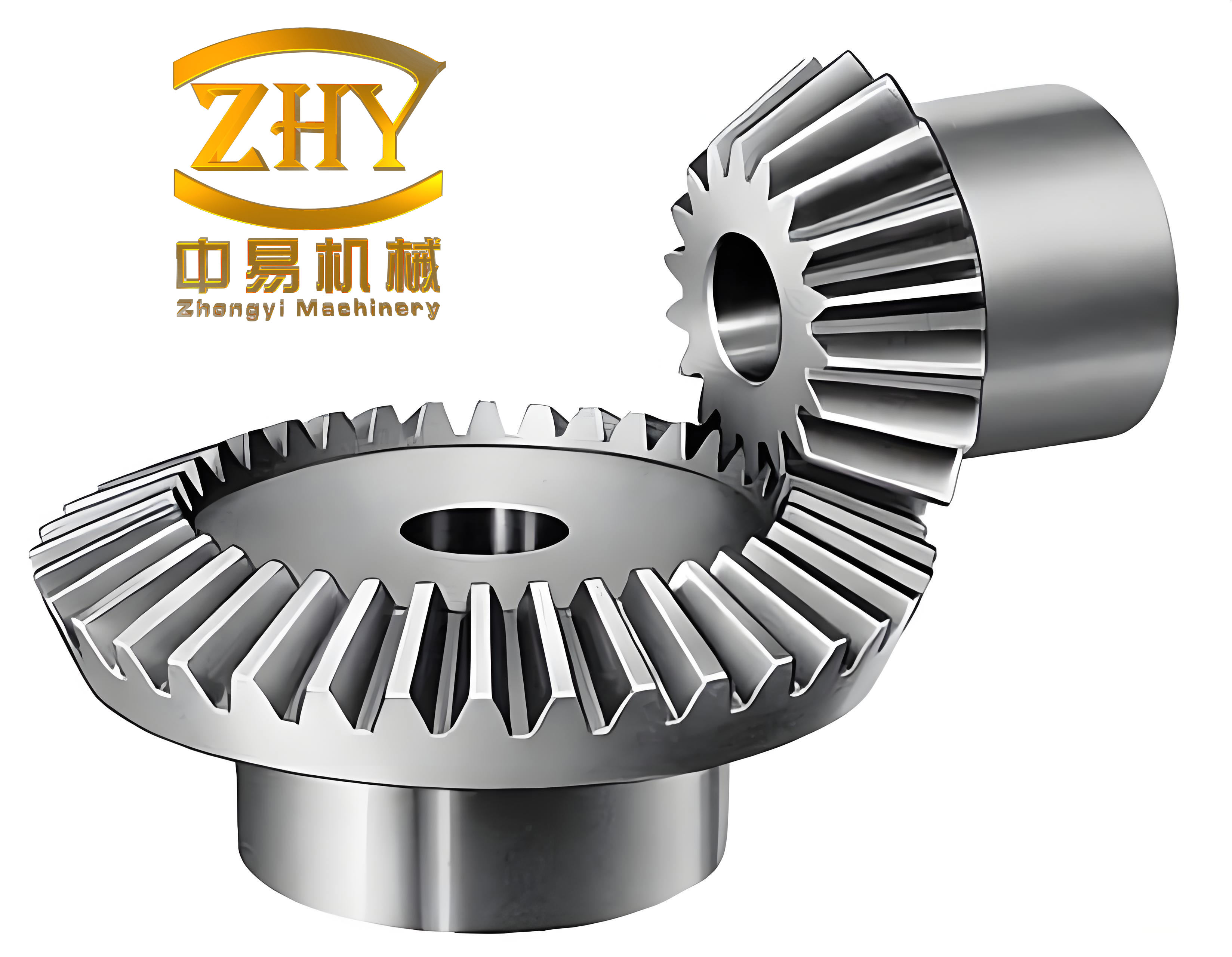
Total power loss and efficiency calculations show that the model predicts efficiency values between 90.36% and 91.52% for theoretical conditions, while experimental measurements range from 89.47% to 90.78%. The discrepancy is attributed to unaccounted factors like noise and vibration. The model’s accuracy is confirmed by the close agreement with experimental data, validating its use for straight bevel gear design.
Discussion on Straight Bevel Gear Efficiency and Lubrication Effects
The analysis of straight bevel gears highlights the critical role of lubrication in determining meshing efficiency. The transition between lubrication regimes—boundary, mixed, and EHL—significantly affects friction factors and power losses. For instance, in boundary lubrication, the constant friction factor of 0.15 leads to higher losses, whereas in EHL, the friction factor depends on operational parameters, resulting in lower losses. Mixed lubrication represents an intermediate state where both fluid film and asperity contacts contribute to friction.
The load distribution model, though simplified, effectively captures the essential features of straight bevel gear behavior. The linear assumption for load variation along the tooth width provides a reasonable approximation, as evidenced by the comparison with finite element analysis results. However, actual load distribution may exhibit nonlinearities due to edge effects and manufacturing inaccuracies. Future work could incorporate more detailed contact analysis to refine the model.
The friction power loss models for sliding and rolling are comprehensive, accounting for the time-varying nature of meshing. The use of double integration over the meshing cycle ensures that all contact points are considered, providing an accurate estimate of total losses. The rolling friction power, though often neglected in simpler models, contributes notably to overall losses, especially in high-speed applications.
Practical implications of this research include the ability to optimize straight bevel gear designs for minimal power loss and improved efficiency. By adjusting parameters such as tooth geometry, surface finish, and lubricant properties, designers can achieve better performance. Additionally, the model aids in thermal analysis by predicting heat generation due to friction, which is crucial for preventing thermal failure.
In conclusion, the developed model offers a robust method for analyzing straight bevel gear efficiency under complex lubrication conditions. It bridges the gap between theoretical calculations and practical applications, providing valuable insights for engineers. The integration of equivalent gear theory, lubrication state determination, and friction modeling ensures a holistic approach to efficiency prediction, making it a valuable tool in gear design and optimization.