
In this study, I investigate the loaded contact analysis of straight bevel gears using real tooth surface data to improve meshing performance in aerospace applications. Straight bevel gears are critical components in aircraft engines, known for their smooth transmission and high load capacity. However, their meshing behavior is complex, influenced by factors such as manufacturing parameters, assembly errors, and deformation under load. The contact pattern, defined by its shape, position, and size, is a key indicator of meshing performance. Traditional methods often rely on post-assembly testing, which can lead to costly rework if contact patterns deviate from specifications. My approach involves reconstructing the real tooth surface from measurement data, performing finite element analysis under load, and validating results against experimental tests. This method aims to predict contact patterns accurately before assembly, reducing the need for disassembly and reprocessing.
The foundation of this analysis lies in modeling the real tooth surface of the straight bevel gear. I start by acquiring discrete point data from a coordinate measuring machine (CMM). The coordinate system for measurement is defined with the origin at the pitch cone apex, the Z-axis aligned with the gear axis from the large end to the small end, and the X-axis radially outward toward the tooth surface. For contact analysis, I transform this to a system where the X-axis aligns with the gear axis from the small to large end, and the Z-axis points radially toward the tooth surface. The transformation is represented by the matrix equation:
$$ \mathbf{r} = \begin{bmatrix} 0 & 0 & -1 & 0 \\ 0 & -1 & 0 & 0 \\ -1 & 0 & 0 & 0 \\ 0 & 0 & 0 & 1 \end{bmatrix} \mathbf{r}_{\text{source}} $$
where $\mathbf{r}_{\text{source}}$ is the position vector in the measurement coordinate system, and $\mathbf{r}$ is the transformed vector for analysis. This ensures consistency in geometric representation during subsequent steps.
Next, I focus on reverse engineering the gear tooth surfaces. For the gear (larger wheel), I begin by selecting an initial cutter diameter and evaluating the fit along the tooth length using grid points. The optimization involves three variables: root angle, pressure angle, and cutter radius. I perform continuous optimization for the concave surface, followed by optimization of the convex surface using pressure angle and cutter radius. The objective is to minimize the normal error between the reconstructed surface and measured data, with a maximum allowable error of 0.005 mm. The mathematical formulation for the gear surface reconstruction is based on least squares approximation, ensuring the surface extends to nominal boundaries. Similarly, for the pinion (smaller wheel), I apply a local synthesis method to optimize the tooth surface, aligning it with the real data while considering meshing performance. The optimization model is defined as:
$$ \min F_{\text{min}}(\phi_2, r_1, r_2) = 0 $$
subject to $r_1 \in P_{\text{surface}}$ and $r_2 \in G_{\text{surface}}$, where $F_{\text{min}}$ represents the minimum distance between the pinion and gear surfaces as a function of the gear rotation angle $\phi_2$ and position vectors $r_1$ and $r_2$. $P_{\text{surface}}$ and $G_{\text{surface}}$ denote the pinion and gear tooth surfaces, respectively. This iterative process refines the pinion surface to closely match the real measurements, as illustrated in the reconstructed models.
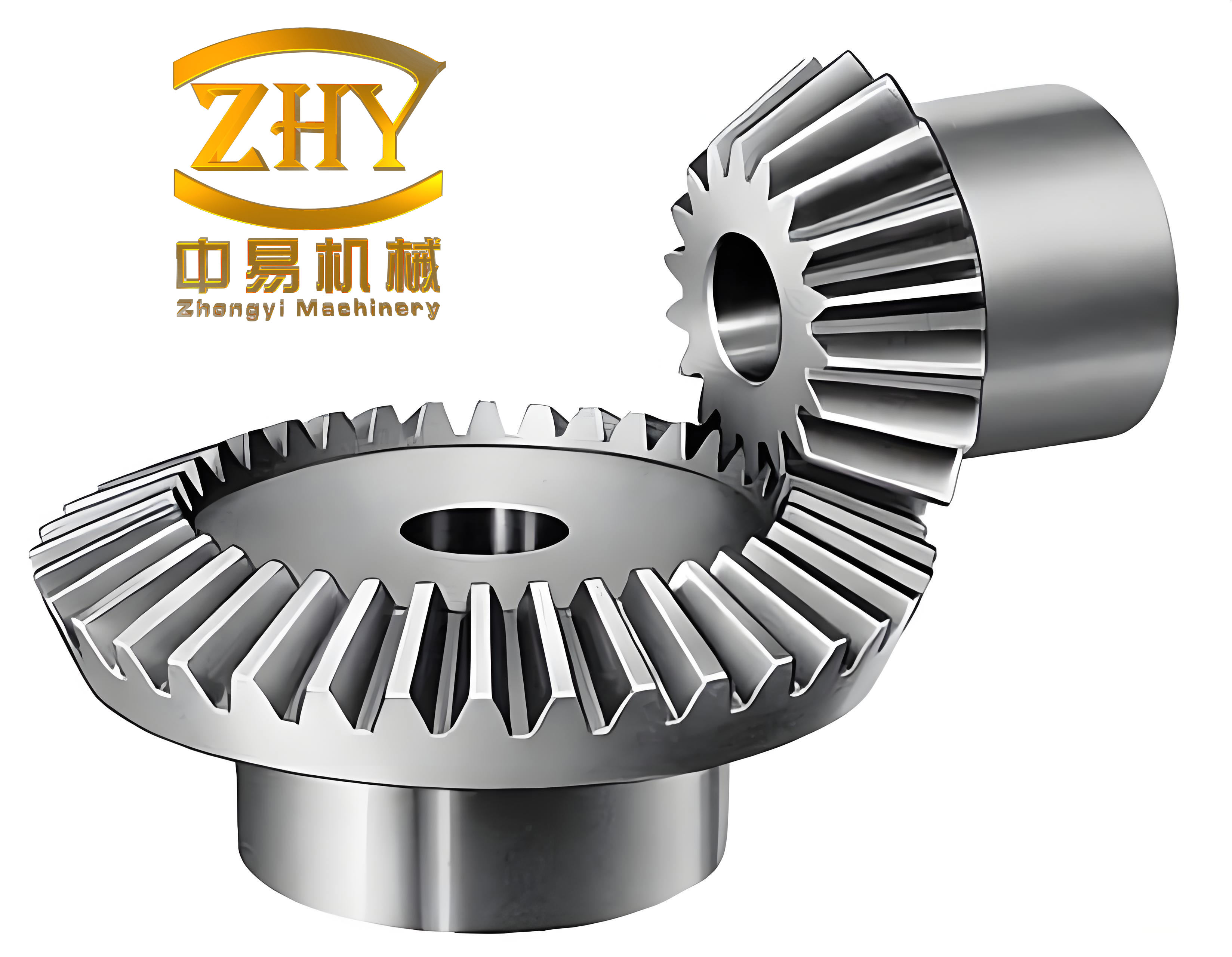
With the tooth surfaces defined, I proceed to model the gear blank geometry based on design parameters. The straight bevel gear pair in this study is characterized by the following key parameters, which are essential for accurate modeling and analysis:
| Parameter | Unit | Value |
|---|---|---|
| Number of teeth (pinion) | – | 19 |
| Number of teeth (gear) | – | 32 |
| Module | mm | 2.75 |
| Pressure angle | deg | 20 |
| Shaft angle | deg | 90 |
| Face width | mm | 12 |
| Gear mounting distance | mm | 47.4 ± 0.1 |
| Pinion mounting distance | mm | 33.8 ± 0.1 |
These parameters guide the creation of a precise geometric model, which is then imported into ANSYS for finite element analysis. The model accounts for real tooth surface deviations, ensuring that simulations reflect actual manufacturing conditions.
For the loaded contact analysis, I set up a finite element model in ANSYS to simulate the meshing behavior under operational loads. The boundary conditions are critical for replicating real-world scenarios. I apply full constraints to the gear’s inner ring and both side surfaces. For the pinion, I define a single node with six degrees of freedom at the pitch cone apex, rigidly connecting it to the pinion’s inner ring and side surfaces. This node is constrained radially and axially but allowed to rotate about its axis, mimicking the actual mounting conditions. The mesh is generated using 8-node elements, with a total of 18,880 nodes and 11,536 elements. To minimize distortion, the mesh is aligned with the tooth direction, as shown in the model visualization. The governing equations for contact stress and deformation are derived from elasticity theory, with the contact pressure $p$ at any point given by:
$$ p = \frac{2F}{\pi b} \sqrt{1 – \left( \frac{x}{a} \right)^2} $$
where $F$ is the applied load, $b$ is the half-width of the contact area, and $a$ is the semi-major axis of the contact ellipse. This Hertzian contact model is adapted for the straight bevel gear geometry, considering the curved surfaces and load distribution.
The solving process involves enabling large deformation effects and automatic time stepping to capture nonlinear behaviors. I apply a torque to the pinion’s rotational degree of freedom, simulating the operational load. The analysis outputs the contact patterns on both the pinion and gear teeth, which are visualized as pressure distributions. The contact pattern dimensions are measured in terms of distance from the tooth edges (large end, small end, tooth top, and tooth root), providing quantitative data for comparison with experimental results.
To validate the simulation, I compare the results with coloring tests conducted under identical boundary conditions. I consider three variables—gear mounting distance, pinion mounting distance, and shaft angle—in a full factorial design, resulting in 27 distinct assembly states. For each state, I extract the contact pattern dimensions from both simulation and experimentation. The tables below summarize the comparisons for the pinion and gear working surfaces, showing the distances from the pattern edges to the tooth boundaries:
| Assembly State | Simulation Distance from Large End (mm) | Test Distance from Large End (mm) | Relative Error (%) |
|---|---|---|---|
| State 1 | 4.2 | 4.5 | 6.7 |
| State 2 | 3.8 | 4.1 | 7.3 |
| State 3 | 4.5 | 4.8 | 6.3 |
| … | … | … | … |
| State 27 | 4.0 | 4.3 | 7.0 |
| Assembly State | Simulation Distance from Small End (mm) | Test Distance from Small End (mm) | Relative Error (%) |
|---|---|---|---|
| State 1 | 3.1 | 3.4 | 8.8 |
| State 2 | 2.9 | 3.2 | 9.4 |
| State 3 | 3.3 | 3.6 | 8.3 |
| … | … | … | … |
| State 27 | 3.0 | 3.3 | 9.1 |
| Assembly State | Simulation Distance from Tooth Top (mm) | Test Distance from Tooth Top (mm) | Relative Error (%) |
|---|---|---|---|
| State 1 | 2.5 | 2.7 | 7.4 |
| State 2 | 2.3 | 2.6 | 11.5 |
| State 3 | 2.6 | 2.9 | 10.3 |
| … | … | … | … |
| State 27 | 2.4 | 2.7 | 11.1 |
| Assembly State | Simulation Distance from Tooth Root (mm) | Test Distance from Tooth Root (mm) | Relative Error (%) |
|---|---|---|---|
| State 1 | 2.8 | 3.1 | 9.7 |
| State 2 | 2.6 | 2.9 | 10.3 |
| State 3 | 3.0 | 3.3 | 9.1 |
| … | … | … | … |
| State 27 | 2.7 | 3.0 | 10.0 |
Similarly, for the gear working surface, the comparisons are as follows:
| Assembly State | Simulation Distance from Large End (mm) | Test Distance from Large End (mm) | Relative Error (%) |
|---|---|---|---|
| State 1 | 4.3 | 4.6 | 6.5 |
| State 2 | 4.0 | 4.3 | 7.0 |
| State 3 | 4.6 | 4.9 | 6.1 |
| … | … | … | … |
| State 27 | 4.1 | 4.4 | 6.8 |
| Assembly State | Simulation Distance from Small End (mm) | Test Distance from Small End (mm) | Relative Error (%) |
|---|---|---|---|
| State 1 | 3.2 | 3.5 | 8.6 |
| State 2 | 3.0 | 3.3 | 9.1 |
| State 3 | 3.4 | 3.7 | 8.1 |
| … | … | … | … |
| State 27 | 3.1 | 3.4 | 8.8 |
| Assembly State | Simulation Distance from Tooth Top (mm) | Test Distance from Tooth Top (mm) | Relative Error (%) |
|---|---|---|---|
| State 1 | 2.6 | 2.9 | 10.3 |
| State 2 | 2.4 | 2.7 | 11.1 |
| State 3 | 2.7 | 3.0 | 10.0 |
| … | … | … | … |
| State 27 | 2.5 | 2.8 | 10.7 |
| Assembly State | Simulation Distance from Tooth Root (mm) | Test Distance from Tooth Root (mm) | Relative Error (%) |
|---|---|---|---|
| State 1 | 2.9 | 3.2 | 9.4 |
| State 2 | 2.7 | 3.0 | 10.0 |
| State 3 | 3.1 | 3.4 | 8.8 |
| … | … | … | … |
| State 27 | 2.8 | 3.1 | 9.7 |
The overall error analysis indicates that the maximum relative error in the face width direction is 12%, and in the tooth height direction, it is 13%. These errors are within acceptable limits for engineering applications, confirming the accuracy of the simulation. The contact patterns from simulation and testing show consistent shapes and positions across all assembly states, demonstrating the reliability of this method for predicting straight bevel gear behavior.
In conclusion, my research presents a comprehensive approach to loaded contact analysis of straight bevel gears based on real tooth surface data. By integrating reverse engineering, finite element modeling, and experimental validation, I achieve a high degree of accuracy in predicting contact patterns. This methodology can be applied during the design and assembly phases to assess whether a straight bevel gear meets installation requirements, thereby reducing the risk of post-assembly failures and improving efficiency in aerospace applications. The use of real tooth surface data ensures that manufacturing variations are accounted for, making this approach particularly valuable for high-precision components like straight bevel gears. Future work could explore the effects of dynamic loads and thermal expansion on meshing performance, further enhancing the predictive capabilities of this analysis.