
In mechanical transmission systems, gears play a pivotal role, and among them, the straight bevel gear is crucial for transmitting power between intersecting shafts. As a key component in industries like automotive, printing machinery, and engineering equipment, the demand for high-precision straight bevel gears has surged, especially with the rapid growth of the automotive sector. However, traditional machining methods face challenges in achieving high accuracy and handling hard materials, leading to issues like vibration and noise. In this article, I will explore the innovative approach of using Electrical Discharge Machining (EDM) wire cutting for manufacturing straight bevel gears, detailing the technology,机床 parameters, and advantages over conventional methods. I will incorporate formulas and tables to summarize key aspects, emphasizing the term “straight bevel gear” throughout to highlight its significance.
Straight bevel gears are widely employed due to their ability to efficiently transfer motion and power at angles, typically 90 degrees. Traditional machining techniques, such as gear planing, milling, and broaching, rely on mechanical tools that remove material layer by layer. For instance, straight bevel gear planers use paired cutting tools in a generating motion to rough and finish gears, but they struggle with hardened materials like stainless steel or titanium alloys. The limitations include tool wear, mechanical vibrations, and the need for post-heat treatment grinding to achieve precision. This often results in gears that only meet lower accuracy grades, such as Grade 7 or 8, with surface roughness values around $$R_a = 1.6 , \mu m$$. In contrast, EDM wire cutting offers a non-contact method with minimal macroscopic cutting forces, making it ideal for high-strength, hard-to-machine materials. The process involves using a thin wire electrode, typically molybdenum or copper, which erodes the workpiece through electrical discharges, allowing for precise control over complex geometries like those of a straight bevel gear.
The fundamental principle of EDM wire cutting for straight bevel gears revolves around computer numerical control (CNC) programming to guide the wire along the desired tooth profile. For a straight bevel gear, the tooth geometry is based on an involute curve, which can be mathematically represented. The standard involute equation for a gear tooth profile is given by: $$x = r_b (\cos \theta + \theta \sin \theta)$$ and $$y = r_b (\sin \theta – \theta \cos \theta)$$, where $$r_b$$ is the base radius and $$\theta$$ is the parameter angle. In the context of a straight bevel gear, this is adapted to a conical surface, requiring adjustments for the cone angle. The wire is positioned at an angle equal to the gear’s pitch cone angle, often denoted as $$\delta$$, and the machining process involves synchronized movements between the wire feed and a rotary table. Specifically, the wire’s path is controlled to generate the tooth profile by coordinating the rotation of the workpiece (mounted on the CNC rotary table) and the linear feed of the wire at the large end of the gear. This ensures that the wire cuts along the equivalent involute curve of the straight bevel gear, producing accurate teeth with minimal deviation.
To illustrate the machine setup, consider a typical EDM wire cutting机床 for straight bevel gears. The workpiece is fixed on a precision rotary table, whose axis is tilted to match the cone angle of the straight bevel gear. The wire, stretched between two guides or nozzles, is aligned such that one end acts as a pivot point at the gear’s virtual apex (the intersection point of the shaft axes), while the other end follows the base circle at the large end of the gear. The distance between the nozzles defines the span, which corresponds to the gear’s pitch cone radius. During operation, the CNC system executes a program that synchronizes the rotary table’s angular movement with the wire’s linear feed. For example, when cutting a tooth, the wire remains stationary at the tooth tip while the table rotates, then moves inward as the table continues to rotate for the tooth flank, and finally holds position at the root to complete the cut. This sequence is repeated for all teeth, ensuring each straight bevel gear tooth is machined to high accuracy. The process allows for multiple passes (e.g., roughing and finishing cuts) to improve surface finish, with capabilities to achieve surface roughness as low as $$R_a = 0.4 , \mu m$$ and accuracy up to Grade 5, surpassing many traditional methods.
The advantages of using EDM wire cutting for straight bevel gears are substantial. Firstly, it eliminates mechanical stresses and deformations, as there is no direct contact between the tool and workpiece. This is particularly beneficial for materials like titanium alloys or hardened steels, which are difficult to machine with conventional tools. For instance, titanium alloys, known as the “21st-century metal” due to their high strength-to-weight ratio and corrosion resistance, are ideal for aerospace applications but pose machining challenges. EDM wire cutting can handle such materials effortlessly, enabling the production of high-performance straight bevel gears for aircraft or military systems. Secondly, the technology simplifies tooling; unlike gear planers that require specialized cutters for different modules, EDM uses a standard wire for various gear sizes, reducing costs and setup time. Additionally, the process is energy-efficient, with power consumption typically under 2 kW for small machines, compared to tens of kilowatts for large planers. Environmental benefits include the use of water-based dielectric fluids, which are less polluting and can be recycled.
To quantify the performance, let’s examine key parameters of EDM wire cutting machines for straight bevel gears. The machining efficiency, often measured in terms of material removal rate, can be modeled using the formula: $$MRR = k \cdot I \cdot f$$, where $$MRR$$ is the material removal rate in mm³/min, $$k$$ is a constant dependent on the material and dielectric, $$I$$ is the discharge current, and $$f$$ is the pulse frequency. For straight bevel gears, the accuracy is influenced by factors like wire tension and guide alignment. Below, I present tables summarizing machine specifications and comparative data.
| Model | Max. Cutting Diameter (mm) | Gear Module Range | Max. Module | Max. Pitch Cone Distance (mm) | Number of Teeth Range | Best Accuracy Grade | Best Surface Roughness $$R_a , (\mu m)$$ | Max. Efficiency (mm²/min) | Machine Dimensions (L × W × H, m) | Net Weight (kg) |
|---|---|---|---|---|---|---|---|---|---|---|
| Model A | 200 | Unlimited | Unlimited | 150 | Unlimited | Grade 6 | 0.8 | 120 | 1.6 × 1.8 × 1.8 | 600 |
| Model B | 300 | Unlimited | Unlimited | 250 | Unlimited | Grade 6 | 0.8 | 120 | 2.6 × 2.2 × 2.6 | 750 |
| Model C | 500 | Unlimited | Unlimited | 300 | Unlimited | Grade 6 | 0.8 | 120 | 3.2 × 2.2 × 2.2 | 800 |
This table highlights the versatility of EDM wire cutting machines in handling various sizes of straight bevel gears, with high accuracy and efficiency. For low-speed wire EDM machines, which offer even better precision, the parameters are as follows:
| Model | Max. Cutting Diameter (mm) | Gear Module Range | Max. Module | Max. Pitch Cone Distance (mm) | Number of Teeth Range | Best Accuracy Grade | Best Surface Roughness $$R_a , (\mu m)$$ | Max. Efficiency (mm²/min) | Machine Dimensions (L × W × H, m) | Net Weight (kg) |
|---|---|---|---|---|---|---|---|---|---|---|
| Model X | 200 | Unlimited | Unlimited | 200 | Unlimited | Grade 5 | 0.2 | 100 | 1.6 × 1.8 × 1.8 | 600 |
| Model Y | 300 | Unlimited | Unlimited | 200 | Unlimited | Grade 5 | 0.2 | 100 | 2.6 × 2.2 × 2.6 | 750 |
These tables demonstrate that EDM wire cutting can achieve superior results for straight bevel gears, with low-speed machines offering Grade 5 accuracy and finer surface finishes. The mathematical relationship for the cone angle in a straight bevel gear is given by $$\tan \delta = \frac{z_1}{z_2}$$ for two mating gears, where $$z_1$$ and $$z_2$$ are the numbers of teeth, and $$\delta$$ is the pitch cone angle. This formula is essential in CNC programming to set the wire angle correctly. Moreover, the wire feed rate and discharge parameters can be optimized using empirical models, such as $$V_w = C \cdot E^{0.5}$$, where $$V_w$$ is the wire feed rate, $$C$$ is a constant, and $$E$$ is the energy per discharge. Such optimizations ensure efficient machining of each straight bevel gear tooth without compromising quality.
In terms of practical implementation, the CNC system for EDM wire cutting of straight bevel gears integrates software that generates G-code based on the gear design. For example, the program calculates the toolpath for the involute profile, adjusting for the conical geometry. The wire diameter, typically 0.1 to 0.3 mm, influences the kerf width, which must be accounted for in the design phase. The dielectric fluid, often deionized water, cools the wire and flushes away debris, maintaining stable discharges. I have found that this setup allows for the production of straight bevel gears with modules ranging from 1 to 10 mm or more, and pitch cone distances up to 300 mm, catering to diverse industrial needs. The ability to perform multiple cuts—first a rough cut with high energy and then fine cuts with lower energy—enables achieving tight tolerances, such as dimensional accuracy within ±0.005 mm for critical applications.
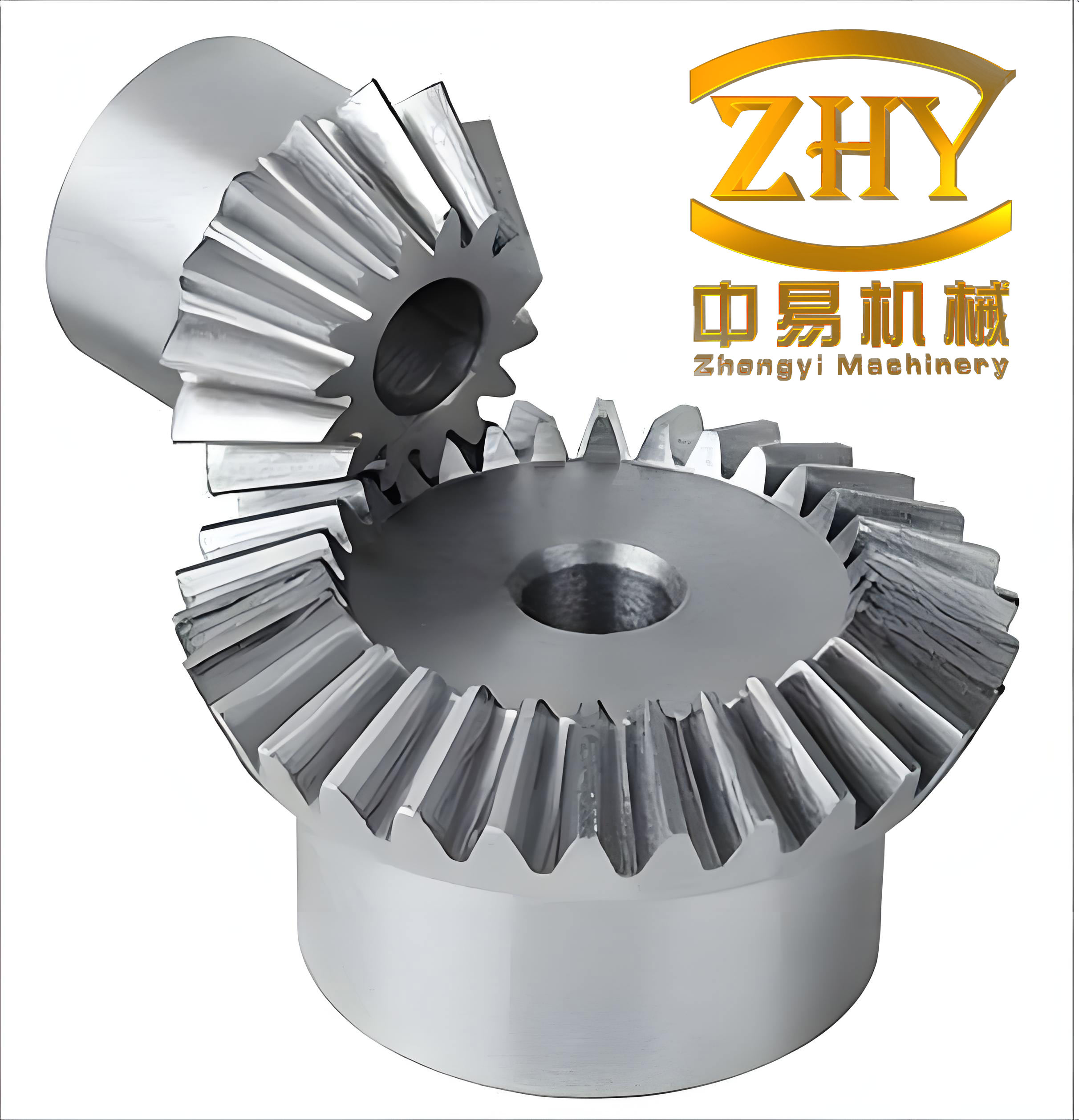
Comparing EDM wire cutting with traditional methods like planing or milling reveals significant benefits. For instance, a large straight bevel gear planer might achieve Grade 7 accuracy with surface roughness of $$R_a = 1.6 , \mu m$$, whereas EDM can consistently reach Grade 5 or better with $$R_a = 0.4 , \mu m$$. This is due to the absence of mechanical vibrations and the precise control offered by CNC. Furthermore, EDM eliminates the need for secondary operations like grinding after heat treatment, as it can directly machine hardened materials. This reduces production time and costs, making it ideal for prototypes and small batches of straight bevel gears. In high-volume scenarios, the flexibility of EDM allows for quick changeovers between different gear designs without tooling changes, enhancing overall efficiency.
In conclusion, the adoption of EDM wire cutting for manufacturing straight bevel gears represents a transformative advancement in gear technology. By leveraging non-contact machining, CNC precision, and adaptability to hard materials, this method addresses the limitations of traditional techniques. The straight bevel gear, as a critical component in various industries, benefits from improved accuracy, reduced noise, and longer service life. As I have detailed through formulas, tables, and practical insights, EDM wire cutting not only simplifies the production process but also opens up new possibilities for high-performance applications. Future developments may focus on enhancing wire materials and dielectric systems to further boost efficiency and environmental sustainability. Ultimately, this technology empowers manufacturers to meet the growing demands for high-quality straight bevel gears in a competitive global market.