
As a technical manager in a company with extensive experience in precision forging, I have been deeply involved in the development and optimization of manufacturing processes for straight bevel gears. Our journey began with early adoption of precision forging techniques, and over the years, we have refined our approaches in hot, cold, and compound forging to meet evolving market demands. This article shares insights from our practical experiences, focusing on the intricacies of forging straight bevel gears, including process details, equipment layout principles, and the integration of advanced methodologies. The straight bevel gear, a critical component in various mechanical systems, requires high precision and durability, which we achieve through meticulous process control. Throughout this discussion, I will emphasize the importance of straight bevel gears in our work, using tables and formulas to summarize key points and enhance clarity.
Hot precision forging is a fundamental process for producing straight bevel gears, characterized by its ability to handle complex shapes with relatively low deformation resistance and high plasticity. In our operations, we often employ a “one-heat, three-forge” approach, which involves heating the workpiece once and sequentially performing upsetting, rough forging, and finish forging. This method minimizes energy consumption and reduces the risk of surface oxidation, a common issue in hot forging. The deformation behavior in hot forging can be described by the flow stress equation: $$\sigma = K \epsilon^n e^{m \dot{\epsilon}}$$ where $\sigma$ represents the flow stress, $\epsilon$ is the true strain, $\dot{\epsilon}$ is the strain rate, and K, n, m are material-dependent constants. For straight bevel gears, this equation helps us predict material behavior under high temperatures, typically ranging from 1000°C to 1200°C, ensuring optimal formability. We have observed that maintaining the final forging temperature above 800°C is crucial to prevent cracking and achieve the desired mechanical properties. The table below summarizes the key parameters and advantages of hot precision forging for straight bevel gears:
| Parameter | Typical Range | Impact on Straight Bevel Gear Quality |
|---|---|---|
| Forging Temperature | 1000°C – 1200°C | Reduces deformation resistance, minimizes defects |
| Strain Rate | 0.1 – 10 s⁻¹ | Influences grain structure and surface finish |
| Material Constants (K, n, m) | Varies by alloy | Determines flow stress and formability limits |
In terms of equipment layout for hot precision forging of straight bevel gears, we adhere to several principles to maximize efficiency and quality. First, the layout follows the sequential workflow of the forging process, such as heating, upsetting, and finishing, to minimize material handling. Second, we keep the distance between forging equipment as short as possible to reduce heat loss and oxidation during transfers. This is critical for straight bevel gears, as excessive exposure to air can lead to scale formation and dimensional inaccuracies. Third, adequate space is allocated for operator safety and maintenance, ensuring that tools and dies can be accessed easily. The overall goal is to create a streamlined production line that supports high-volume manufacturing of straight bevel gears while maintaining tight tolerances. For instance, the force required in hot forging can be estimated using: $$F = A \sigma$$ where F is the forging force, A is the projected area of the straight bevel gear, and $\sigma$ is the flow stress derived from the earlier equation. This calculation aids in selecting appropriate press capacities, typically ranging from 500 to 2000 tons for medium-sized straight bevel gears.
Cold precision forging, conducted at room temperature, offers distinct advantages for straight bevel gears, including superior surface finish, dimensional accuracy, and enhanced mechanical properties due to strain hardening. Unlike hot forging, cold forging does not involve heating, which eliminates oxidation and allows for tighter control over the final geometry. The process is ideal for high-precision applications where straight bevel gears must meet strict specifications. The strain hardening behavior in cold forging can be modeled using the Hollomon equation: $$\sigma = K \epsilon^n$$ where $\sigma$ is the true stress, $\epsilon$ is the true strain, and K and n are the strength coefficient and strain hardening exponent, respectively. For straight bevel gears, this relationship helps us optimize the forging sequence to achieve the desired hardness and strength without compromising ductility. Additionally, the absence of thermal effects reduces residual stresses, leading to better performance in service. The following table compares cold forging with other processes for straight bevel gears:
| Aspect | Cold Forging | Hot Forging | Compound Forging |
|---|---|---|---|
| Surface Quality | High (smooth, oxide-free) | Moderate (may have scale) | Variable (combines benefits) |
| Dimensional Accuracy | Very High | Good | High |
| Mechanical Properties | Improved via strain hardening | Good, but may vary with cooling | Optimized through process integration |
When it comes to equipment layout for cold precision forging of straight bevel gears, we prioritize factors that ensure precision and efficiency. The horizontal spacing between machines is set to at least 2 meters to facilitate the placement and movement of handling equipment, such as robotic arms or conveyors. This is essential for straight bevel gears, as any misalignment during transfer can lead to defects. Moreover, we typically use die sets with guide pillars and bushes to maintain alignment during forging, which is critical for achieving the high accuracy required for straight bevel gears. The longitudinal spacing between equipment is made sufficiently large to allow for easy die and mold changes; in multi-row layouts, we prefer a back-to-back arrangement to share tooling facilities and enhance changeover efficiency. Additionally, we always预留 space for future equipment upgrades or maintenance activities. The forging pressure in cold forging can be calculated as: $$P = \frac{F}{A}$$ where P is the pressure, F is the force, and A is the contact area. For straight bevel gears, this often results in higher pressures compared to hot forging, necessitating robust press designs with capacities up to 3000 tons for complex geometries.
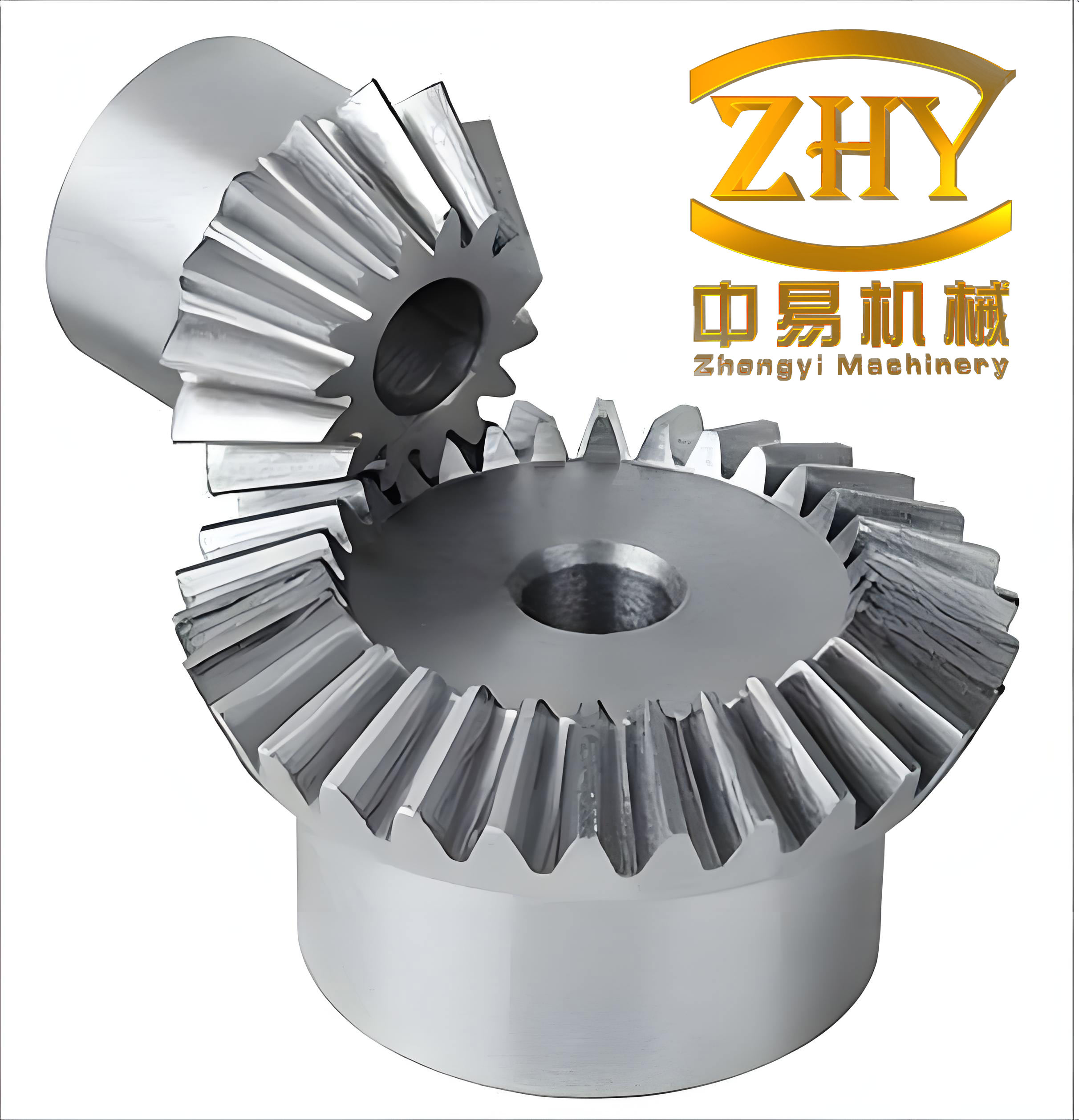
Compound precision forging represents an advanced approach that combines the benefits of hot, warm, and cold forging to produce straight bevel gears with optimized properties. In this process, we initially use hot or warm forging to achieve preliminary shaping with low force, followed by cold forging to refine the geometry and enhance surface quality. This hybrid method mitigates the drawbacks of individual processes, such as oxidation in hot forging and high tool wear in cold forging. For straight bevel gears, compound forging allows us to tackle challenging geometries while maintaining high precision and mechanical integrity. The overall deformation energy in compound forging can be integrated as: $$W = \int \sigma \, d\epsilon$$ where W is the work done, $\sigma$ is the flow stress, and $\epsilon$ is the strain, evaluated over the entire process sequence. This energy minimization is key to reducing costs and improving sustainability. The equipment layout for compound forging integrates elements from both hot and cold forging lines, with dedicated zones for each stage. For example, the hot forging section is arranged compactly to preserve heat, while the cold forging area has ample space for precision tooling. The table below outlines the typical stages in compound forging for straight bevel gears:
| Stage | Process | Temperature Range | Key Objectives for Straight Bevel Gears |
|---|---|---|---|
| 1 | Hot Forging | 800°C – 1200°C | Rough shaping, material savings |
| 2 | Warm Forging | 500°C – 800°C | Intermediate forming, reduced oxidation |
| 3 | Cold Forging | Room Temperature | Final precision, surface finish |
In our experience, the successful implementation of these forging processes for straight bevel gears relies heavily on a holistic view of material science and equipment dynamics. For instance, the selection of lubricants in cold forging is critical to reduce friction and wear, which can be quantified using the coefficient of friction $\mu$ in the equation: $$F_f = \mu F_n$$ where $F_f$ is the frictional force and $F_n$ is the normal force. For straight bevel gears, we often use phosphate-based coatings to enhance lubrication and extend die life. Moreover, the design of dies and molds must account for springback in cold forging, which can be predicted using elastic recovery models: $$\epsilon_e = \frac{\sigma_y}{E}$$ where $\epsilon_e$ is the elastic strain, $\sigma_y$ is the yield stress, and E is Young’s modulus. This ensures that the final straight bevel gear dimensions meet specifications after unloading. We continuously monitor process parameters through sensors and data analytics, allowing for real-time adjustments and quality control. The integration of Industry 4.0 technologies has further improved our ability to produce straight bevel gears with consistent quality across large batches.
Another critical aspect is the thermal management in hot and compound forging of straight bevel gears. The heat transfer during forging can be modeled using Fourier’s law: $$q = -k \nabla T$$ where q is the heat flux, k is the thermal conductivity, and $\nabla T$ is the temperature gradient. By controlling the cooling rates, we can influence the microstructure of the straight bevel gear, such as grain size and phase distribution, which directly affects mechanical properties like toughness and fatigue resistance. In practice, we use water or air cooling systems tailored to the specific alloy of the straight bevel gear. For example, low-carbon steels may require faster cooling to achieve fine pearlite structures, whereas alloy steels might need slower cooling to prevent cracking. The table below provides a comparison of microstructural outcomes for different forging processes applied to straight bevel gears:
| Forging Process | Typical Microstructure | Impact on Straight Bevel Gear Performance |
|---|---|---|
| Hot Forging | Coarse grains, recrystallized | Good toughness, lower strength |
| Cold Forging | Fine grains, work-hardened | High strength, potential brittleness |
| Compound Forging | Mixed, optimized grains | Balanced strength and ductility |
Looking at the broader production environment, the layout of forging equipment must also consider logistical factors such as material flow, inventory management, and energy efficiency. For straight bevel gears, we often implement just-in-time principles to reduce work-in-progress and minimize storage costs. The overall equipment effectiveness (OEE) can be calculated as: $$\text{OEE} = \text{Avaliability} \times \text{Performance} \times \text{Quality}$$ where each factor is optimized through strategic layout planning. In multi-line setups for straight bevel gears, we group similar processes together to facilitate resource sharing and reduce setup times. For instance, all finishing operations might be clustered in one area, while rough forging is done in another. This not only improves workflow but also enhances safety by isolating high-risk activities. Additionally, we incorporate predictive maintenance schedules based on equipment usage data, which helps prevent downtime and ensures consistent production of high-quality straight bevel gears.
In conclusion, the precision forging of straight bevel gears is a multifaceted discipline that requires a deep understanding of both process mechanics and practical layout considerations. Through years of experimentation and application, we have refined our approaches in hot, cold, and compound forging to achieve superior results. The straight bevel gear remains a focal point in our innovations, driving us to adopt advanced formulas and table-based summaries for continuous improvement. As we move forward, we aim to further integrate digital twins and simulation tools to optimize every aspect of straight bevel gear production, from material selection to final inspection. This commitment ensures that we stay at the forefront of the industry, delivering straight bevel gears that meet the highest standards of precision and reliability.