
In modern mechanical engineering, the design of gears plays a critical role in ensuring efficient power transmission across various applications. Among these, straight bevel gears are widely used for transmitting motion between intersecting shafts, particularly in systems like planetary gear reducers. As an engineer specializing in computer-aided design, I have extensively utilized Pro/Engineer (Pro/E) for parametric modeling, which allows for the creation of adaptable and precise geometric models. This article delves into the parametric design process of straight bevel gears, focusing on how Pro/E’s robust capabilities facilitate the development of complex gear profiles. By emphasizing parameters and relational equations, I aim to demonstrate a method that not only streamlines the design phase but also supports subsequent assembly and manufacturing simulations. The straight bevel gear, with its conical shape and straight teeth, requires meticulous attention to geometric relationships, and Pro/E’s parametric environment enables the automation of these calculations, reducing human error and saving time.
Parametric design revolves around defining key variables and their interrelationships, which drive the geometry of the model. For a straight bevel gear, essential parameters include the module, number of teeth, pressure angle, and shaft angle. In my approach, I start by inputting these design parameters into Pro/E, followed by establishing relational equations that govern the gear’s dimensions. These equations are derived from fundamental gear theory and ensure that any changes to the primary parameters automatically update the entire model. For instance, the addendum and dedendum heights are calculated based on the module and profile shift coefficients. This parametric foundation is crucial for adapting the straight bevel gear to different applications, such as in controlled-start planetary gear systems, where precise gear meshing is vital for smooth operation. Below, I present a table summarizing the primary parameters and their symbols used in the parametric design of a straight bevel gear.
| Parameter | Symbol | Description |
|---|---|---|
| Module | m | Defines the size of the gear teeth |
| Number of Teeth | z | Determines the gear ratio and size |
| Pressure Angle | α | Angle between the tooth profile and a radial line |
| Shaft Angle | δ | Angle between the intersecting shafts |
| Addendum Coefficient | hax | Factor for calculating addendum height |
| Dedendum Coefficient | cx | Factor for calculating dedendum height |
| Profile Shift Coefficient | x | Adjusts tooth thickness for meshing conditions |
Once the parameters are defined, I proceed to establish the relational equations that form the backbone of the parametric model. These equations calculate critical dimensions such as the pitch diameter, base diameter, and tooth heights. For example, the pitch diameter d is given by the product of the module and the number of teeth: $$d = m \cdot z$$. Similarly, the base diameter db, which is essential for defining the involute tooth profile, is derived as $$db = d \cdot \cos(\alpha)$$. The addendum ha and dedendum hf are computed using the formulas $$ha = (hax + x) \cdot m$$ and $$hf = (hax + cx – x) \cdot m$$, respectively. These equations ensure that the straight bevel gear adheres to standard gear design principles while allowing for customization through parameter adjustments. The total tooth height h is then $$h = (2 \cdot hax + cx) \cdot m$$, which influences the gear’s strength and durability. Additionally, the shaft angle δ is calculated as $$\delta = \atan(z / z_{\text{asm}})$$, where z_asm represents the number of teeth on the mating gear, ensuring proper alignment in the assembly.
The three-dimensional modeling process begins with creating two-dimensional curves that represent the gear’s cross-sectional profiles. In Pro/E, I use the sketching environment to draw concentric circles for the tip, root, pitch, and base circles at both the large and small ends of the straight bevel gear. These circles are defined by the diameters calculated from the parametric equations. For instance, the tip diameter da is $$da = d + 2 \cdot ha \cdot \cos(\delta)$$, and the root diameter df is $$df = d – 2 \cdot hf \cdot \cos(\delta)$$. This step is critical as it lays the groundwork for generating the tooth profiles. The relationships between these circles are governed by the gear’s geometry, and Pro/E’s parametric capabilities allow me to link these dimensions directly to the initial parameters, ensuring that any modifications propagate through the model seamlessly. To illustrate the complexity of these relationships, I often refer to the following set of derived parameters, which include angles and radii specific to the straight bevel gear configuration.
| Parameter | Formula | Significance |
|---|---|---|
| Cone Distance | rx = d / (2 \cdot \sin(\delta)) | Distance from apex to pitch circle |
| Addendum Angle | θ_a = \atan(ha / rx) | Angle defining tip cone |
| Dedendum Angle | θ_f = \atan(hf / rx) | Angle defining root cone |
| Tip Angle | δ_a = δ + θ_a | Angle of the tip cone surface |
| Root Angle | δ_f = δ – θ_f | Angle of the root cone surface |
After setting up the 2D curves, I focus on generating the tooth profile, which is based on an involute curve. The involute shape is fundamental to straight bevel gears as it ensures smooth and efficient power transmission by maintaining constant relative motion between meshing teeth. In Pro/E, I create a Cartesian coordinate system at the center of the concentric circles and use the equation-driven curve tool to define the involute. The parametric equations for the involute curve in terms of parameter t (ranging from 0 to 1) are as follows: $$r = \frac{db}{\cos(\delta)} / 2$$, $$\theta = t \cdot 60$$, $$x = r \cdot \cos(\theta) + r \cdot \sin(\theta) \cdot \theta \cdot \frac{\pi}{180}$$, $$y = r \cdot \sin(\theta) – r \cdot \cos(\theta) \cdot \theta \cdot \frac{\pi}{180}$$, and $$z = 0$$. These equations produce a precise involute curve that represents one side of the tooth. This curve is then mirrored across the central plane to create the symmetrical opposite side, resulting in a complete tooth profile for both the large and small ends of the straight bevel gear. The accuracy of this step is vital, as any deviation can lead to improper meshing and reduced performance in practical applications.
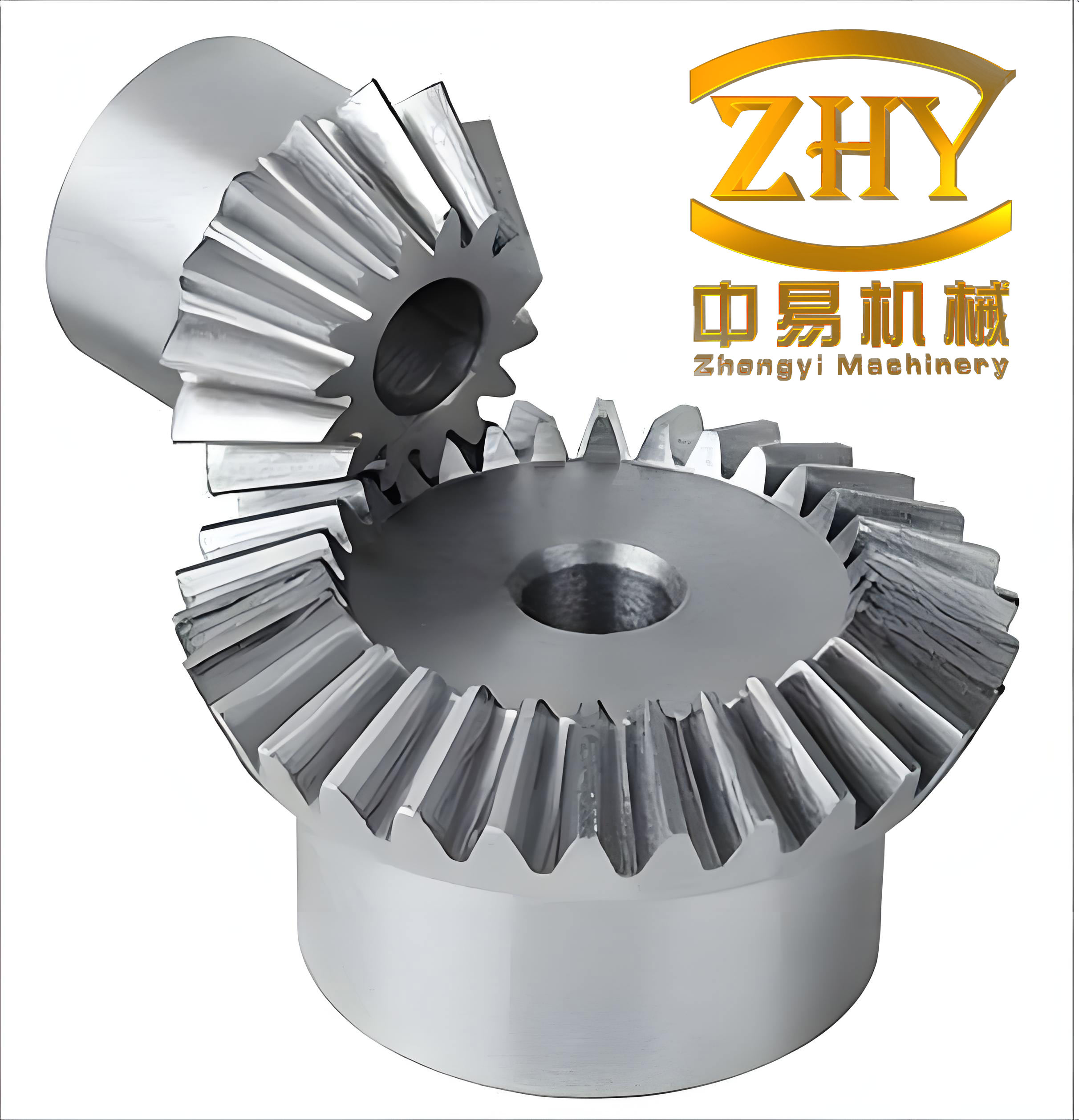
With the tooth profile defined, I proceed to create the solid model of the first tooth using Pro/E’s sweep blend feature. This involves sketching the tooth cross-sections at the large and small ends and then sweeping them along a path that follows the gear’s conical surface. The sweep blend command allows for a smooth transition between the two end sections, accurately capturing the tapered nature of the straight bevel gear. During this process, I ensure that the profiles are aligned with the previously drawn curves and that the parameters control all dimensions. For example, the face width b is incorporated into the model through relational equations that define the axial dimensions, such as $$ba = b / \cos(\theta_a)$$ for the addendum-related width. This step transforms the 2D sketches into a 3D entity, representing a single tooth that is fully parametric and adaptable to design changes. The completion of the first tooth marks a significant milestone, as it serves as the basis for generating the entire gear through pattern operations.
To populate the gear with multiple teeth, I use Pro/E’s pattern tool, specifically the axis pattern option. This feature allows me to create a circular array of the first tooth around the gear’s central axis. The number of instances in the pattern is set equal to the number of teeth z, which is a key parameter in the design. The pattern angle is automatically calculated as $$360 / z$$ degrees, ensuring uniform distribution of teeth. This automated approach highlights the power of parametric design; if the number of teeth is modified, the pattern updates instantly, maintaining the gear’s integrity without manual intervention. The resulting 3D model of the straight bevel gear is a fully detailed representation that can be used for further analysis, such as finite element analysis for stress evaluation or dynamic simulation for performance testing. The ability to rapidly iterate through different design configurations makes this method invaluable for optimizing straight bevel gears in complex assemblies like planetary reducers.
The parametric design of straight bevel gears extends beyond mere modeling; it has profound implications for manufacturing and assembly processes. In controlled-start planetary gear systems, for instance, the precise geometry of straight bevel gears ensures minimal backlash and efficient torque transmission. By using Pro/E, I can simulate the assembly of multiple gears, checking for interferences and verifying kinematic behavior before physical prototyping. This virtual validation reduces development costs and time, as potential issues are identified and resolved early. Moreover, the parametric model can be exported to computer-aided manufacturing (CAM) software to generate toolpaths for gear cutting processes, such as milling or hobbing. The relational equations ensure that manufacturing drawings and specifications are always synchronized with the 3D model, eliminating discrepancies that could arise from manual updates. This seamless integration from design to production underscores the importance of parametric methodologies in modern engineering.
In conclusion, the parametric design of straight bevel gears using Pro/Engineer represents a sophisticated approach that leverages software capabilities to enhance accuracy and efficiency. Through the systematic definition of parameters and relational equations, I have demonstrated how complex gear geometries can be modeled with flexibility and precision. The straight bevel gear, as a critical component in many mechanical systems, benefits greatly from this method, which supports rapid prototyping, virtual assembly, and manufacturing preparation. As engineering demands evolve, the adoption of parametric tools will continue to drive innovation in gear design, enabling more reliable and high-performance solutions. The insights shared here aim to inspire further exploration into parametric techniques, ultimately contributing to advancements in mechanical transmission technology.