
In mechanical transmission systems, the straight bevel gear plays a critical role in transmitting motion and power between intersecting shafts. As an engineer specializing in CAD and gear design, I have explored the parametric modeling of straight bevel gears using forming method principles. This approach leverages the Autolisp programming language within AutoCAD to dynamically simulate gear generation, enabling rapid creation of three-dimensional models tailored to specific parameters like module, number of teeth, and pressure angle. The forming method, which involves machining gear teeth with a formed cutter, offers advantages in versatility and precision, especially for small-module gears. By developing a parametric model, I aim to enhance design efficiency and provide a foundation for broader engineering applications, such as custom gear production and simulation-based analysis.
The theoretical foundation of straight bevel gear design revolves around the concept of spherical involutes, which define the ideal tooth profile. However, due to the complexity of spherical geometry, practical designs often approximate this using conical involutes derived from the back cone. This approximation simplifies modeling while maintaining accuracy. In the forming method, a disk-shaped cutter—whose profile matches the gear tooth—is used to mill the teeth into a gear blank. The cutter’s motion replicates the machining process, where it follows a circular path to carve out each tooth slot sequentially. This method is particularly effective in standard milling machines, making it accessible for various industrial settings. My implementation focuses on automating this process through parametric relationships, ensuring that changes in input parameters instantly update the gear geometry.
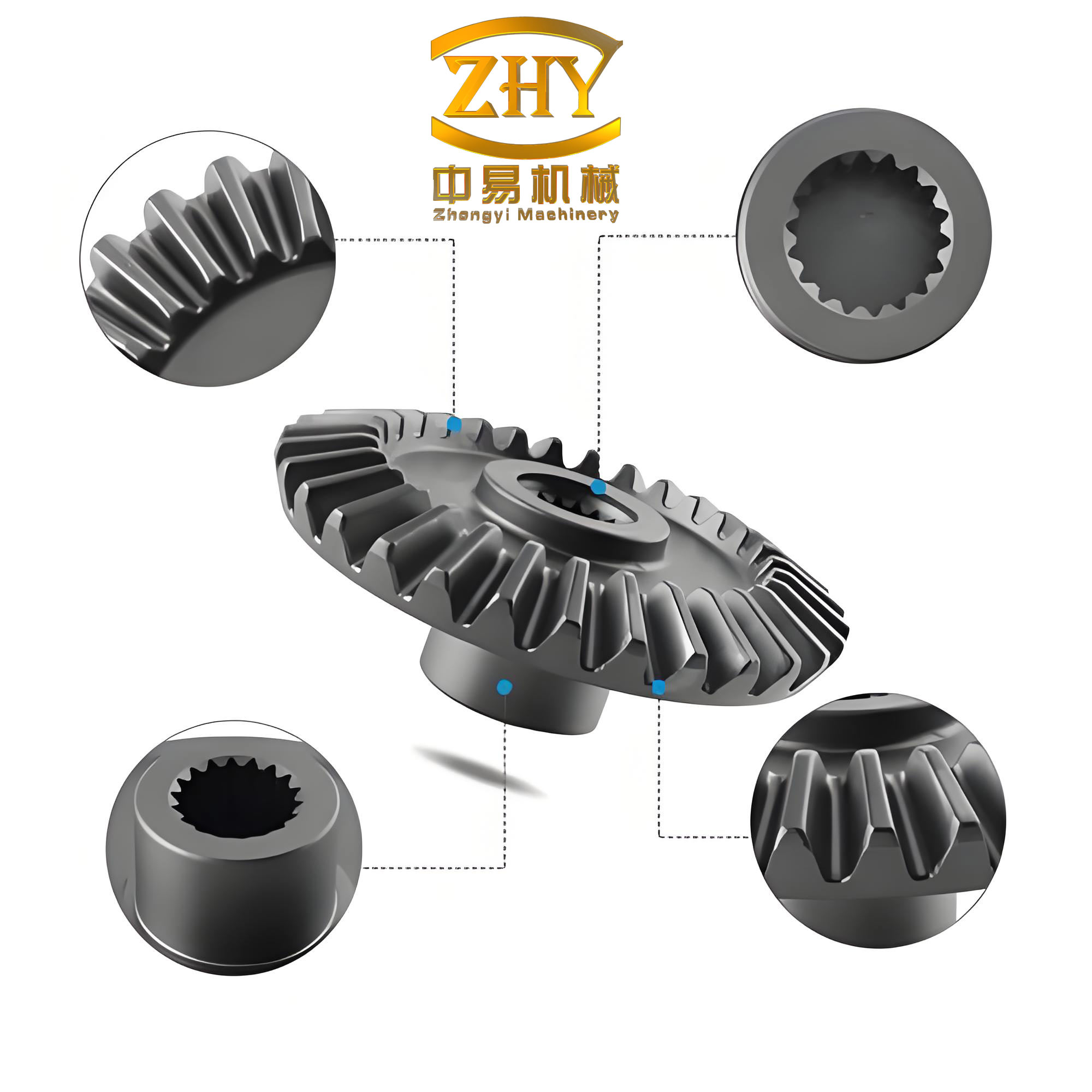
To establish the parametric model, I defined key design parameters and their mathematical relationships. The primary inputs include the module (M), number of teeth (Z1 and Z2 for mating gears), face width (B), pressure angle (α), addendum coefficient (Hax), and clearance coefficient (Cx). These parameters drive the calculation of dimensional attributes, such as the pitch cone angle, tooth height, and equivalent gear properties. For instance, the pitch cone angle δ is derived as δ = arctan(Z1 / Z2), which influences the gear’s conical shape. The equivalent gear, used to simplify calculations, has a virtual number of teeth Zy1 = Z1 / cos(δ), allowing us to apply standard spur gear formulas to the straight bevel gear design. This equivalence facilitates accurate modeling of tooth profiles and ensures compatibility with forming cutter specifications.
The mathematical model for the straight bevel gear involves several critical equations. The pitch diameter d at the large end is given by d = M × Z1, while the base diameter db, essential for involute generation, is calculated as db = d × cos(α). Tooth dimensions, such as addendum ha and dedendum hf, follow ha = (1 + Hax) × M and hf = (1 + Cx) × M, respectively. The outer cone distance R, which defines the gear’s taper, is R = M × Z1 / (2 × sin(δ)). These formulas are embedded in the Autolisp program to dynamically compute geometry, enabling real-time updates when parameters change. For example, the equivalent gear’s root diameter df is df = d – 2 × (1.2 – X) × M, where X is a profile shift factor if applicable. This parametric framework ensures that the straight bevel gear model adapts to various design requirements without manual recalculation.
| Parameter | Symbol | Formula |
|---|---|---|
| Module | M | Input value |
| Number of Teeth | Z1, Z2 | Input values |
| Pitch Cone Angle | δ | $$ \delta = \arctan\left(\frac{Z_1}{Z_2}\right) $$ |
| Equivalent Teeth | Zy1 | $$ Z_{y1} = \frac{Z_1}{\cos(\delta)} $$ |
| Pitch Diameter | d | $$ d = M \times Z_{y1} $$ |
| Base Diameter | db | $$ d_b = d \times \cos(\alpha) $$ |
| Addendum | ha | $$ h_a = (1 + H_{ax}) \times M $$ |
| Dedendum | hf | $$ h_f = (1 + C_x) \times M $$ |
In the dynamic simulation module, I programmed the cutter’s geometry and motion trajectory using Autolisp. The cutter profile is based on the involute curve of the equivalent gear, generated through parametric equations. For a point on the involute, the coordinates (Xa, Ya) in a Cartesian system are given by $$ X_a = R_c (\cos(\alpha) + \alpha \sin(\alpha)) $$ and $$ Y_a = R_c (\sin(\alpha) – \alpha \cos(\alpha)) $$, where Rc is the base circle radius and α is the pressure angle in radians. This curve is discretized into multiple points and connected using polyline commands to form the tooth profile. The cutter, designed as a disk with multiple teeth, is then extruded and arrayed in 3D space. Its motion follows a circular path: approach (1→2), cutting (2→3), retraction (3→4), and reset (4→1). This trajectory ensures that each tooth slot is milled accurately, with the gear blank rotating by an angle Ψ = 2π / Z1 after each cut to position for the next slot.
The Autolisp code for generating the involute curve and simulating the machining process involves iterative loops and geometric transformations. For example, the program calculates the base radius Rc as Rc = (M × Z1) / (2 × cos(δ)), then iterates over angles to plot involute points. The “pline” command connects these points, and “mirror” creates the symmetric tooth profile. During simulation, a while loop controls the rotation of the gear blank and the cutter’s movement, using commands like “rotate”, “copy”, “region”, and “subtract” to perform Boolean operations that carve the teeth. This dynamic simulation visually replicates the forming process, allowing users to observe the progressive generation of the straight bevel gear. The parametric nature of the code means that altering input values—such as module or tooth count—automatically adjusts all aspects of the model, from cutter size to motion path.
| Step | Action | Description |
|---|---|---|
| 1 | Initialize Parameters | Input M, Z1, Z2, B, α, etc., via dialog box |
| 2 | Generate Cutter | Create disk cutter with involute profile based on equivalent gear |
| 3 | Position Cutter | Move cutter along trajectory: approach, cut, retract, reset |
| 4 | Rotate Blank | After each cut, rotate gear blank by $$ \Psi = \frac{2\pi}{Z_1} $$ |
| 5 | Repeat Cutting | Iterate until all teeth are milled, using Boolean subtraction |
| 6 | Add Features | Include shaft hole and keyway via additional subroutines |
One of the core challenges in straight bevel gear design is ensuring the accuracy of the tooth profile, which directly affects meshing efficiency and noise reduction. The parametric model addresses this by deriving the cutter profile from the equivalent gear’s involute, minimizing errors associated with spherical approximations. The base circle radius Rc is critical here, as it defines the involute’s shape. Using the formula $$ R_c = \frac{M \times Z_1}{2 \times \cos(\delta)} $$, the program ensures that the cutter matches the desired tooth geometry. Additionally, the face width B influences the taper of the straight bevel gear; I incorporated calculations for both large and small end dimensions to maintain consistency. For example, the pitch diameter at the small end d_small is scaled as d_small = d × (R – B) / R, where R is the outer cone distance. This level of detail in the parametric relationships enhances the model’s realism and applicability.
The implementation of the dynamic simulation involves nested loops to handle the sequential machining of each tooth. In Autolisp, I used a while loop to control the gear blank rotation and an inner loop for the cutter’s incremental movements. Each iteration updates the cutter’s position and performs a Boolean subtraction to remove material from the blank. The rotation angle Ψ is computed as $$ \Psi = \frac{2\pi}{Z_1} $$, ensuring even spacing of teeth. This process not only generates the gear but also provides a visual aid for understanding the forming method. The simulation can be extended to include error analysis, such as deviations in tooth thickness or profile, by comparing the modeled gear to theoretical standards. For instance, the tooth thickness t at the pitch circle can be derived as $$ t = \frac{\pi \times M}{2} $$, and any discrepancies can be flagged for correction in the parametric setup.
Beyond the basic gear geometry, the parametric model includes features like shaft holes and keyways, which are essential for practical applications. I developed subroutines in Autolisp to automatically generate these elements based on user inputs, such as bore diameter and keyway dimensions. This comprehensive approach ensures that the straight bevel gear model is ready for integration into larger assemblies. The use of AutoCAD’s 3D modeling commands, like “extrude” and “3darray”, allows for efficient creation of complex shapes. Moreover, the parametric design facilitates rapid prototyping and customization; for example, increasing the module M automatically adjusts all dependent dimensions, reducing the risk of human error in manual calculations.
The advantages of this parametric design method for straight bevel gears are manifold. First, it significantly reduces design time by automating repetitive calculations and geometry generation. Second, the dynamic simulation provides insights into the manufacturing process, helping identify potential issues like tool interference or incomplete cuts. Third, the model’s flexibility supports a wide range of applications, from educational tools to industrial design. In my experience, this approach has proven particularly valuable for small-batch production, where custom straight bevel gears are needed quickly. The ability to simulate the forming process also aids in optimizing cutter design and machining parameters, ultimately improving gear quality and performance.
In conclusion, the parametric design of straight bevel gears based on the forming method represents a powerful integration of theoretical principles and practical implementation. By leveraging Autolisp within AutoCAD, I have created a system that dynamically generates accurate 3D models, simulates machining processes, and adapts to varying design parameters. The mathematical foundations, including involute generation and equivalent gear calculations, ensure geometric precision, while the parametric framework enhances usability and efficiency. This methodology not only streamlines the design of straight bevel gears but also serves as a template for other gear types, promoting advanced CAD techniques in mechanical engineering. As technology evolves, further enhancements could incorporate finite element analysis for stress evaluation or integration with CAM systems for direct manufacturing, expanding the impact of parametric design in real-world applications.