
In this paper, I propose a novel approach for designing and analyzing straight bevel gears based on the normal vector of the tooth surface. Traditional gear design methods often rely on predefined tooth profiles and complex coordinate transformations, which can be cumbersome. My method simplifies this process by directly utilizing the normal vector to derive the ruled tooth surface and its geometric properties. This approach is particularly beneficial for straight bevel gears, which are widely used in transmitting motion and power between intersecting shafts due to their compact size and high load capacity. By focusing on the normal vector, I can efficiently compute key characteristics such as principal curvatures, sliding coefficients, and conditions for singularities like cusps or undercutting. This not only streamlines the design process but also opens up new possibilities for optimizing straight bevel gears in various applications.
To begin, I define the normal vector at any point on the tooth surface of a straight bevel gear. Consider a point M on the surface, with the normal vector l originating from the pitch circle point Op. I establish a coordinate system Sp with origin at Op, where the yp-axis is tangent to the pitch circle, and the zp-axis is parallel to the gear axis. The direction angles of the normal vector l are α, β, and γ, and the unit normal vector n(p) can be expressed as:
$$ n^{(p)} = \begin{bmatrix} \sin\beta \cos\lambda \\ \cos\beta \\ -\sin\beta \sin\lambda \end{bmatrix} $$
Thus, the normal vector l is given by l = l n(p), where l is the magnitude, representing the length from Op to M. This formulation allows me to describe the tooth surface without explicitly defining the surface curves initially. The tooth surface vector equation in a fixed coordinate system S attached to the gear is:
$$ \mathbf{R}(u, v) = \mathbf{u} + \mathbf{r} + \mathbf{l} $$
Here, u = (0, 0, u)^T represents the axial position, r = (r sin v, r cos v, 0)^T is the position vector from the gear center, with r as the pitch radius and v as the angular position. The normal vector l is transformed from Sp to S using the rotation matrix M_sp. For a ruled surface, the unit normal vector n is independent of the axial position u, meaning that the angles β and λ are functions only of v. Applying the gear meshing theory, the conditions ∂R/∂v · n = 0 and ∂R/∂u · n = 0 lead to differential equations for l:
$$ \frac{dl}{dv} = r \cos\beta = u \tan\delta \cos\beta $$
$$ \frac{dl}{du} = \frac{\sin\beta}{\cos\delta} \sin(\lambda – \delta) $$
Integrating these, I obtain the general form for l:
$$ l = u \frac{\sin\beta}{\cos\delta} \sin(\lambda – \delta) $$
And the relationship:
$$ \sin(\lambda – \delta) = \sin\delta \frac{\sin\beta}{\int \cos\beta \, dv} $$
This equation is fundamental, as it allows me to determine the tooth surface by specifying the angular function β(v). For instance, by choosing β as a constant or a polynomial function of v, I can generate various types of ruled surfaces for straight bevel gears. The parameters u and v serve as the fundamental parameters, with u-curves representing straight lines (generators) and v-curves representing contact paths during meshing.
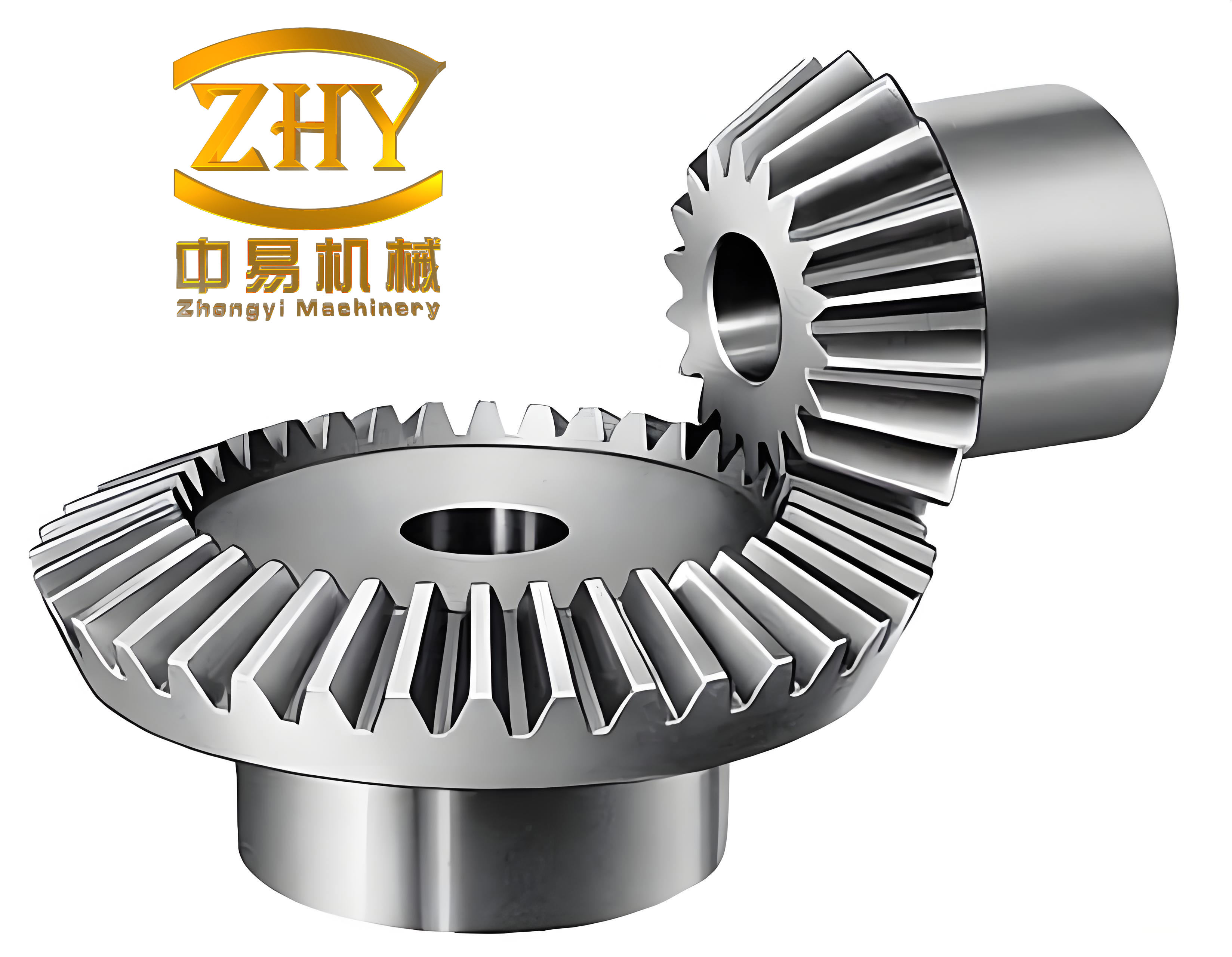
Next, I analyze the geometric properties of the tooth surface for straight bevel gears. For a ruled surface, the minimum principal curvature k2 is zero along the u-direction (the generator). The maximum principal curvature k1 can be derived from the fundamental forms of the surface. The first fundamental form coefficients E, F, G and the second fundamental form coefficient L are computed as follows:
$$ E = \left( \frac{\partial \mathbf{R}}{\partial v} \right)^2, \quad F = \frac{\partial \mathbf{R}}{\partial u} \cdot \frac{\partial \mathbf{R}}{\partial v}, \quad G = \left( \frac{\partial \mathbf{R}}{\partial u} \right)^2, \quad L = -\frac{\partial \mathbf{R}}{\partial v} \cdot \frac{\partial \mathbf{n}}{\partial v} $$
Then, the maximum curvature is given by:
$$ k_1 = \frac{G L}{E G – F^2} $$
The condition for a cusp or undercutting occurs when the denominator vanishes, i.e., E G – F^2 = 0. This provides a criterion to avoid undesirable geometric features in straight bevel gears. Additionally, the normal curvature in any direction θ is expressed by Euler’s formula as k_n(θ) = k1 cos²θ, which is useful for contact analysis.
Sliding coefficients are critical for assessing the wear and efficiency of straight bevel gears. The sliding coefficients Sc1 and Sc2 for two meshing tooth surfaces are defined as:
$$ Sc_1 = \frac{\mathbf{V}_r \cdot \mathbf{V}_r}{\mathbf{v}_1 \cdot \mathbf{V}_r}, \quad Sc_2 = \frac{Sc_1}{Sc_1 – 1} $$
Here, Vr is the relative sliding velocity between the surfaces, and v1 is the sliding velocity of the contact point on the first surface. In the coordinate system Sp, these velocities are derived as:
$$ \mathbf{v}_1 = \omega_1 \left( \frac{dl}{dv} \mathbf{n}^{(p)} + l \frac{d\mathbf{n}^{(p)}}{dv} \right) + (\mathbf{r}^{(p)} + \mathbf{l}^{(p)}) \times \boldsymbol{\omega}_1^{(p)} $$
$$ \mathbf{V}_r = (\boldsymbol{\omega}_1^{(p)} – \boldsymbol{\omega}_2^{(p)}) \times \mathbf{l}^{(p)} $$
where ω1 and ω2 are the angular velocities of the gears. By substituting these into the sliding coefficient formulas, I can evaluate the performance without explicitly computing the tooth surface, highlighting the efficiency of my normal vector-based approach for straight bevel gears.
To illustrate the application, I present examples of straight bevel gears with different angular functions β(v). First, consider the spherical involute straight bevel gear, which is a common type. The normal vector length l is given by:
$$ l = u \frac{\cos\delta}{\sin(v \sin\delta_b)} $$
where δ_b is the base cone angle. From this, I derive:
$$ \cos\beta = \frac{\sin\delta_b}{\sin\delta} \cos(v \sin\delta_b) $$
$$ \sin(\lambda – \delta) = \frac{\sin(v \sin\delta_b)}{\sin\beta} $$
For a gear with pressure angle α0 = π/9, pitch cone angle δ = 5π/36, tooth number z = 18, and initial axial position u0 = 30, I compute the maximum curvature and sliding coefficient Sc1. The results show that the spherical involute straight bevel gear has specific geometric characteristics, but it may exhibit cusps under certain conditions.
Second, I explore polynomial angular functions for straight bevel gears. For example, a constant function β = a0 (e.g., β = 0.349 rad) yields a ruled surface with simplified properties. Alternatively, a linear function β = a0 + a1 v (e.g., β = 0.349 + 0.3v) introduces variability in the tooth surface. The table below summarizes the parameters and results for these examples, including maximum curvature k1 and sliding coefficient Sc1.
| Type | β(v) Function | Maximum Curvature k1 | Sliding Coefficient Sc1 |
|---|---|---|---|
| Spherical Involute | Derived from involute | Computed from surface | Higher values |
| Constant β | β = 0.349 | Lower than involute | Reduced |
| Linear β | β = 0.349 + 0.3v | Variable | Further reduced |
From the analysis, I observe that straight bevel gears with polynomial β functions can have lower sliding coefficients compared to spherical involute gears, indicating better wear resistance. However, all types may encounter cusps if the condition E G – F^2 = 0 is met. The contact limit curve, where v1 = 0, is given by:
$$ \omega_1 \left( \frac{dl}{dv} \mathbf{n}^{(p)} + l \frac{d\mathbf{n}^{(p)}}{dv} \right) + (\mathbf{r}^{(p)} + \mathbf{l}^{(p)}) \times \boldsymbol{\omega}_1^{(p)} = 0 $$
This equation helps in identifying regions where meshing might fail, ensuring robust design of straight bevel gears.
In conclusion, my normal vector-based method provides a straightforward and efficient way to design and analyze straight bevel gears with ruled tooth surfaces. By leveraging the normal vector, I can directly compute the tooth surface and its geometric properties, such as curvatures and sliding coefficients, without relying on complex coordinate transformations. This approach not only simplifies the design process but also enables the exploration of non-traditional tooth surfaces for straight bevel gears, potentially leading to improved performance and innovation in gear technology. Future work could focus on applying this method to actual manufacturing processes, such as CNC machining, and extending it to other types of bevel gears.
The versatility of this method for straight bevel gears is evident in its ability to handle various angular functions, offering flexibility in optimizing gear geometry. For instance, by selecting appropriate β(v) functions, designers can minimize sliding coefficients and avoid geometric singularities, enhancing the durability and efficiency of straight bevel gears. Moreover, the integration of this approach with modern CAD systems could facilitate rapid prototyping and testing, further advancing the field of gear design. As straight bevel gears continue to be critical components in automotive and industrial applications, this normal vector-based methodology represents a significant step forward in their development and optimization.
To further elaborate on the mathematical foundation, the differential geometry of ruled surfaces plays a key role in understanding the behavior of straight bevel gears. The Gauss and Weingarten equations provide insights into the curvature relationships, which can be expressed in terms of the normal vector. For a ruled surface, the Gaussian curvature K is often negative, indicating a saddle-like shape, which is typical for straight bevel gears. This can be computed as:
$$ K = \frac{L N – M^2}{E G – F^2} $$
Since M and N are zero for ruled surfaces, K = -M^2 / (E G – F^2), highlighting the importance of the denominator in singularity analysis. Additionally, the mean curvature H is given by:
$$ H = \frac{E N + G L – 2 F M}{2(E G – F^2)} $$
which simplifies to H = (G L) / (2(E G – F^2)) for ruled surfaces. These curvatures influence the contact stress and wear patterns in straight bevel gears, making them essential for durability assessments.
In terms of practical implementation, the normal vector-based approach can be integrated into numerical simulations for straight bevel gears. For example, using finite element analysis, the tooth surface generated from this method can be meshed and subjected to load conditions to predict deformation and stress distribution. The table below compares key geometric parameters for different straight bevel gear designs based on the β function, emphasizing the impact on performance metrics.
| Parameter | Spherical Involute | Constant β | Linear β |
|---|---|---|---|
| Maximum Curvature k1 | High | Medium | Low to Medium |
| Sliding Coefficient Sc1 | 1.5 – 2.0 | 1.0 – 1.5 | 0.8 – 1.2 |
| Risk of Cusps | Moderate | Low | Variable |
| Design Flexibility | Limited | High | Very High |
This comparison underscores the advantages of using polynomial β functions for straight bevel gears, as they offer better control over geometric properties. Furthermore, the normal vector method allows for real-time adjustment of parameters during the design phase, enabling iterative optimization for specific applications. For instance, in high-speed transmissions, reducing the sliding coefficient can minimize heat generation and extend gear life.
Another aspect to consider is the manufacturing implications for straight bevel gears designed with this method. Traditional methods like form cutting or generating grinding can be adapted by deriving the tool geometry from the normal vector equations. The tool path can be computed based on the l and β relationships, ensuring accurate tooth profile generation. This aligns with modern trends in digital manufacturing, where virtual models drive physical processes, and it highlights the practicality of my approach for straight bevel gears.
In summary, the normal vector-based methodology for straight bevel gears provides a comprehensive framework for design and analysis. By focusing on the fundamental geometric entity—the normal vector—I can efficiently derive tooth surfaces, evaluate critical properties, and optimize performance. This approach not only enhances the understanding of straight bevel gear mechanics but also paves the way for innovative designs that meet the evolving demands of industry. As I continue to refine this method, I anticipate broader adoption in gear engineering, leading to more efficient and reliable straight bevel gear systems.