
In modern manufacturing, the demand for lightweight and high-strength components has driven the adoption of aluminum alloys in various structural applications, including gears. Traditional gear materials, such as steel, often result in high forming forces, poor模具 working conditions, and reduced tool life during precision forging. Aluminum alloys, particularly forgeable grades like 7075 aluminum, offer significant advantages due to their low density, excellent strength-to-weight ratio, and good corrosion resistance. This makes them ideal for applications in aerospace and automotive industries, where weight reduction is critical for improving fuel efficiency and structural stability. Among gear types, the straight bevel gear is commonly used in differential systems and other power transmission mechanisms due to its ability to transmit motion between intersecting shafts. However, the complex geometry of a straight bevel gear poses challenges in forging processes, such as ensuring complete die filling without defects like folds or cracks. Isothermal forging, which involves maintaining the die and workpiece at a constant elevated temperature, can mitigate these issues by reducing flow stress and improving material formability. In this study, we focus on the isothermal forging of an aluminum alloy straight bevel gear, employing numerical simulation and parameter optimization to achieve optimal forming conditions with minimal defects and reduced forming loads.
The straight bevel gear under investigation has specific geometric parameters that influence the forging process. Key dimensions include the number of teeth, module, pressure angle, and other critical features that determine the gear’s performance. For instance, the average pitch diameter and cone length play a vital role in metal flow during deformation. To facilitate the forging process, we adopted an open-die forging approach with a simplified flash design, where the dies do not fully close at the end of the process. This helps in lowering the forming load and extending模具 life by allowing excess material to form a uniform flash around the parting line. The cold forging model was developed based on these parameters, and the parting surface was selected at the maximum cross-section of the gear side to ensure that the tooth profile is entirely formed in the lower die. This strategic design minimizes stress concentrations and promotes uniform material distribution. The use of aluminum alloy, specifically 7075, is advantageous due to its superior forgeability compared to other materials, but it requires careful control of process parameters to avoid defects. The initial simulations revealed that without optimization, the forging process could lead to folding and high forming loads, underscoring the need for a systematic approach to parameter adjustment.
To analyze the isothermal forging process, we established a finite element model using Deform-3D software, which is widely used for simulating metal forming operations. The model included the gear-shaped die, back taper die, and the billet, all assembled to represent the actual forging setup. Given the rotational symmetry of the straight bevel gear, we simplified the model by considering only a single tooth segment to reduce computational time while maintaining accuracy. The material properties of 7075 aluminum alloy were defined, including its flow stress behavior at elevated temperatures, which is crucial for isothermal conditions. The initial parameters set for simulation included temperature, flash thickness, web height, web thickness, fillet radius, punch velocity, and friction coefficient. For example, the temperature was varied between 400°C and 475°C to study its effect on material flow and forming load. The finite element analysis allowed us to observe the metal deformation stages, starting from initial upsetting, through tooth cavity filling, to flash formation. The results indicated that the process involves multiple phases: initially, the billet undergoes upsetting, followed by H-shaped deformation as material flows into the tooth cavities, and finally, flash formation occurs as the dies approach closure. The forming load was monitored throughout, showing a significant increase during the final stages due to the resistance from flash and die contact.
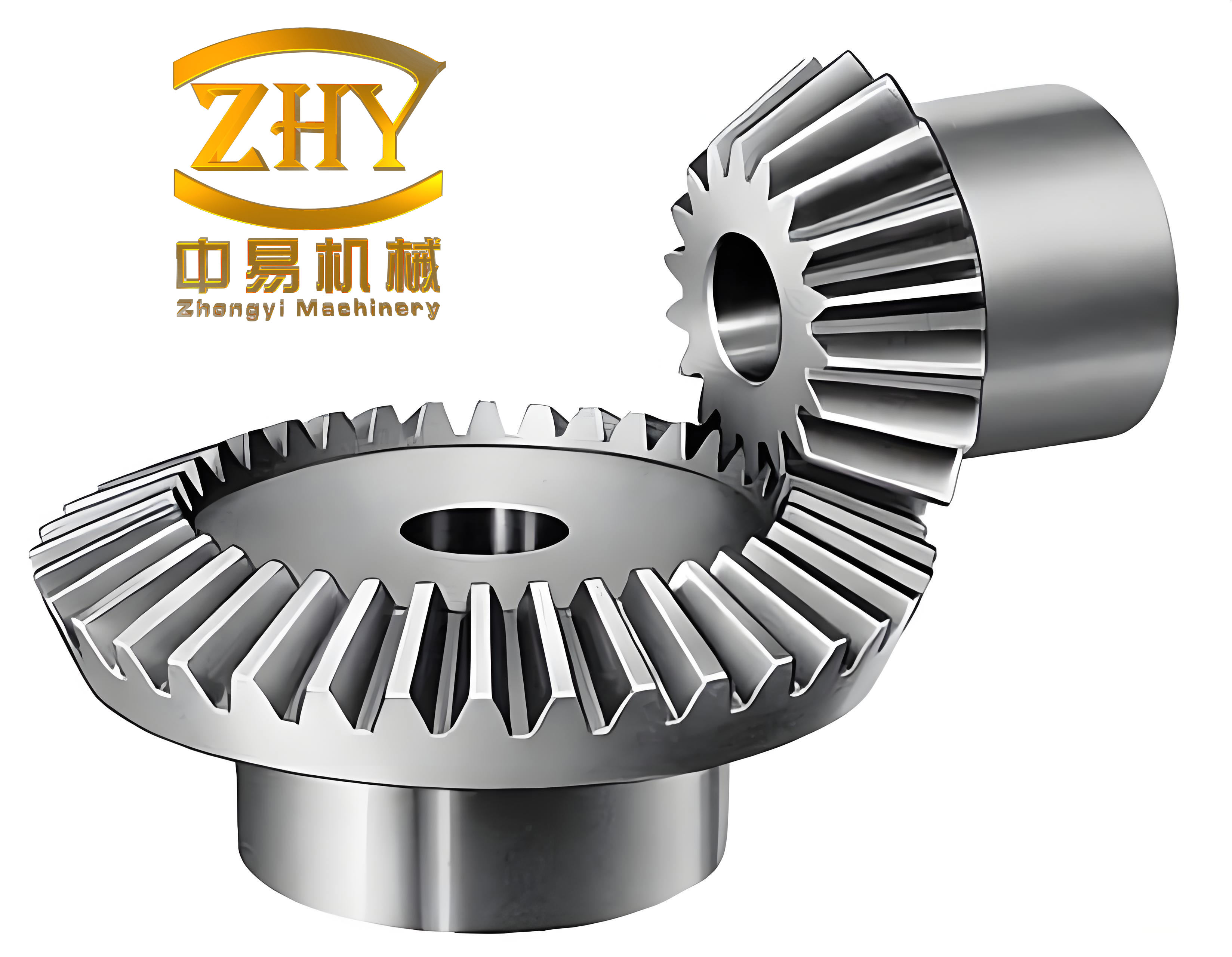
The simulation outcomes highlighted several key aspects of the straight bevel gear forging process. In the early stages, the billet experienced uniform compression, leading to a reduction in height and radial expansion. As deformation progressed, the material began to flow into the intricate tooth cavities, which required sufficient pressure to ensure complete filling without voids or folds. The formation of a blind hole in the center of the gear was observed, which is typical in such forgings and must be controlled to prevent defects. The load-displacement curve from the simulation showed that the forming load remained relatively low during the initial and intermediate stages but surged sharply as the flash thickened and the tooth cavities filled completely. This load peak, reaching up to 73 kN in unoptimized cases, poses a risk of模具 wear and potential failure. Moreover, folding defects were identified in certain regions, particularly at the junctions where material flow reversed or stagnated. These defects are critical as they can compromise the gear’s mechanical integrity and fatigue life. Therefore, optimizing process parameters became essential to achieve a defect-free straight bevel gear with reduced forming loads. The insights from these simulations provided a foundation for designing an optimization strategy using orthogonal experiments and single-variable analyses.
Orthogonal experimental design was employed to systematically optimize the key parameters influencing the isothermal forging of the straight bevel gear. The selected factors included temperature (A), web thickness (B), web height (C), fillet radius (D), and flash thickness (E), each at four levels to cover a wide range of conditions. The orthogonal array L16(4^5) was chosen, resulting in 16 distinct experimental runs. This approach allows for efficient exploration of the parameter space while minimizing the number of simulations required. The response variable was the forming load, with the objective of minimizing it while ensuring complete die filling and absence of defects like folding or cracking. The initial parameter levels were set based on preliminary simulations and industry practices, such as temperatures ranging from 400°C to 475°C, and flash thicknesses from 0.6 mm to 1.2 mm. The results from these orthogonal trials were analyzed using range analysis to determine the influence of each parameter on the forming load. The range values indicated the degree of impact, with larger ranges signifying greater sensitivity. For instance, temperature had the most significant effect, followed by flash thickness, fillet radius, web height, and web thickness. This hierarchy guided subsequent optimization steps, as adjusting the most influential parameters could lead to substantial improvements in process efficiency.
| Experiment No. | Temperature (°C) | Web Thickness (mm) | Web Height (mm) | Fillet Radius (mm) | Flash Thickness (mm) | Forming Load (kN) | Filling Condition |
|---|---|---|---|---|---|---|---|
| 1 | 400 | 6 | 19 | 1 | 0.6 | 21.9 | Fold, filled |
| 2 | 400 | 7 | 20 | 2 | 0.8 | 159 | Fold, filled |
| 3 | 400 | 8 | 21 | 3 | 1.0 | 140 | No fold, filled |
| 4 | 400 | 9 | 22 | 4 | 1.2 | 126 | Fold, filled |
| 5 | 425 | 6 | 20 | 3 | 1.2 | 84.1 | Fold, filled |
| 6 | 425 | 7 | 19 | 4 | 1.0 | 122 | No fold, filled |
| 7 | 425 | 8 | 22 | 1 | 0.8 | 138 | Fold, filled |
| 8 | 425 | 9 | 21 | 2 | 0.6 | 100 | No fold, filled |
| 9 | 450 | 6 | 21 | 4 | 0.8 | 107 | Fold, filled |
| 10 | 450 | 7 | 22 | 3 | 0.6 | 123 | No fold, filled |
| 11 | 450 | 8 | 19 | 2 | 1.2 | 57.6 | Fold, filled |
| 12 | 450 | 9 | 20 | 1 | 1.0 | 101 | Fold, filled |
| 13 | 475 | 6 | 22 | 2 | 1.0 | 77.1 | No fold, crack, filled |
| 14 | 475 | 7 | 21 | 1 | 1.2 | 63.2 | No fold, crack, filled |
| 15 | 475 | 8 | 20 | 4 | 0.6 | 86.4 | Fold, filled |
| 16 | 475 | 9 | 19 | 3 | 0.8 | 97.7 | No fold, filled |
The analysis of the orthogonal experiments revealed that temperature was the most dominant factor affecting the forming load for the straight bevel gear. This can be attributed to the thermal sensitivity of aluminum alloys, where higher temperatures reduce the flow stress and enhance ductility, thereby lowering the required forging force. The relationship between temperature and flow stress can be expressed using a constitutive equation, such as the Arrhenius-type model commonly used for hot deformation:
$$ \sigma = K \cdot \varepsilon^n \cdot \exp\left(\frac{Q}{RT}\right) $$
where \(\sigma\) is the flow stress, \(K\) is a material constant, \(\varepsilon\) is the strain, \(n\) is the strain-hardening exponent, \(Q\) is the activation energy for deformation, \(R\) is the universal gas constant, and \(T\) is the absolute temperature. For the straight bevel gear forging, increasing the temperature from 400°C to 475°C resulted in a significant decrease in forming load, as evidenced by the range analysis. Flash thickness was the second most influential parameter; a thicker flash allows more material to flow outward, reducing resistance but potentially increasing waste, whereas a thinner flash increases constraint and load. The optimal flash thickness of 1.2 mm balanced these effects, minimizing load without compromising fill quality. Fillet radius also played a crucial role, as sharper radii can lead to stress concentrations and folding, while larger radii promote smoother material flow. Web height and thickness had relatively minor impacts, but their optimization was still necessary to achieve a defect-free straight bevel gear.
Based on the orthogonal results, we identified a preliminary optimal parameter combination: A4B3C3D2E4, corresponding to temperature 475°C, web thickness 8 mm, web height 21 mm, fillet radius 2 mm, and flash thickness 1.2 mm. However, additional simulations showed that this combination still resulted in folding defects in some cases. Therefore, we performed single-variable optimization by iteratively adjusting each parameter while keeping others constant, focusing on the most influential factors. Starting from experiment 16, which had no folding and complete filling, we applied the optimal levels from the range analysis in sequence. This led to a refined combination: A4B4C1D3E4, i.e., temperature 475°C, web thickness 9 mm, web height 19 mm, fillet radius 3 mm, and flash thickness 1.2 mm. This setup achieved a forming load of 56 kN, representing a reduction of approximately 30% compared to the initial unoptimized case, and ensured full die filling without folds or cracks. Furthermore, we extended the optimization to include punch velocity and friction coefficient, which were not part of the initial orthogonal design due to their secondary effects but still warranted attention. Single-variable tests showed that a punch velocity of 0.01 mm/s and a friction coefficient of 0.15 yielded the best results, as lower friction reduced shear stresses and lower velocity allowed for more controlled material flow, both contributing to lower loads and better surface quality for the straight bevel gear.
The optimization process underscores the importance of a holistic approach in isothermal forging of straight bevel gears. The use of numerical simulation enabled us to visualize metal flow and identify potential defects early, while orthogonal experiments provided a structured method for parameter screening. The final optimized parameters not only reduced the forming load but also enhanced the geometric accuracy and mechanical properties of the forged straight bevel gear. For instance, the elimination of folding defects is critical for fatigue resistance, as stress concentrators can lead to premature failure in service. The reduction in forming load also implies lower energy consumption and longer模具 life, which are economically beneficial for mass production. In practice, these findings can be applied to industrial forging processes for aluminum alloy gears, with adjustments based on specific gear designs and material batches. Future work could explore the effects of other parameters, such as billet preform shape or cooling rates, and incorporate advanced material models to further improve prediction accuracy. Overall, this study demonstrates that through systematic optimization, isothermal forging can produce high-quality straight bevel gears with minimal defects and efficient use of resources.
In conclusion, the isothermal forging of aluminum alloy straight bevel gears requires careful control of multiple process parameters to achieve optimal outcomes. Our investigation using finite element simulation and orthogonal experimentation revealed that temperature, flash thickness, fillet radius, web height, and web thickness significantly influence the forming load and defect formation. The optimized parameter set—temperature 475°C, web thickness 9 mm, web height 19 mm, fillet radius 3 mm, flash thickness 1.2 mm, punch velocity 0.01 mm/s, and friction coefficient 0.15—resulted in a substantial reduction in forming load to 56 kN and ensured complete filling without folds or cracks. This approach not only enhances the manufacturing efficiency of straight bevel gears but also supports the broader adoption of aluminum alloys in gear applications, contributing to lightweight design goals in automotive and aerospace industries. The methodologies developed here can be extended to other complex forging processes, providing a framework for parameter optimization in metal forming operations.