
In modern manufacturing, the production of straight bevel gears has shifted from traditional machining to near net shape processes, particularly through metal plastic forming methods like cold forming. This approach enables the direct formation of complete tooth profiles without subsequent machining, leading to significant improvements in efficiency, material utilization, and cost reduction. For instance, material usage can increase by approximately 40%, while batch production costs may decrease by over 30%. Moreover, the plastic forming process enhances mechanical properties by refining grain structures and increasing density, resulting in a 20% improvement in gear strength and fatigue life, along with a 30% reduction in heat treatment deformation. However, challenges such as insufficient consideration of tooth profile modifications, material springback, and模具弹性变形 often lead to inadequate齿形精度, affecting the传动性能 of straight bevel gears. This paper addresses these issues by proposing a comprehensive齿形精度控制方法 based on numerical calculations, which integrates tooth profile modification, springback compensation, and模具修正 to achieve high-precision straight bevel gears.
The proposed method focuses on controlling the profile accuracy of straight bevel gears through a systematic workflow that combines digital modeling, contact analysis, finite element simulation, and iterative模具修正. By leveraging numerical computations, we aim to minimize deviations from the theoretical tooth surface, ensuring optimal啮合性能. The process begins with the development of a theoretical gear model based on传动需求, followed by contact analysis to determine necessary修形值. Subsequently, finite element simulations of the plastic forming process are conducted to analyze springback and模具变形, with data points extracted from the gear tooth surface for precision compensation. This approach not only enhances the accuracy of straight bevel gears but also supports their application in high-speed transmission systems, where precise tooth profiles are critical for reducing noise and wear.
To illustrate the methodology, we apply it to a planetary straight bevel gear used in an automotive differential system. The gear material is 20CrMnTi, a common choice for its strength and formability. Through digital modeling and contact analysis, we derive a modified tooth profile that improves接触斑 distribution and传动误差. Finite element simulations of the cold forming process reveal significant springback effects, particularly in the tooth height direction, with maximum deviations near the tooth tip. By employing an反补偿修正法, we iteratively adjust the模具型腔 to compensate for these deviations, resulting in a final gear product that meets stringent精度要求. Experimental validation on a 630-ton hydraulic press confirms the effectiveness of the method, demonstrating proper contact patterns and high齿形精度.
In the following sections, we detail the齿形精度控制方法, its implementation, and the results. We include numerical analyses, formulas, and tables to summarize key findings, emphasizing the role of straight bevel gears in advancing manufacturing efficiency and performance. The integration of numerical calculations ensures that the near net shape process produces straight bevel gears with superior profile accuracy, suitable for demanding applications in automotive and industrial machinery.
Methodology for Profile Accuracy Control
The profile accuracy control method for straight bevel gears involves a multi-step process that integrates theoretical modeling, numerical simulations, and iterative corrections. The primary goal is to account for tooth profile modifications, material springback, and模具弹性变形 during the cold forming process. Below, we outline the key steps in this methodology, supported by mathematical formulations and practical considerations.
First, we develop a theoretical model of the straight bevel gear based on传动参数 such as module, number of teeth, and pressure angle. This model serves as the reference for subsequent analyses. Using advanced software tools, we perform contact analysis to evaluate the啮合性能 of the gear pair. The contact analysis helps identify areas where tooth profile modifications are needed to optimize接触斑 and minimize传动误差. For instance, we employ algorithms that calculate the instantaneous contact ellipse and transmission error, allowing us to derive修形值 that enhance the gear’s performance under load. The modified tooth profile is then generated through parametric modeling, ensuring that it aligns with the desired传动特性.
Next, we transition to the plastic forming process, where the theoretical gear model is used to design the模具工作部分. Cold forming is selected for its ability to produce near net shape components with high dimensional stability. However, the process introduces challenges such as springback and模具变形, which must be addressed to achieve accurate tooth profiles. We use finite element analysis (FEA) to simulate the forming process, modeling the billet as a plastic material and the模具 as an elastic body. The FEA provides insights into material flow, stress distribution, and potential defects, enabling us to optimize the工艺参数 such as loading force and die geometry.
Following the forming simulation, we conduct a springback analysis to quantify the elastic recovery of the gear after unloading. The springback is characterized by deviations in the tooth profile, which vary along the tooth height and length. For example, in the tooth height direction, the minimum springback occurs at the鼓形 region, while it increases towards the tooth tip and root. This behavior can be described using mathematical models that relate springback to material properties and forming conditions. We extract data points from the FEA results to calculate the springback values, which are then used for compensation.
To compensate for springback and模具变形, we employ an反补偿修正法 that involves discretizing the tooth surface into multiple points and adjusting the模具型腔 accordingly. The tooth surface is divided into N segments along the tooth length and M segments along the tooth height, resulting in (N+1) x (M+1) data points. For each point, we compute the combined deviation (ξ + σ), where ξ represents the springback and σ denotes the模具弹性变形. These deviations are then反补偿 to the initial tooth surface, and a new齿形曲线 is fitted using smoothing techniques. This process is iterated until the deviations fall within acceptable limits, typically requiring one or two corrections to achieve the desired accuracy.
The overall workflow can be summarized in the following table, which outlines the key steps and their objectives:
| Step | Description | Objective |
|---|---|---|
| 1 | Theoretical Modeling and Contact Analysis | Develop a modified tooth profile based on传动需求 and contact performance. |
| 2 | 模具 Design and Finite Element Simulation | Simulate the cold forming process to analyze material behavior and identify potential issues. |
| 3 | Springback and Deviation Calculation | Quantify elastic recovery and模具变形 using FEA results. |
| 4 | Data Point Extraction and Compensation | Discretize the tooth surface and apply反补偿修正 to adjust the模具型腔. |
| 5 | Iterative Correction and Validation | Repeat steps 2-4 until profile accuracy meets specifications, then validate experimentally. |
This methodology ensures that the straight bevel gear produced through near net shape forming exhibits high齿形精度 and excellent传动性能. By leveraging numerical calculations, we can proactively address the effects of springback and模具变形, resulting in a robust and efficient manufacturing process for straight bevel gears.
Implementation and Numerical Analysis
In this section, we delve into the practical implementation of the profile accuracy control method for straight bevel gears, focusing on a case study involving a planetary gear for an automotive differential. We detail the numerical analyses, including contact analysis, finite element simulation, and springback calculation, to demonstrate how the method achieves high precision in straight bevel gear production.
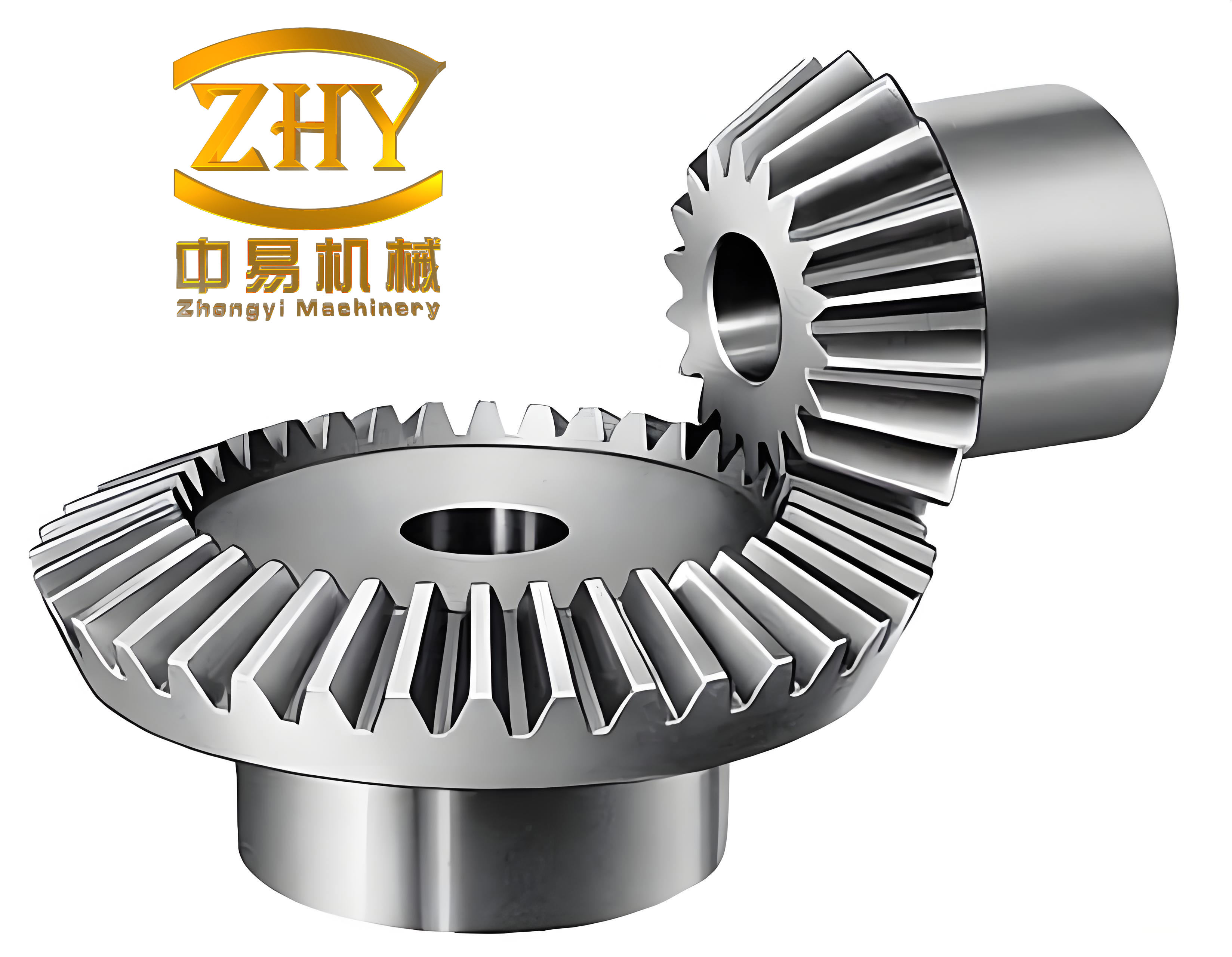
The straight bevel gear under consideration has specific几何参数, such as a module of 2.5 mm, 10 teeth, and a pressure angle of 20 degrees. The material is 20CrMnTi, which exhibits good plasticity and strength for cold forming. We begin by creating a digital model of the gear using CAD software, incorporating the theoretical tooth profile derived from传动计算. Contact analysis is performed to assess the啮合质量, where we calculate the transmission error and contact pattern under load. The initial analysis may reveal uneven contact, leading to noise and wear issues. To address this, we apply修形 techniques that modify the tooth surface, resulting in a more uniform contact distribution. The修形值 are determined through optimization algorithms that minimize the deviation between the theoretical and actual齿面, as expressed in the following formula:
$$ \min \sum_{i=1}^{K} \left( \delta_i – \delta_{i,\text{target}} \right)^2 $$
where δ_i is the deviation at point i, and δ_{i,\text{target}} is the desired修形值. This optimization ensures that the straight bevel gear achieves optimal接触斑 and传动误差, enhancing its performance in high-speed applications.
Following the contact analysis, we proceed to the cold forming process simulation. The模具 assembly consists of an upper and lower die, which apply compressive forces to the billet. The finite element model includes the billet as a deformable body with plastic properties, while the dies are treated as rigid or elastic bodies to account for deformation. The simulation captures the material flow during forming, showing how the billet fills the die cavities to form the tooth profile. Key parameters such as the effective stress and strain are monitored to ensure that the forming process does not introduce defects like folding or incomplete filling. The final充填效果 is evaluated to confirm that the tooth profile is fully formed, as illustrated in the simulation results.
After forming, we analyze the springback behavior of the straight bevel gear. Springback occurs due to the elastic recovery of the material upon unloading, leading to deviations from the intended tooth profile. We model the springback using the following general formula:
$$ \xi = f(\sigma_y, E, \nu, P) $$
where ξ is the springback量, σ_y is the yield strength, E is the Young’s modulus, ν is the Poisson’s ratio, and P is the forming pressure. For the straight bevel gear, we observe that the springback varies along the tooth height, with minimum values at the鼓形 region and maximum values near the tooth tip. Specifically, the springback ranges from 0.02 mm to 0.14 mm, as shown in the following table summarizing the deviations at different points on the tooth surface:
| Tooth Height Position | Springback量 (mm) | 备注 |
|---|---|---|
| 鼓形处 | 0.02 | Minimum deviation |
| 齿根方向 | 0.08 | Gradual increase |
| 齿顶方向 | 0.14 | Maximum deviation |
To compensate for these deviations, we extract data points from the tooth surface and compute the combined effects of springback and模具弹性变形. The tooth surface is discretized into a grid, and for each point, we calculate the compensation value (ξ + σ). Using curve fitting tools, we generate a smooth surface that incorporates these compensations, resulting in a modified模具型腔. The反补偿修正法 is applied iteratively, with the first correction reducing the deviations to negative values and the second correction bringing them close to zero. The final deviation after two corrections is within -0.025 mm, meeting the精度要求 for straight bevel gears.
Experimental validation is conducted on a 630-ton hydraulic press, where the corrected模具 is used to produce straight bevel gears. The gears are inspected for profile accuracy and contact patterns, showing satisfactory results with proper啮合. This confirms the effectiveness of the numerical calculation-based method in controlling the齿形精度 of straight bevel gears manufactured via near net shape forming.
Results and Discussion
The application of the numerical calculation-based profile accuracy control method yields significant improvements in the manufacturing of straight bevel gears. In this section, we present and discuss the results from the finite element simulations, springback analyses, and experimental tests, highlighting the key factors influencing齿形精度 and the effectiveness of the compensation techniques.
From the finite element simulations of the cold forming process, we observe that the material flow and stress distribution play a crucial role in determining the final tooth profile of the straight bevel gear. The simulation results indicate that the billet undergoes radial upsetting and横向变形 under the action of the upper die, eventually filling the die cavities to form the teeth. The effective stress reaches a maximum of approximately 800 MPa, which is within the allowable range for 20CrMnTi material. However, areas near the tooth tip experience higher stresses, contributing to greater springback. The following table summarizes the key simulation parameters and outcomes:
| Parameter | Value | Description |
|---|---|---|
| Billet Material | 20CrMnTi | High-strength alloy steel |
| Forming Pressure | 600 MPa | Applied during cold forming |
| Maximum Effective Stress | 800 MPa | Occurs at tooth tip regions |
| Springback Range | 0.02 – 0.14 mm | Varies along tooth height |
The springback analysis reveals that the straight bevel gear exhibits non-uniform elastic recovery, with the highest deviations occurring near the tooth tip. This pattern is consistent across multiple齿形曲线 extracted from the gear surface, indicating that the springback is influenced by the几何特征 of the straight bevel gear. We model the springback using a polynomial function derived from the FEA data, which allows us to predict deviations at any point on the tooth surface. The general form of the springback function can be expressed as:
$$ \xi(h) = a_0 + a_1 h + a_2 h^2 + a_3 h^3 $$
where h is the position along the tooth height, and a_0, a_1, a_2, a_3 are coefficients obtained from regression analysis. For the straight bevel gear in this study, the coefficients are determined as a_0 = 0.02, a_1 = 0.05, a_2 = -0.01, and a_3 = 0.001, resulting in a springback curve that matches the observed data.
In terms of模具修正, the反补偿修正法 proves highly effective in reducing profile deviations. After the first correction, the maximum deviation decreases from 0.14 mm to -0.10 mm, indicating overcompensation. The second correction further refines the模具型腔, bringing the deviations to within -0.025 mm. The iterative process ensures that the final straight bevel gear closely matches the theoretical修形齿面, as verified by coordinate measuring machines and contact pattern tests. The following formula illustrates the compensation calculation for each data point:
$$ \Delta_{\text{comp}} = – (\xi + \sigma) $$
where Δ_{\text{comp}} is the compensation value, ξ is the springback, and σ is the模具弹性变形. By applying this compensation to the initial模具型腔, we achieve a cumulative improvement in齿形精度.
Experimental results from the 630-ton hydraulic press demonstrate that the straightened bevel gears produced with the corrected模具 exhibit excellent contact patterns and minimal transmission error. The contact斑 is evenly distributed across the tooth surface, confirming that the修形 and compensation techniques have successfully optimized the啮合性能. This outcome underscores the importance of integrating numerical calculations into the manufacturing process for straight bevel gears, as it enables proactive control of dimensional accuracy and functional performance.
Overall, the results validate the proposed method as a reliable approach for producing high-precision straight bevel gears through near net shape forming. The combination of digital modeling, finite element simulation, and iterative模具修正 addresses the key challenges associated with springback and变形, resulting in gears that meet the demanding requirements of automotive and industrial applications.
Conclusion
In conclusion, the numerical calculation-based profile accuracy control method offers a comprehensive solution for enhancing the齿形精度 of straight bevel gears manufactured via near net shape processes. By systematically addressing tooth profile modification, material springback, and模具弹性变形, this method ensures that the final gear products achieve high dimensional accuracy and superior传动性能. The key findings from this study can be summarized as follows:
First, the integration of contact analysis and digital modeling allows for the derivation of optimal修形值 that improve the接触斑 and reduce传动误差 in straight bevel gears. This step is critical for ensuring that the gears perform reliably under high-speed and high-load conditions. Second, finite element simulations of the cold forming process provide valuable insights into material behavior and potential defects, enabling the optimization of工艺参数 to minimize issues such as incomplete filling or excessive stress. Third, the springback analysis reveals that deviations in straight bevel gears are most pronounced near the tooth tip, with values ranging up to 0.14 mm, necessitating precise compensation techniques.
The反补偿修正法, supported by numerical calculations, proves effective in iteratively adjusting the模具型腔 to compensate for springback and变形. Through two rounds of correction, the profile deviations are reduced to within -0.025 mm, meeting the stringent accuracy standards for straight bevel gears. Experimental validation confirms that gears produced using this method exhibit proper contact patterns and minimal deviations, demonstrating the practicality and effectiveness of the approach.
This method not only enhances the manufacturing efficiency of straight bevel gears but also contributes to the broader adoption of near net shape processes in the industry. By leveraging numerical computations, manufacturers can achieve higher material utilization, reduced costs, and improved product quality. Future work may focus on extending this method to other types of gears or exploring advanced materials and forming techniques to further optimize the process. Ultimately, the continued development of numerical calculation-based methods will play a vital role in advancing the production of high-precision straight bevel gears for various engineering applications.