
In modern manufacturing, precision forging of straight bevel gears is a critical process that aims to produce components with high dimensional accuracy and minimal post-processing requirements. However, a significant challenge arises from the elastic recovery or springback that occurs after the forging process, leading to deviations in the final gear geometry. This springback phenomenon affects both the workpiece and the die, resulting in inaccuracies that can compromise the performance of the straight bevel gear in applications such as automotive transmissions and industrial machinery. To address this issue, we have developed a method based on reverse compensation principles, utilizing DEFORM-3D simulation software to analyze and compensate for elastic deformations during the forging process. This approach enables the design of a precise die cavity that accounts for springback, ensuring that the forged straight bevel gear meets stringent technical specifications without additional machining steps.
The fundamental principle behind our method involves understanding the elastic deformations that occur during the forging of straight bevel gears. When the die closes and applies pressure to the workpiece, both the die and the workpiece undergo elastic deformation due to the internal stresses generated. Upon demolding, the release of these stresses causes springback, where the materials attempt to return to their original shapes. This results in a total error in the final straight bevel gear geometry, which can be expressed as the sum of the die elastic deformation error and the workpiece elastic deformation error. Mathematically, this is represented as:
$$ \Delta_{\text{total}} = h + s $$
where \( \Delta_{\text{total}} \) is the total error, \( h \) is the die elastic deformation error, and \( s \) is the workpiece elastic deformation error. By accurately quantifying these errors through finite element analysis (FEA), we can apply a reverse compensation to the die design, effectively canceling out the springback effects and producing a straight bevel gear with the desired dimensions.
To implement this, we conducted a detailed FEA using DEFORM-3D, focusing on a straight bevel gear with 26 teeth and a module of 8 mm. The analysis was divided into two phases: the clamping phase, where the die and workpiece are in contact under forging pressure, and the demolding phase, where they are separated and springback occurs. In the clamping phase, the workpiece was modeled as a plastic body, while the die was treated as a rigid body to simulate the forging conditions. The finite element assembly model was set up with specific parameters to ensure accuracy, as summarized in the table below:
| Parameter | Value |
|---|---|
| Die Material | H13 |
| Workpiece Material | 20CrMnTi |
| Die Temperature (°C) | 20 |
| Workpiece Temperature (°C) | 20 |
| Meshing Method | Relative Method |
| Total Mesh Elements | 80,000 |
| Environmental Temperature (°C) | 20 |
| Iteration Method | Direct Iteration |
| Heat Convection Coefficient (kW/m²·K) | 20 |
| Reaction Rate Coefficient (mm/s) | 0.00025 |
| Maximum Iteration Steps | 200 |
During the clamping phase, the die and workpiece interact under high pressure, leading to elastic deformations that are initially unaccounted for in the die design. The finite element model allowed us to simulate this interaction and extract data on the displacement and stress distributions. For instance, the deformation of the die cavity was analyzed by examining the nodal displacements after applying the forging load. The results indicated that the elastic deformation of the die increased progressively from the small end to the large end of the straight bevel gear, highlighting the non-uniform nature of the springback effect. This deformation pattern is critical for designing the compensated die cavity, as it ensures that the final straight bevel gear geometry is accurate across all tooth profiles.
In the demolding phase, the die and workpiece were separated, and their springback behaviors were analyzed. The die was switched from a rigid body to an elastic body in the simulation to capture its recovery. Similarly, the workpiece was modeled as an elastic body to study its rebound. The boundary conditions included fixing the die base and applying the residual forces from the clamping phase. The simulation was run for a short duration to observe the instantaneous springback. The nodal displacements from this phase were exported and processed to determine the compensation values. For example, the displacement data for selected nodes on the die are shown in the following table, which illustrates the initial coordinates, the displacement due to springback, and the new compensated coordinates:
| Node ID | Initial X (mm) | Initial Y (mm) | Initial Z (mm) | Displacement X (mm) | Displacement Y (mm) | Displacement Z (mm) | New X (mm) | New Y (mm) | New Z (mm) |
|---|---|---|---|---|---|---|---|---|---|
| 1 | 10.1179 | -100.621 | 170.039 | -0.172334 | -0.111683 | 0.0777267 | 9.94556 | -100.733 | 170.117 |
| 2 | 11.6902 | -100.446 | 170.035 | -0.171833 | -0.114276 | 0.0648049 | 11.5184 | -100.560 | 170.100 |
| 20286 | 101.097 | -0.960619 | 170.033 | 0.310335 | 0.000112231 | 0.112206 | 101.408 | -0.960506 | 170.146 |
| 20287 | 101.130 | -2.50043 | 170.138 | 0.309482 | 0.00128438 | 0.114485 | 101.439 | -2.49915 | 170.252 |
The displacement data reveal that the die undergoes significant elastic recovery, particularly in the Z-direction, which corresponds to the axial direction of the straight bevel gear. This compensation is essential for achieving the desired tooth profile accuracy. Similarly, the workpiece springback was analyzed by tracking nodal displacements along five radial curves on the gear tooth surface. These curves were defined from the tooth root to the tip, and the displacements in the X, Y, and Z directions were recorded. The average displacements across these curves were calculated to determine the overall springback pattern of the straight bevel gear. The results are summarized in the table below:
| Curve ID | Average X Displacement (mm) | Average Y Displacement (mm) | Average Z Displacement (mm) |
|---|---|---|---|
| 1 | 0.024900 | 0.011771 | 2.117955 |
| 2 | 0.028473 | 0.012670 | 2.117434 |
| 3 | 0.028034 | 0.012584 | 2.116977 |
| 4 | 0.024967 | 0.015246 | 2.116399 |
| 5 | 0.022853 | 0.017713 | 2.116058 |
The data show that the springback varies along the tooth profile, with the X-direction displacement being larger in the middle regions and decreasing towards the edges. This non-uniformity underscores the importance of applying an averaged compensation to the die cavity to ensure consistency in the straight bevel gear production. The overall average displacements for the workpiece were computed as \( \Delta X = 0.0332 \, \text{mm} \), \( \Delta Y = 0.0148 \, \text{mm} \), and \( \Delta Z = 2.1284 \, \text{mm} \). These values were used in the reverse compensation formula to adjust the die cavity coordinates.
The compensated die cavity coordinates were calculated by adding the die springback displacements and the workpiece average displacements to the initial die coordinates. This can be expressed as:
$$ \text{Final Die Node Coordinate} = \text{Initial Die Coordinate} + \text{Die Displacement} + \text{Workpiece Average Displacement} $$
For example, considering the nodal data, the new coordinates for the die were derived as shown in the previous table. This compensation ensures that after springback, the forged straight bevel gear will have the intended dimensions. The effectiveness of this approach was validated through experimental forging trials using a 40 MN cold forging press. The parameters for the trial included a forging pressure of 35 MN, a speed of 100 mm/s, and ambient temperatures for both the die and workpiece. The die was designed with the compensated cavity, and the forging process was conducted with the die acting as the lower mold. The results demonstrated that the straight bevel gear produced had dimensional accuracy within the required tolerances, confirming the reliability of our method.
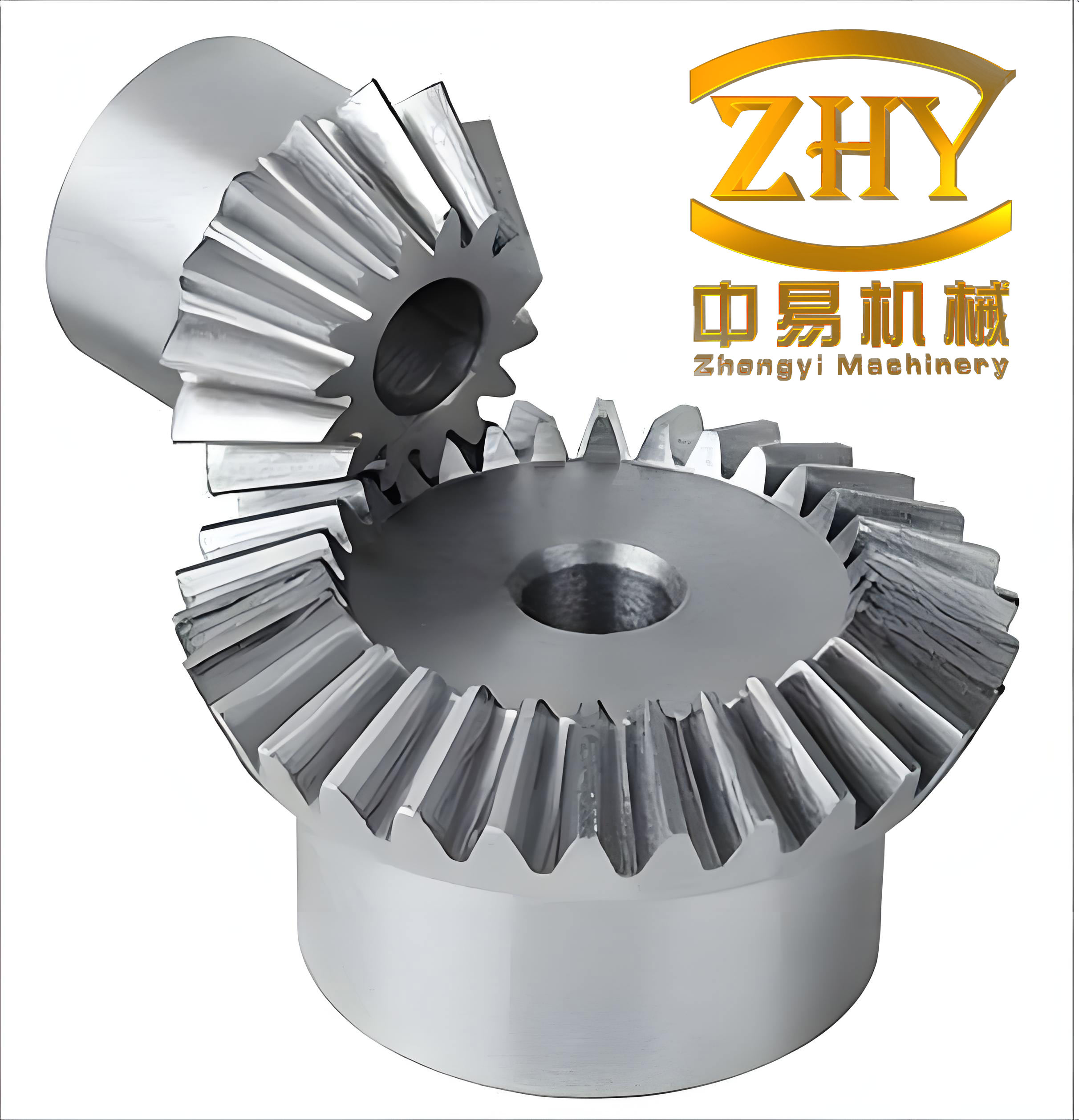
The image above illustrates a typical straight bevel gear forged using our compensated die design, highlighting the precise tooth profile achieved without post-forging corrections. This visual evidence supports the numerical findings from the FEA, showing that the reverse compensation method effectively mitigates springback-related errors. In conclusion, our study presents a comprehensive framework for the accurate design of forging dies for straight bevel gears by leveraging DEFORM-3D simulations and reverse compensation principles. This approach not only enhances the precision of straight bevel gears but also reduces manufacturing costs by eliminating the need for secondary operations. Future work could explore the application of this method to other gear types or materials, further advancing the field of precision forging.
Throughout this process, the straight bevel gear served as the focal point, with multiple analyses confirming that the springback effects are predictable and compensatable. The use of finite element analysis provided deep insights into the elastic behaviors, enabling a data-driven design approach. By integrating simulation results with practical experimentation, we have established a robust methodology for producing high-quality straight bevel gears that meet modern industrial standards. This underscores the importance of advanced simulation tools in addressing complex manufacturing challenges, particularly in the realm of gear production where accuracy is paramount.