
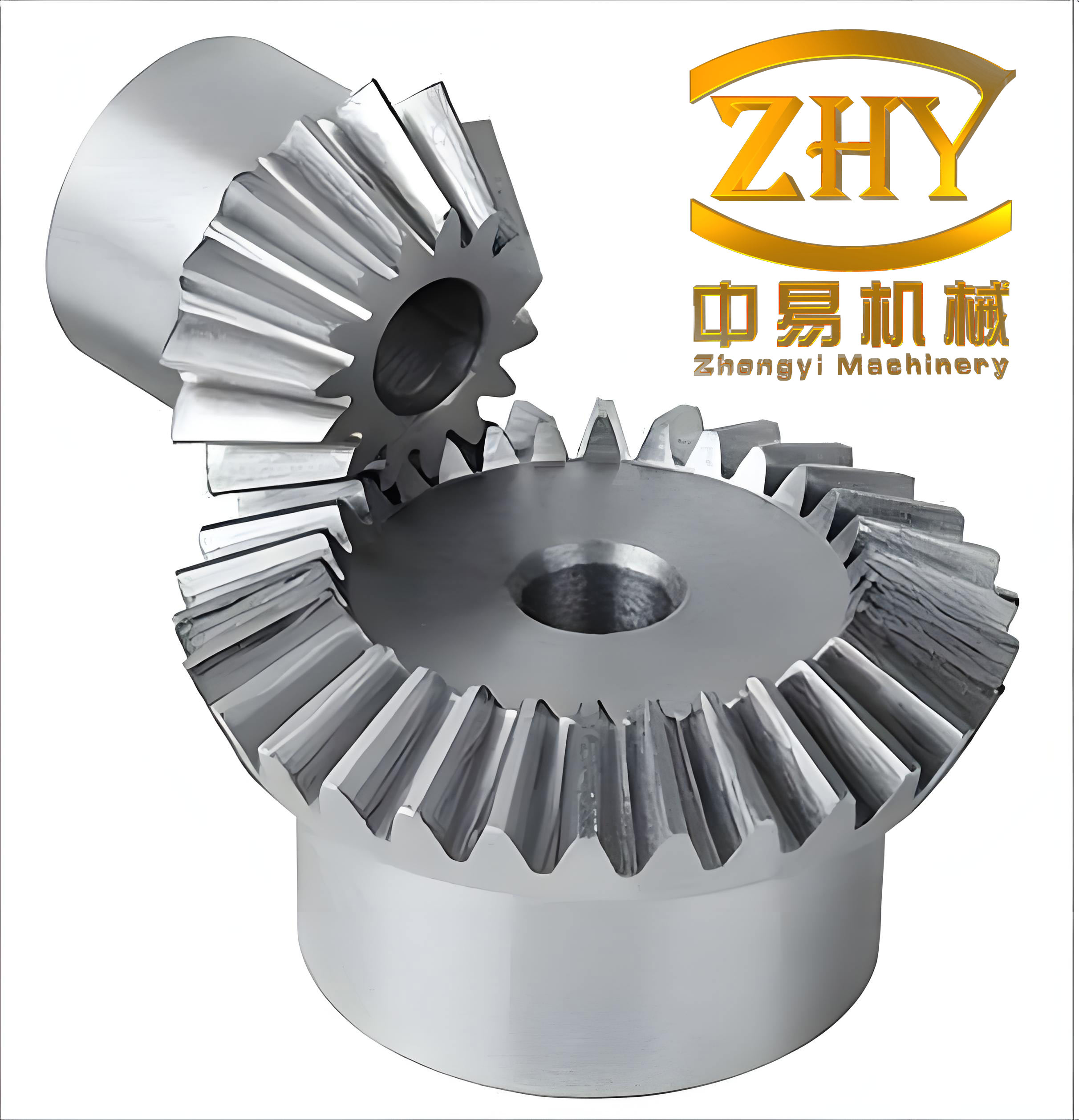
In mechanical transmission systems, gear drives are widely used due to their smooth operation, broad power range, high efficiency, compact structure, and long service life. Among various gear types, the straight bevel gear plays a critical role in applications requiring angular power transmission, such as in aerospace and automotive industries. The straight bevel gear is characterized by its straight teeth that converge at a common point, making it suitable for high-speed operations. However, dynamic transmission error (DTE) in straight bevel gears is a primary source of vibration and noise, which can significantly impact the performance and reliability of transmission systems. This article focuses on the testing and analysis of dynamic transmission errors in high-speed straight bevel gears, exploring the relationship between DTE and gear vibration. By constructing a specialized test platform and employing signal processing techniques, we aim to provide insights into the dynamic behavior of straight bevel gears under high-speed conditions.
The concept of transmission error is defined as the difference between the actual position of the driven gear and its ideal position, assuming perfect gear geometry and no tooth deformation. For dynamic conditions, this is expressed as DTE. In the context of straight bevel gears, DTE can be mathematically represented as:
$$ DTE = \theta_g – \frac{N_p}{N_g} \theta_p $$
where \( \theta_p \) and \( \theta_g \) are the rotational angles of the pinion and gear, respectively, and \( N_p \) and \( N_g \) are the numbers of teeth on the pinion and gear. This formula is fundamental for measuring and analyzing the dynamic performance of straight bevel gears. The single-flank testing method is commonly used for dynamic DTE measurement, where the gear pair is operated under actual working conditions with a slight backlash, and angular sensors record the real-time rotational positions. This approach allows for accurate capture of DTE variations during high-speed operation.
To address the challenges of high-speed DTE measurement, such as limited installation space, harsh operating environments, and high data acquisition demands, we developed a test system based on magnetic encoders. The key components include Renishaw LM13 series magnetic encoders, which offer high precision and can operate at speeds up to 19,500 rpm. The specifications of these encoders are summarized in Table 1.
| Parameter | Value |
|---|---|
| Pulses per Revolution | 3,200 |
| Theoretical Accuracy (arcsec) | 21.06 |
| Maximum Allowable Speed (rpm) | 19,500 |
| Outer Diameter (mm) | 40 |
| Inner Diameter (mm) | 30 |
| Output Type | ABR RS422 |
| Output Signal | Square Wave Pulse (±5V) |
| Supply Voltage (V) | 5 |
| Reference Zero Position | 1 |
The test platform was built for a two-stage transmission system consisting of a spur gear pair and a straight bevel gear pair. The straight bevel gear pair, with parameters detailed in Table 2, was the primary focus of this study. The system integrated magnetic encoders on both the input and output shafts to measure angular positions, and data was acquired using a LabVIEW-based system with a “producer-consumer” architecture for efficient data flow.
| Design Parameter | Pinion (z9) | Gear (z10) |
|---|---|---|
| Number of Teeth | 19 | 32 |
| Module (mm) | 2.75 | 2.75 |
| Pressure Angle (°) | 20 | 20 |
| Accuracy Grade | 6 | 6 |
During testing, the straight bevel gear pair was operated at speeds ranging from 8,135 rpm to 16,200 rpm. The DTE curves were obtained by processing the angular data according to the DTE formula. For instance, at 8,135 rpm, the DTE curve exhibited a sinusoidal pattern dominated by shaft frequency components. To analyze the frequency content, we applied filtering techniques: a low-pass filter (0.1–1,000 Hz) to isolate low-frequency components and a band-pass filter for high-frequency components. The low-frequency DTE spectrum revealed peaks at the shaft frequencies and their harmonics, indicating the influence of cumulative pitch errors and gear runout. The high-frequency spectrum showed significant amplitude at the meshing frequency of the straight bevel gear, with modulation effects suggesting coupling with other excitations in the system.
To quantify the dynamic performance, we calculated the root mean square (RMS) values of DTE across different speeds. The RMS DTE values showed notable variations, with a peak around 14,800 rpm, attributed to low-frequency excitations. Additionally, the band-pass filtered DTE (0.5f_m to 3.5f_m, where f_m is the meshing frequency) highlighted resonances at 9,200 rpm and 11,000 rpm, caused by meshing激励. The amplitude of the meshing frequency component in DTE was dominant throughout the speed range, reaching up to 0.6 micro-radians at 11,000 rpm. This is consistent with the vibration acceleration measured near the supporting bearings of the straight bevel gear, where the meshing frequency component also peaked at similar speeds.
The relationship between DTE and vibration was further analyzed by comparing the frequency spectra. The DTE low-frequency components, primarily shaft frequencies, remained relatively constant in amplitude across speeds, reflecting geometric errors in the straight bevel gear. In contrast, the high-frequency components varied with speed, indicating dynamic effects such as tooth contact deformations. The vibration acceleration data, measured using accelerometers, showed a strong correlation with DTE, particularly at the meshing frequency. This confirms that DTE is a reliable indicator of the dynamic response in straight bevel gear systems.
For a comprehensive analysis, we derived the following equation to describe the dynamic behavior of the straight bevel gear system, considering the stiffness and damping effects:
$$ m \ddot{x} + c \dot{x} + k x = F(t) $$
where \( m \) is the equivalent mass, \( c \) is the damping coefficient, \( k \) is the stiffness, and \( F(t) \) is the excitation force due to DTE. This model helps in understanding how DTE influences the system’s vibration response. Additionally, the meshing frequency \( f_m \) for the straight bevel gear can be calculated as:
$$ f_m = \frac{N_p \cdot n_p}{60} = \frac{N_g \cdot n_g}{60} $$
where \( n_p \) and \( n_g \) are the rotational speeds of the pinion and gear in rpm. This frequency is critical for identifying resonance conditions in the straight bevel gear pair.
In conclusion, the dynamic transmission error in high-speed straight bevel gears is predominantly influenced by shaft frequency components, which are related to geometric inaccuracies. The low-frequency DTE varies significantly with speed, leading to increased vibration in specific ranges, such as 11,000–14,000 rpm. The test system developed for this study effectively measures DTE under high-speed conditions, providing valuable data for improving straight bevel gear design and reducing vibration. The consistency between DTE and vibration measurements underscores the importance of DTE as a diagnostic tool for dynamic performance analysis of straight bevel gears. Future work could focus on optimizing tooth profiles and manufacturing processes to minimize DTE in straight bevel gear applications.