
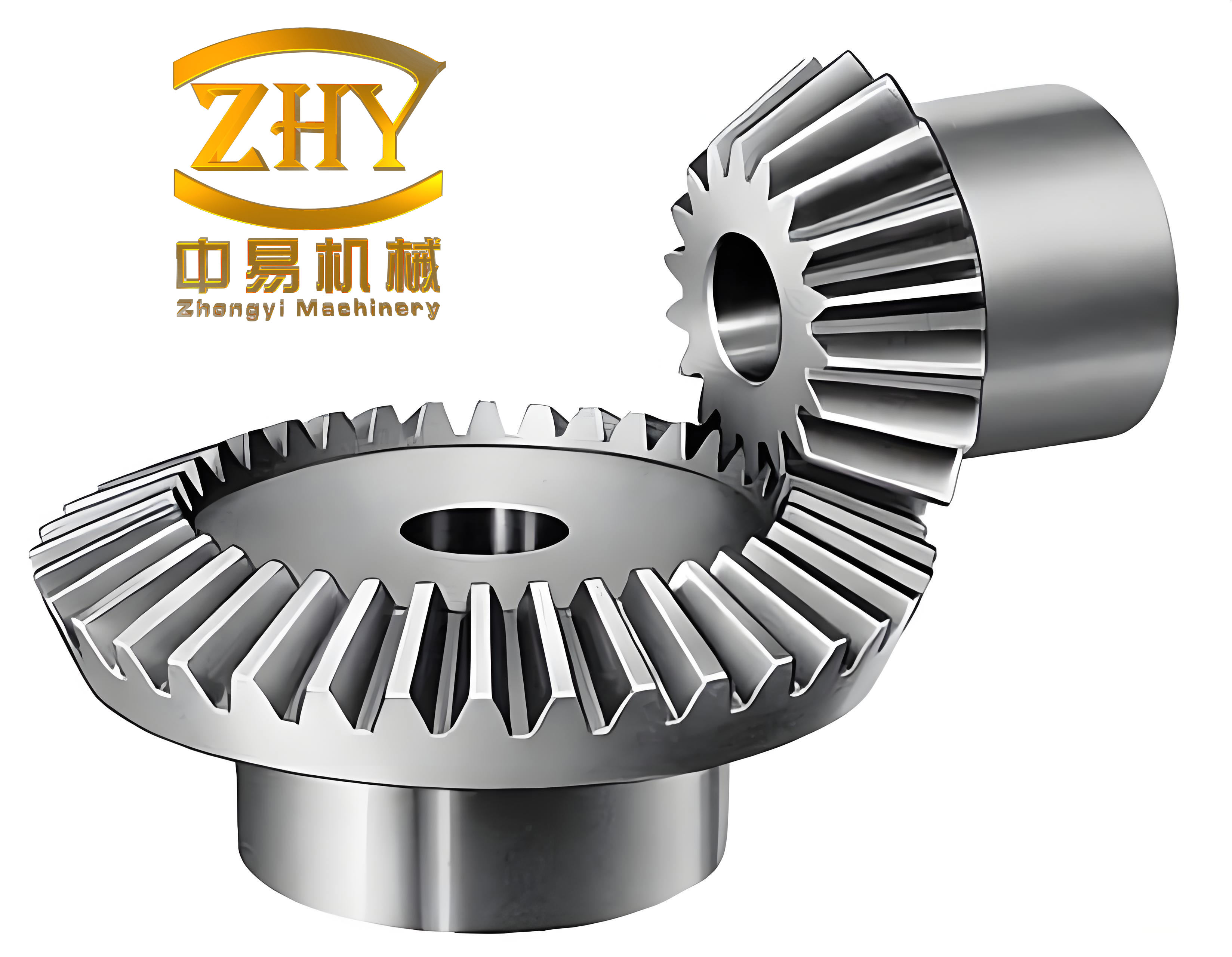
In mechanical transmission systems, straight bevel gears play a critical role due to their ability to transmit power between intersecting shafts. Accurate calculation of the time-varying meshing stiffness of straight bevel gears is essential for evaluating their dynamic performance, durability, and noise characteristics. However, traditional methods, such as finite element analysis (FEA), are computationally intensive, while analytical approaches often neglect the coupling effects between tooth pairs, leading to significant errors in multi-tooth engagement stiffness. To address these challenges, we propose a slice-based method that incorporates tooth pair coupling effects for efficient and precise meshing stiffness calculation of straight bevel gears. This method discretizes the gear into thin slices along the tooth width and axis directions, applies energy principles for stiffness computation, and introduces correction factors for body stiffness to account for multi-tooth interactions. Furthermore, we extend the model to include assembly errors, such as shaft angle and intersection point deviations, and validate the results against FEA simulations.
The foundation of our approach lies in the slice discretization of straight bevel gears. By dividing the gear tooth and body into equally spaced thin slices along the tooth width and axial directions, we transform the complex three-dimensional geometry into a series of manageable two-dimensional problems. Each slice is approximated as a spur gear using the back-cone equivalence principle, which simplifies the analysis while maintaining accuracy. The key parameters for each slice, such as equivalent tooth number and radii, are derived as follows:
$$ z_{vj} = \frac{z_j}{\cos \delta_j} $$
$$ r’_{ij} = r_{ij} \sin \delta_j $$
$$ r’_{aij} = r_{aij} \sin \delta_{aj} $$
$$ r’_{fij} = r_{fij} \sin \delta_{fj} $$
Here, \( z_{vj} \) represents the equivalent tooth number for slice \( i \) of gear \( j \) (where \( j=1 \) for the driving gear and \( j=2 \) for the driven gear), \( \delta_j \) is the pitch angle, and \( r_{ij} \), \( r_{aij} \), and \( r_{fij} \) are the pitch, tip, and root radii, respectively, adjusted for the slice position. The slice width \( d_b \) and the number of slices \( n \) are related to the total tooth width \( b \) by \( b = n d_b \). This discretization allows us to treat each slice as an independent spur gear, enabling the use of energy methods for stiffness calculation.
For each slice, the meshing stiffness is computed by considering various deformation components, including Hertzian contact, bending, shear, axial compression, and gear body flexibility. The single-tooth linear meshing stiffness \( k^d_{li} \) for slice \( i \) is given by:
$$ k^d_{li} = \frac{1}{\frac{1}{k^1_b} + \frac{1}{k^1_s} + \frac{1}{k^1_a} + \frac{1}{k^1_f} + \frac{1}{k^2_b} + \frac{1}{k^2_s} + \frac{1}{k^2_a} + \frac{1}{k^2_f} + \frac{1}{k_h}} $$
where \( k_h \) is the Hertzian contact stiffness, \( k_b \), \( k_s \), and \( k_a \) are the bending, shear, and axial compression stiffnesses, respectively, and \( k_f \) is the gear body stiffness. The superscripts 1 and 2 denote the driving and driven gears. To address the coupling effects in multi-tooth engagement, we introduce correction factors \( \lambda^1_j \) and \( \lambda^2_j \) for the gear body stiffness in double-tooth meshing. The double-tooth linear meshing stiffness \( k^s_{li} \) is expressed as:
$$ k^s_{li} = \sum_{j=1}^{2} \frac{1}{\frac{1}{k^1_{bj}} + \frac{1}{k^1_{sj}} + \frac{1}{k^1_{aj}} + \frac{1}{\lambda^1_j k^1_{fj}} + \frac{1}{k^2_{bj}} + \frac{1}{k^2_{sj}} + \frac{1}{k^2_{aj}} + \frac{1}{\lambda^2_j k^2_{fj}} + \frac{1}{k_{hj}}} $$
The correction factors are determined using finite element analysis on individual slices to model the displacement along the line of action under load. By applying forces at meshing points and measuring displacements, we calculate the load distribution factors and derive \( \lambda^1_j \) and \( \lambda^2_j \) as:
$$ \lambda^1 = \frac{L_{sf1} (\delta_{111} + \delta_{112})}{L_{sf1} (\delta_{111} + \delta_{112}) + (1 – L_{sf1}) (\delta_{211} + \delta_{212})} $$
$$ \lambda^2 = \frac{L_{sf2} (\delta_{221} + \delta_{222})}{L_{sf2} (\delta_{221} + \delta_{222}) + (1 – L_{sf2}) (\delta_{121} + \delta_{122})} $$
Here, \( L_{sf1} \) and \( L_{sf2} \) are the load-sharing factors, and \( \delta_{ijk} \) represents the displacement at point \( i \) due to force applied at point \( j \) for gear \( k \). This approach significantly reduces the error in double-tooth meshing stiffness compared to traditional methods.
To compute the torsional meshing stiffness, which is more practical for system-level analysis, we convert the linear stiffness using the base circle radius \( r_{bi} \) for each slice:
$$ k_t = \sum_{i=1}^{n} r^2_{bi} k_{li} $$
This formulation allows us to aggregate the stiffness contributions from all active slices during the meshing cycle.
Assembly errors, such as shaft angle error \( \theta \) and shaft intersection point error \( \varepsilon \), significantly impact the meshing stiffness of straight bevel gears by altering the tooth contact pattern. We model these errors by deriving the tooth profile deviations \( E^1_i \) and \( E^2_i \) for each slice \( i \):
$$ E^1_i = \theta R_i (\cos \delta_j \sin \psi + \sin \psi) $$
$$ E^2_i = \varepsilon \cos \delta_j \cos \psi $$
where \( R_i \) is the outer cone distance for slice \( i \), and \( \psi = \alpha + \alpha’ \) is the angle between the tooth centerline and the driving gear slice direction, with \( \alpha \) being the pressure angle. The corresponding angular deviations \( e^1_i \) and \( e^2_i \) are given by \( e^i_j = E^i_j / r_{bi} \). Under error conditions, the engagement of slices is determined by comparing the angular displacements, and the load distribution is adjusted iteratively until equilibrium is reached. The overall torsional meshing stiffness \( K \) under error is computed as \( K = T / \theta_m \), where \( T \) is the applied torque and \( \theta_m \) is the angular displacement of the first contacting slice.
We validated our method using a case study with straight bevel gear parameters as listed in Table 1. The gear had a module of 1.75 mm, 35 teeth on both driving and driven gears, a tooth width of 10 mm, and a pressure angle of 20°. The mesh independence test confirmed that dividing the gear into 60 slices ensured result stability.
| Parameter | Value |
|---|---|
| Module (mm) | 1.75 |
| Number of Teeth (z1, z2) | 35, 35 |
| Tooth Width (mm) | 10 |
| Pressure Angle (°) | 20 |
| Tip Height Coefficient | 1 |
| Clearance Coefficient | 0.25 |
| Bore Radius (mm) | 15 |
| Poisson’s Ratio | 0.3 |
| Elastic Modulus (GPa) | 206 |
Comparative analysis with FEA and traditional analytical methods demonstrated the accuracy and efficiency of our approach. As shown in Table 2, our method achieved errors of approximately 3% in single-tooth engagement and 2% in double-tooth engagement, while reducing computational time by over 99% compared to FEA. The traditional analytical method, in contrast, exhibited a 40% error in double-tooth engagement stiffness.
| Method | Single-Tooth Stiffness Error (%) | Double-Tooth Stiffness Error (%) | Calculation Time (min) |
|---|---|---|---|
| Proposed Method | 3 | 2 | 5 |
| Traditional Analytical | 3 | 40 | 0.4 |
| FEA | — | — | 1440 |
Under assembly errors, our model effectively captured the reduction in meshing stiffness. For instance, with a shaft intersection point error \( \varepsilon = 80 \, \mu m \), the double-tooth engagement stiffness error was around 3%, and single-tooth engagement error was 2%. We further analyzed the impact of varying errors on straight bevel gear performance. As shaft angle error \( \theta \) increased from 0° to 0.02°, and shaft intersection error \( \varepsilon \) increased from 0 to 90 μm, the meshing stiffness decreased progressively, leading to higher transmission errors and potential fatigue issues. The load distribution under errors showed edge contact, with maximum loads shifting to the toe or heel depending on the error type, highlighting the importance of precise assembly for straight bevel gears.
The angular displacement and load distribution across slices were also investigated. In ideal conditions, the angular displacement peaked in the single-tooth engagement region near the heel, while under shaft angle error, the toe experienced higher displacements due to earlier contact. Similarly, shaft intersection error caused increased displacements at the heel. The load distribution was non-uniform, with higher loads in regions of greater stiffness, emphasizing the need for error compensation in design.
In conclusion, our slice-based method for calculating meshing stiffness of straight bevel gears offers a balanced combination of accuracy and computational efficiency. By incorporating tooth pair coupling effects and assembly errors, it provides a reliable tool for optimizing straight bevel gear designs in practical applications. Future work could focus on extending the model to include factors like surface roughness and lubrication, further enhancing its applicability to real-world scenarios.