
In the field of mechanical transmission systems, straight bevel gears play a critical role due to their ability to transmit power between intersecting shafts. As one of the primary dynamic excitation sources in gear systems, the time-varying meshing stiffness is a key parameter that influences system stability and induces parametric vibrations. Accurately calculating this stiffness is essential for optimizing gear design and ensuring reliable performance. Traditional methods, such as finite element analysis (FEA), offer high precision but are computationally intensive and time-consuming, making them less suitable for rapid iterative design processes. In this study, I develop an efficient analytical model based on energy equivalence principles to compute the time-varying meshing stiffness of straight bevel gears. By dividing the variable-section tooth profile into micro-segments and applying energy methods, I derive expressions for single-tooth and overall meshing stiffness. The model is validated against FEA results, demonstrating high accuracy and computational efficiency.
The geometry of straight bevel gears involves complex tooth profiles that vary along the face width. To simplify the analysis, I utilize the concept of the back cone, which allows the gear teeth to be represented as planar involutes. The key geometric parameters, such as the tip circle radius, base circle radius, and root circle radius, are expressed as functions of the gear dimensions. For instance, the radii at any point along the tooth can be described using the following equations:
$$ r_{ad} = \frac{d_a}{2 \cos \delta} $$
$$ r_{ax} = \frac{d_a – 2B \sin(\delta + \theta_a) / \cos \theta_a}{2 \cos \delta} $$
$$ r_d = \frac{d}{2 \cos \delta} $$
$$ r_x = \frac{d – 2B \sin \delta}{2 \cos \delta} $$
$$ r_{bd} = \frac{d_b}{2 \cos \delta} $$
$$ r_{bx} = \frac{d_b – 2B \sin(\delta – \theta_b) / \cos \theta_b}{2 \cos \delta} $$
$$ r_{fd} = \frac{d_f}{2 \cos \delta} $$
$$ r_{fx} = \frac{d_f – 2B \sin(\delta – \theta_f) / \cos \theta_f}{2 \cos \delta} $$
Here, \(d\), \(d_a\), \(d_b\), and \(d_f\) represent the pitch circle diameter, tip circle diameter, base circle diameter, and root circle diameter, respectively. The angles \(\delta\), \(\theta_a\), \(\theta_b\), and \(\theta_f\) denote the pitch cone angle, tip angle, base angle, and root angle, while \(B\) is the face width. The planar involute tooth profile is then generated based on the base circle radius using parametric equations:
$$ x = r_b \cos \theta + \frac{\pi r_b \theta \sin \theta}{180^\circ} $$
$$ y = r_b \sin \theta – \frac{\pi r_b \theta \cos \theta}{180^\circ} $$
$$ z = 0 $$
To handle the variable cross-section along the tooth, I divide the tooth into multiple micro-segments along the face width direction. Each segment is treated as a constant cross-section element, and the stiffness contributions are integrated over the entire tooth. The radii for each micro-segment are updated as follows:
$$ r^{*}_{ad} = \frac{d_a – 2(i-1) db \sin(\delta + \theta_a) / \cos \theta_a}{2 \cos \delta} $$
$$ r^{*}_{ax} = \frac{d_a – 2i db \sin(\delta + \theta_a) / \cos \theta_a}{2 \cos \delta} $$
$$ r^{*}_{d} = \frac{d – 2(i-1) db \sin \delta}{2 \cos \delta} $$
$$ r^{*}_{x} = \frac{d – 2i db \sin \delta}{2 \cos \delta} $$
$$ r^{*}_{bd} = \frac{d_b – 2(i-1) db \sin(\delta – \theta_b) / \cos \theta_b}{2 \cos \delta} $$
$$ r^{*}_{bx} = \frac{d_b – 2i db \sin(\delta – \theta_b) / \cos \theta_b}{2 \cos \delta} $$
$$ r^{*}_{fd} = \frac{d_f – 2(i-1) db \sin(\delta – \theta_f) / \cos \theta_f}{2 \cos \delta} $$
$$ r^{*}_{fx} = \frac{d_f – 2i db \sin(\delta – \theta_f) / \cos \theta_f}{2 \cos \delta} $$
In these equations, \(i\) represents the segment index, and \(db\) is the width of each micro-segment. By assuming that the load is uniformly distributed along the contact line and neglecting elastic coupling between adjacent segments, I model each micro-segment as a cantilever beam with variable cross-section. The total deformation energy under a normal contact force \(F_n\) is decomposed into Hertzian contact energy \(U_h\), bending energy \(U_b\), shear energy \(U_s\), and axial compression energy \(U_a\). The equivalent stiffness components are derived from these energy contributions.
For a single micro-segment, the strain energies are expressed as:
$$ dU_b = \frac{F_n^2}{2 dK_b} = \int_0^{x_{ps}} \frac{[F_n (x_{ps} – x) \cos \alpha_1 – F_n h_{ps} \sin \alpha_1]^2}{2E db (2h_x)^3/12} dx $$
$$ dU_s = \frac{F_n^2}{2 dK_s} = \int_0^{x_{ps}} \frac{1.2 (F_n \cos \alpha_1)^2}{2G 2h_x db} dx $$
$$ dU_a = \frac{F_n^2}{2 dK_a} = \int_0^{x_{ps}} \frac{(F_n \sin \alpha_1)^2}{2E 2h_x db} dx $$
$$ dU_h = \frac{F_n^2}{2 dK_h} $$
Here, \(\alpha_1\) is the angle between the normal force and the tooth thickness direction, \(h_{ps}\) is half the tooth thickness at the load application point, \(h_x\) is half the tooth thickness at a distance \(x\) from the base, and \(dx\) is an infinitesimal length along the tooth. The terms \(K_b\), \(K_s\), \(K_a\), and \(K_h\) denote the equivalent stiffnesses for bending, shear, axial compression, and Hertzian contact, respectively. The material properties include the elastic modulus \(E\) and shear modulus \(G\).
The geometric parameters \(x_{ps}\), \(h_{ps}\), \(x\), and \(h_x\) are determined using the following relations:
$$ x_{ps} = r_b [\cos \theta_k + (\theta_k + \theta_b) \sin \theta_k] – r_f \cos \theta_F + \frac{(r_{ad} – r_{fd})}{(r_{ax} – r_{fx})} \times (i-1) \times \frac{db}{B} $$
$$ h_{ps} = r_b [(\theta_k + \theta_b) \cos \theta_k – \sin \theta_k] $$
$$ x = r_b [\cos \theta_x + (\theta_x + \theta_b) \sin \theta_x] – r_f \cos \theta_F $$
$$ h_x = r_b [(\theta_x + \theta_b) \cos \theta_x – \sin \theta_x] $$
In these equations, \(\theta_k\), \(\theta_x\), \(\theta_b\), and \(\theta_F\) represent angles at the contact point, variable section point, base circle point, and root circle point, respectively. By integrating these expressions along the face width, the equivalent stiffness components for a single tooth are obtained:
$$ K_b = \int_0^B \frac{1}{\int_0^{x_{ps}} \frac{3[(x_{ps} – x) \cos \alpha_1 – h_{ps} \sin \alpha_1]^2}{2E h_x^3} dx} db $$
$$ K_s = \int_0^B \frac{1}{\int_0^{x_{ps}} \frac{1.2 \cos^2 \alpha_1}{2G h_x} dx} db $$
$$ K_a = \int_0^B \frac{1}{\int_0^{x_{ps}} \frac{\sin^2 \alpha_1}{2E h_x} dx} db $$
$$ K_h = \frac{\pi E B}{4(1 – \nu^2)} $$
where \(\nu\) is Poisson’s ratio. Additionally, the deformation of the gear body is considered by modeling it as a hollow shaft. The equivalent torsional stiffness \(K_t\) is calculated based on the geometry:
$$ L_x = \tan[2 \arctan(h_f / R)] \times (R – B) – h_f (R – B) / R $$
$$ L_d = \tan[2 \arctan(h_f / R)] \times R – h_f $$
$$ L_{hx} = \left[1 – \frac{L_x + h_f (R – B) / R}{(d/2 – B \sin \delta) / \cos \delta}\right] \times \left[\frac{d (R – B)}{2R}\right] $$
$$ L_{hd} = \frac{d}{2} \left(1 – \frac{L_d + h_f}{d \cos \delta / 2}\right) $$
Here, \(R\) is the outer cone distance, and \(h_f\) is the dedendum. The torsional stiffness for a hollow shaft segment is given by:
$$ dK_t = \frac{G \pi (D^4 – d_k^4)}{32} $$
where \(D\) and \(d_k\) are the outer and inner diameters, respectively. Integrating over the cross-section yields the total torsional stiffness \(K_t\). The single-tooth meshing stiffness \(K_e\) for a gear pair is then computed as:
$$ K_e = \frac{1}{\frac{1}{K_{b1}} + \frac{1}{K_{s1}} + \frac{1}{K_{a1}} + \frac{1}{K_{t1}} + \frac{1}{K_{b2}} + \frac{1}{K_{s2}} + \frac{1}{K_{a2}} + \frac{1}{K_{t2}} + \frac{1}{K_h}} $$
The subscripts 1 and 2 refer to the driving and driven gears, respectively.
For time-varying meshing stiffness, I account for multiple tooth pairs in contact based on the gear contact ratio. The contact ratio \(\varepsilon_a\) for straight bevel gears is calculated as:
$$ \varepsilon_a = \frac{Z_1}{360^\circ \sin \delta_{b1}} (\psi_1 + \psi_2 – \psi_{m1} – \psi_{m2}) $$
where \(Z_1\) is the number of teeth on the driving gear, \(\delta_b\) is the base cone angle, and \(\psi\) and \(\psi_m\) are the expansion angles at the pitch cone and involute start point, respectively. The meshing process includes single-tooth and double-tooth contact zones. In the double-tooth zone, the force balance and deformation compatibility conditions must be satisfied. For \(N\) tooth pairs in contact, the deformation \(\delta_i\) of the \(i\)-th tooth pair under a rotation angle \(\theta\) is:
$$ \delta_i = L_i \theta \cos \alpha_i $$
where \(L_i\) is the distance from the mesh point to the gear center, and \(\alpha_i\) is the angle between the mesh force and the tooth thickness direction. The mesh force for each pair is \(F_i = K_i \delta_i\), and the total force balance gives:
$$ F_n = \sum_{i=1}^N F_i = \sum_{i=1}^N K_i \delta_i $$
The overall meshing stiffness \(K\) is defined as the ratio of the normal force to the total deformation \(\delta_z\):
$$ K = \frac{F_n}{\delta_z} $$
Assuming the \(j\)-th tooth pair has the largest deformation, the time-varying meshing stiffness in the multi-tooth zone is derived as:
$$ K = \frac{\sum_{i=1}^N K_i L_i \cos \alpha_i}{L_j \cos \alpha_j} $$
The transmission error \(E_t\), which represents the deviation from ideal motion due to elastic deformations, is calculated from the torque \(T\) and mesh stiffness. The tangential force \(F_t\) and normal force \(F_n\) are related by:
$$ F_t = \frac{T}{R_m} $$
$$ F_n = \frac{F_t}{\cos \alpha} $$
$$ E_t = 2 \arcsin \left( \sin \left[ \frac{F_n}{K \times L_p} / 2 \right] \times \frac{L_p}{R_m} \right) $$
Here, \(R_m\) is the mean pitch radius, and \(L_p\) is a characteristic length. This formulation allows for efficient computation of the dynamic behavior of straight bevel gear systems.
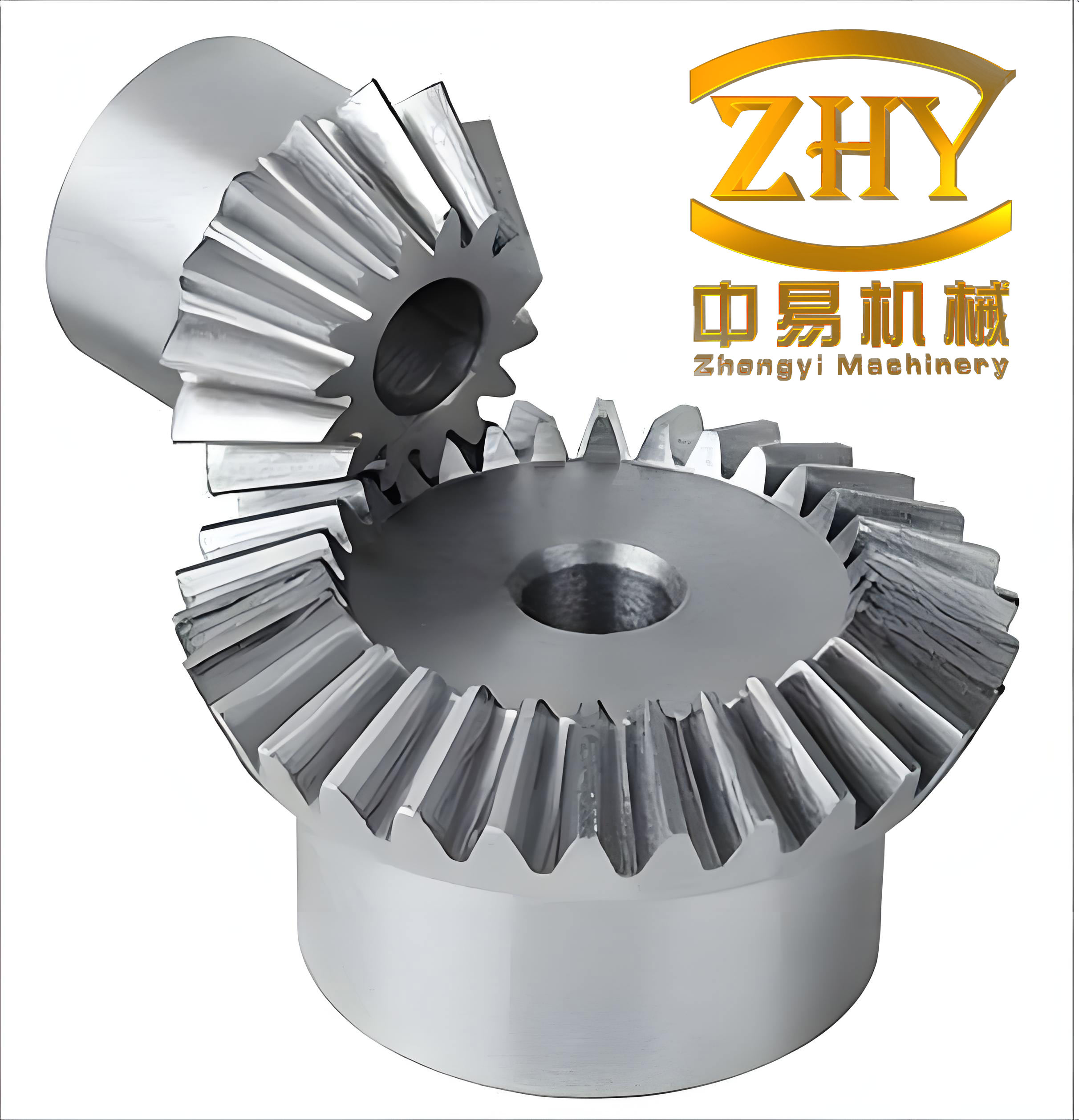
To validate the proposed model, I compare its results with finite element analysis for four different straight bevel gear configurations. The gear parameters are summarized in the table below:
| Parameter | Gear Set 1 | Gear Set 2 | Gear Set 3 | Gear Set 4 |
|---|---|---|---|---|
| Driving Gear Teeth (\(z_1\)) | 17 | 19 | 20 | 16 |
| Driven Gear Teeth (\(z_2\)) | 19 | 34 | 25 | 28 |
| Normal Pressure Angle (\(\alpha\)) | 20° | 20° | 20° | 20° |
| Face Width (\(B\)) | 8 mm | 23 mm | 20 mm | 12 mm |
| Module (\(m\)) | 2 mm | 4 mm | 4 mm | 2.5 mm |
| Elastic Modulus (\(E\)) | 206 GPa | 206 GPa | 206 GPa | 206 GPa |
| Poisson’s Ratio (\(\nu\)) | 0.3 | 0.3 | 0.3 | 0.3 |
For the finite element analysis, I model three tooth pairs to capture the contact behavior accurately. The gears are discretized using hexahedral elements, with finer mesh in the contact regions (element size 0.2 mm) and coarser mesh elsewhere (1–2 mm). The material properties are defined with a friction coefficient of 0.15. The driving gear is subjected to rotation, and the driven gear is loaded with torques of 10, 30, and 50 N·m. The analysis excludes dynamic effects to focus on stiffness characteristics.
The single-tooth meshing stiffness curves from both methods show close agreement. The stiffness is lower at the entry and exit points of the mesh and higher in the middle region. The time-varying meshing stiffness exhibits periodic fluctuations, with higher values in the double-tooth contact zones and lower values in the single-tooth zones. The transmission error increases with torque and varies between single and double-tooth regions. The table below summarizes the comparison results, including maximum single-tooth stiffness, average time-varying stiffness, relative errors, and computational time.
| Gear Parameters | Method | Max Single-Tooth Stiffness (kN/mm) | Relative Error (%) | Avg Time-Varying Stiffness (kN/mm) | Relative Error (%) | Computational Time |
|---|---|---|---|---|---|---|
| \(m=2, z_1=17, z_2=19\) | FEA | 313 | 0.51 | 505 | 1.48 | 4 h 0 min 36 s |
| Analytical | 314.6 | 497.5 | 21.084 s | |||
| \(m=4, z_1=19, z_2=34\) | FEA | 835 | 1.32 | 1409 | 1.39 | 6 h 27 min 3 s |
| Analytical | 846 | 1389.4 | 46.262 s | |||
| \(m=4, z_1=20, z_2=25\) | FEA | 758 | 1.58 | 1288 | 1.65 | 5 h 51 min 49 s |
| Analytical | 770 | 1266.7 | 38.847 s | |||
| \(m=2.5, z_1=16, z_2=28\) | FEA | 448 | 1.11 | 734 | 1.42 | 4 h 45 min 21 s |
| Analytical | 453 | 723.6 | 23.329 s |
The relative errors in stiffness calculations are all below 2%, confirming the accuracy of the analytical model. Moreover, the computational time for the analytical method is significantly lower than for FEA, making it suitable for rapid design iterations. The minor discrepancies arise from approximations such as using planar involutes to represent the spherical tooth profiles, neglecting inter-segment coupling, and geometric simplifications in contact ratio calculations.
In conclusion, the energy equivalence-based model provides an efficient and accurate approach for calculating the time-varying meshing stiffness of straight bevel gears. By integrating micro-segment analysis and deformation compatibility conditions, it captures the essential dynamics while reducing computational effort. This method is particularly beneficial for system-level simulations where resource allocation for gear analysis is limited. Future work could extend this approach to modified tooth profiles, such as those with crowning or lead corrections, by adapting the slice geometry and energy formulations accordingly. For gears with complex geometries like spiral bevel gears, alternative methods such as boundary element or finite element analysis may be more appropriate due to their non-planar contact characteristics.