
Straight bevel gears are essential components in mechanical transmission systems, particularly for transmitting motion between intersecting shafts, often at a 90-degree angle. They are widely used in differentials of automobiles, agricultural machinery, machine tools, and other industrial applications due to their ability to handle heavy loads at low speeds. However, their straight tooth geometry makes them sensitive to installation errors and load variations, necessitating precise design and analysis. In this study, I focus on developing an accurate mathematical model for straight bevel gears using a generative shaping principle and conducting dynamic contact zone simulations to optimize performance. This approach leverages computational tools to enhance design accuracy and reduce prototyping costs, offering a universal methodology for the gear industry.
The foundation of this work lies in the generative gear shaping method, which simulates the machining process on a gear planer. By establishing a meshing coordinate system that incorporates installation errors, I derive the tooth surface points for modified straight bevel gears. The key innovation involves using the Gaussian curvature of the difference surface at the point of tangency between two tooth surfaces to evaluate the sensitivity of the modified gear tooth surface to installation errors. This is optimized using a penalty function method to adjust the major axis of the contact ellipse, resulting in a contact pattern that minimizes sensitivity. Through this, I demonstrate that optimizing the contact ellipse’s major axis significantly reduces the influence of installation errors, leading to improved contact trace alignment perpendicular to the root cone, which enhances gear performance.
To facilitate this, I developed a specialized software tool using Visual Basic language, which calculates the spatial coordinates of tooth surface points based on input parameters such as number of teeth, module, pressure angle, and cone distance. This software automates the computation of points for modified straight bevel gears, enabling precise modeling. For instance, considering a differential straight bevel gear pair from a tractor, the software processes parameters like those shown in the table below, which summarizes the main specifications for the semi-axle gear and planetary gear pair. This tool ensures that the calculated points accurately represent the gear geometry, accounting for modifications like crowning or profile shifts to mitigate edge contact and stress concentrations.
| Parameter | Semi-Axle Gear | Planetary Gear |
|---|---|---|
| Number of Teeth | 19 | 11 |
| Module at Large End (mm) | 6.17 | 6.17 |
| Pitch Cone Angle (°) | 59.93 | 30.07 |
| Cone Distance (mm) | 67.73 | 67.73 |
| Normal Backlash (mm) | 0.18 | 0.18 |
| Pressure Angle (°) | 22.5 | 22.5 |
The mathematical formulation for the tooth surface points is derived from the gear meshing theory and the generative process. For a straight bevel gear, the tooth profile can be approximated using spherical involute geometry. The position vector of a point on the tooth surface in the gear coordinate system can be expressed as:
$$ \mathbf{r}(\theta, \phi) = \begin{bmatrix} R \sin(\theta) \cos(\phi) \\ R \sin(\theta) \sin(\phi) \\ R \cos(\theta) \end{bmatrix} $$
where \( R \) is the cone distance, \( \theta \) is the polar angle, and \( \phi \) is the azimuthal angle. For modified gears, additional terms are introduced to account for crowning or other corrections, which are computed iteratively in the software to minimize sensitivity. The Gaussian curvature \( K \) at a point on the tooth surface is given by:
$$ K = \frac{LN – M^2}{EG – F^2} $$
where \( E, F, G \) are the coefficients of the first fundamental form, and \( L, M, N \) are the coefficients of the second fundamental form of the surface. This curvature is used as an indicator of installation error sensitivity, and the optimization aims to achieve a uniform curvature distribution across the contact zone.
Using the computed tooth surface point data, I proceed to build a three-dimensional mathematical model in UG software. The process involves several steps: First, I import the point data (in .dat format) into UG and use the “Through Points – Points from File” command in the surface modeling toolkit to create a surface patch for a single tooth flank. This patch represents one side of the tooth, and it is constructed by interpolating the calculated points to form a smooth surface. Next, I mirror this surface to create the symmetric flank of the tooth slot, ensuring the gear’s bilateral symmetry. Then, I generate the bottom surface of the tooth slot using a “Ruled Surface” feature, which connects the edges of the flanks to form a closed volume. After stitching these surfaces together, I obtain a complete tooth slot as a single sheet body.
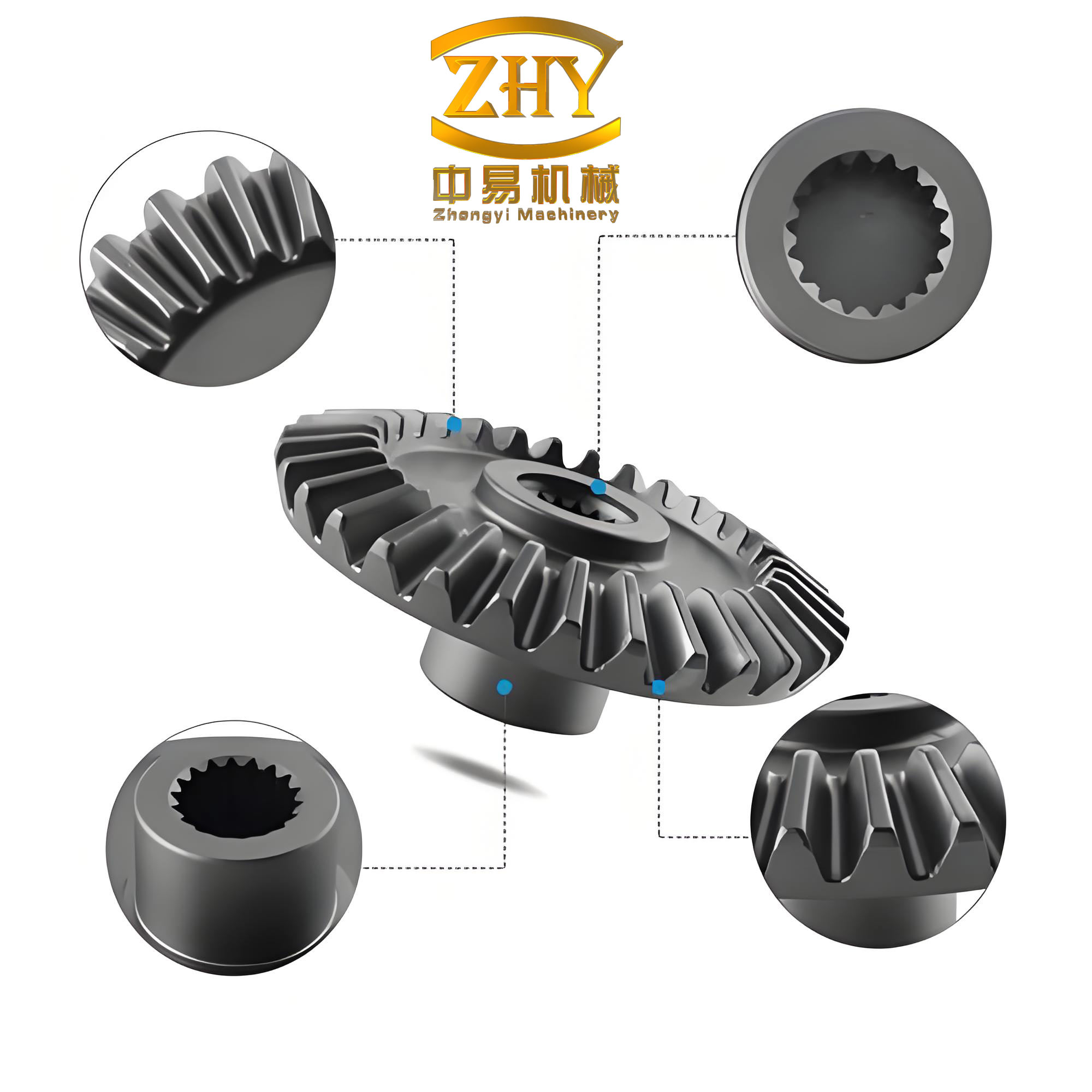
Subsequently, I create the gear blank based on the drawing specifications, such as the outer diameter and bore dimensions. By using the tooth slot sheet body to subtract material from the blank, I form one tooth slot. This operation is repeated for all teeth using a “Circular Array” command, resulting in a full gear model with the desired number of teeth. For the semi-axle gear, which includes modifications in both profile and length directions, the model incorporates these adjustments to enhance contact performance. In contrast, the planetary gear model is built without modifications, maintaining a standard geometry. This modeling approach ensures that the digital representation accurately mirrors the physical gear, facilitating further analysis and manufacturing.
With the three-dimensional models of the semi-axle and planetary straight bevel gears completed, I conduct dynamic contact zone simulations in the UG motion simulation module. This involves setting up a kinematic model where the gears are assembled with their axes intersecting at the specified angle, typically 90 degrees. I define the motion constraints, such as rotational joints, and apply a driver to one gear to simulate meshing. The contact parameters are configured with an interference value of 0.005 mm to represent the minimal clearance under load. The simulation runs for a duration of 30 seconds at a speed of 50 RPM, allowing me to observe the contact pattern at various instants.
The simulation results show that the contact zone under no-load conditions is positioned near the small end of the tooth, covering approximately 50% of the tooth length and 60% of the tooth height. This indicates an ideal contact pattern, as it avoids edge contact and ensures even stress distribution. The dynamic simulation helps in visualizing how the contact ellipse evolves during meshing, and by adjusting the modification parameters iteratively, I can optimize the contact pattern to reduce noise and vibration. This virtual testing phase is crucial for validating the design before physical manufacturing, as it identifies potential issues early, saving time and resources.
To validate the mathematical model and simulation findings, I proceed to manufacture standard gears using a five-axis machining center. The DMG Mori five-axis machine is employed for this purpose, as it can interpret the 3D model and generate CNC programs automatically based on the selected tooling. A finger-type milling cutter is used to machine the gears from 45 steel material, ensuring high precision and surface quality. The machining process faithfully replicates the digital model, producing gears that match the design specifications closely. After machining, the gears are inspected on a gear measuring machine to verify their accuracy. The inspection involves measuring 45 points on the tooth surface near the pitch circle, and the results show that the gears achieve a grade 4 accuracy level, with a maximum deviation of 0.007 mm from the digital model. This confirms the fidelity of the modeling process.
Furthermore, the manufactured straight bevel gears are tested on a roll testing machine to evaluate the actual contact pattern, vibration, and noise. The roll test reveals that the contact zone aligns well with the simulation predictions, exhibiting a similar size and location. The vibration and noise levels are within acceptable limits, indicating that the design modifications effectively enhance performance. This real-world validation underscores the reliability of the proposed methodology for straight bevel gear design and analysis.
In conclusion, this study presents a comprehensive approach to modeling and simulating straight bevel gears, emphasizing the use of computational tools to achieve high precision and performance. The development of a custom software for tooth surface point calculation, combined with UG-based modeling and dynamic simulation, provides a robust framework for optimizing gear designs. The successful manufacturing and testing of standard gears demonstrate the practical applicability of this method, which can be universally adopted in the gear industry to streamline development processes and improve product quality. Future work could explore extensions to other gear types or more complex modification schemes to further enhance performance under varying operating conditions.