
In this study, we investigate the impact of profile modification on the elastohydrodynamic lubrication (EHL) of straight bevel gears, which are commonly used in automotive differentials. The primary issue addressed is the end-meshing problem, where uneven load distribution along the tooth width leads to stress concentration and potential failure. By applying profile modifications, such as parabolic curves and tip relief, we aim to enhance the oil film’s load-carrying capacity at the small end, ensuring uniform load distribution and improved lubrication. We develop an infinite line contact EHL model for straight bevel gears, solving pressure and film thickness using the multigrid method and elastic deformation with the multigrid integration technique. Our results demonstrate that profile modification significantly reduces oil film pressure in the Hertzian contact zone, increases film thickness, and shifts load distribution from the ends toward the center of the tooth width. This improves lubrication, reduces friction and wear, and prevents surface scoring.
Straight bevel gears are critical components in power transmission systems, such as automotive differentials, where they facilitate torque transfer between non-parallel shafts. However, these gears often experience end-meshing issues due to elastic deformations and manufacturing inaccuracies, resulting in localized stress and inadequate lubrication. The formation of a stable oil film is essential to minimize wear and extend gear life. Profile modification, including tip relief and parabolic curve adjustments, has been proposed to mitigate these problems by optimizing load distribution and enhancing lubricant entrainment. In this work, we explore how such modifications influence the EHL characteristics of straight bevel gears, focusing on parameters like oil film pressure and thickness under varying operating conditions.
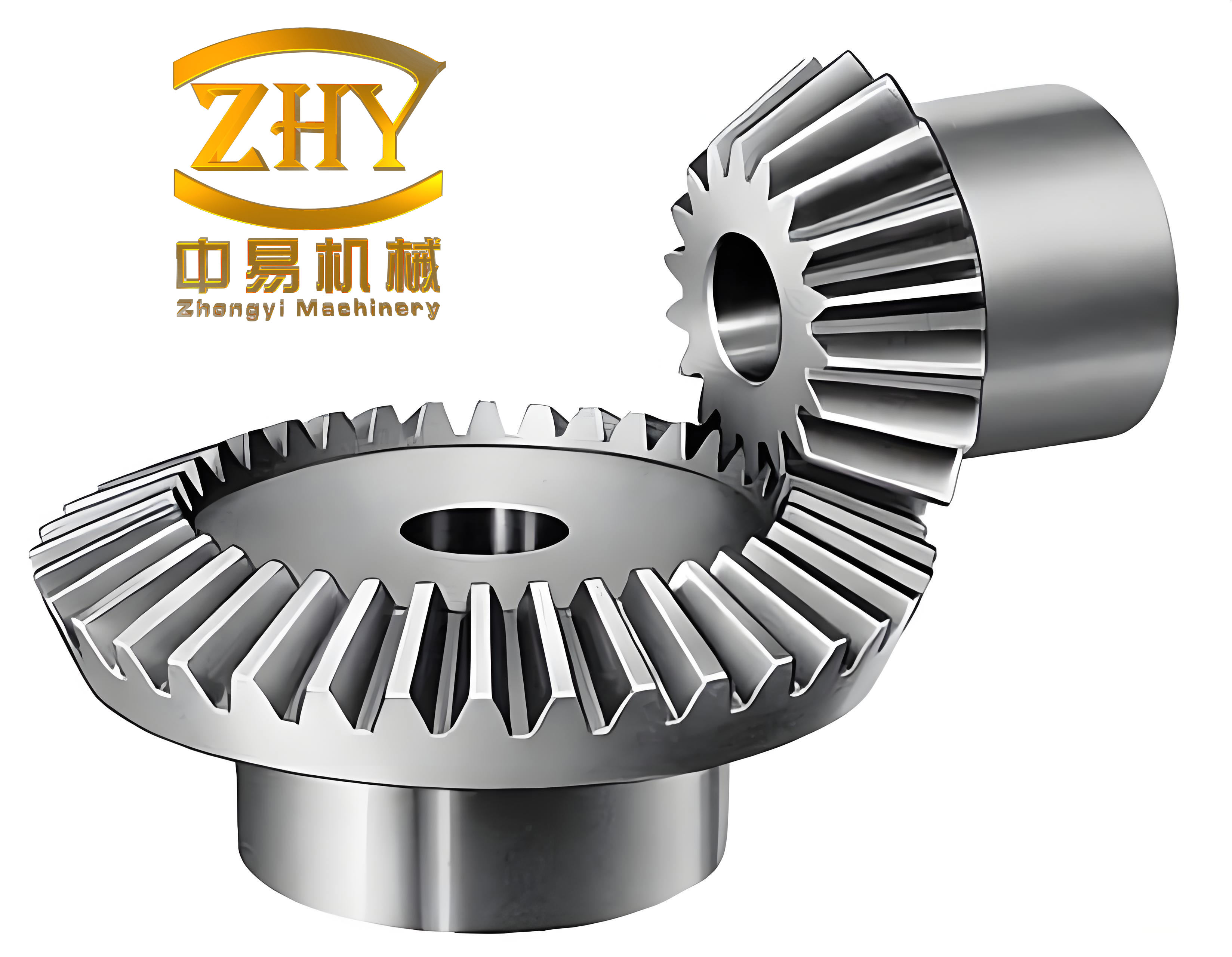
To model the lubrication behavior, we consider an equivalent infinite line contact scenario for straight bevel gears, as illustrated in the following representation of gear geometry and contact. This approach simplifies the complex tooth geometry while capturing essential EHL phenomena. The key parameters for our analysis are summarized in Table 1, which includes gear specifications, material properties, and operating conditions. These parameters form the basis for our numerical simulations and result interpretations.
The fundamental equations governing the EHL model are derived from lubrication theory and elasticity. The Reynolds equation describes pressure generation in the lubricant film, accounting for viscous flow and transient effects. For a straight bevel gear system, this equation is expressed as:
$$ \frac{\partial}{\partial x} \left( \frac{\rho h^3}{\eta} \frac{\partial p}{\partial x} \right) = 12 \frac{\partial (\rho u h)}{\partial x} + 12 \frac{\partial (\rho h)}{\partial t} $$
where \( p \) is the oil film pressure, \( h \) is the film thickness, \( \rho \) is the lubricant density, \( \eta \) is the dynamic viscosity, \( u \) is the entrainment velocity, \( x \) is the spatial coordinate along the contact, and \( t \) is time. The film thickness equation incorporates geometric profiles, elastic deformations, and profile modifications:
$$ h = h_0 + \frac{x^2}{2R} – \frac{2}{\pi E} \int_{-\infty}^{x} p(s) \ln(x – s)^2 ds + \delta(x) $$
Here, \( h_0 \) is the central film thickness, \( R \) is the equivalent radius of curvature at the contact point, \( E \) is the composite elastic modulus, and \( \delta(x) \) represents the profile modification function. For parabolic curve modifications, \( \delta(x) \) is defined as \( \delta(x) = \Delta_{\text{max}} \left( \frac{x}{L} \right)^b \), where \( \Delta_{\text{max}} \) is the maximum modification amount, \( L \) is the modification length, and \( b = 2 \) for a quadratic profile. The viscosity-pressure relationship follows the Roelands equation:
$$ \eta = \eta_0 \exp \left\{ (\ln \eta_0 + 9.67) \left[ (1 + 5.1 \times 10^{-9} p)^{z_0} – 1 \right] \right\} $$
with \( z_0 = \alpha / [5.1 \times 10^{-9} (\ln \eta_0 + 9.67)] \), where \( \alpha \) is the pressure-viscosity coefficient. The density-pressure relationship is given by the Dowson-Higginson formula:
$$ \rho = \rho_0 \left( \frac{1 + 0.6 \times 10^{-9} p}{1 + 1.7 \times 10^{-9} p} \right) $$
The load balance equation ensures that the integrated pressure supports the applied load per unit length \( w \):
$$ \int_{-\infty}^{x} p(x) dx = w $$
Table 1 summarizes the baseline parameters used in our simulations for straight bevel gears, including gear geometry, material properties, and lubrication conditions. These values are typical for automotive applications and provide a reference for analyzing the effects of profile modifications.
| Parameter | Value |
|---|---|
| Number of pinion teeth, \( z_1 \) | 21 |
| Number of gear teeth, \( z_2 \) | 60 |
| Module at large end, \( m \) (mm) | 2 |
| Tooth width, \( b \) (mm) | 42 |
| Pressure angle at large end, \( \alpha \) (°) | 20 |
| Addendum coefficient, \( h_a^* \) | 1.0 |
| Elastic modulus, \( E \) (GPa) | 210 |
| Poisson’s ratio, \( \mu \) | 0.3 |
| Pinion speed, \( n_1 \) (r/min) | 1000 |
| Input power, \( P \) (kW) | 5.45 |
| Environmental viscosity, \( \eta_0 \) (Pa·s) | 0.08 |
| Pressure-viscosity coefficient, \( \alpha \) (Pa⁻¹) | 2.19 × 10⁻⁸ |
We employ a numerical approach based on the finite difference method to discretize the governing equations. The multigrid technique is used to solve for pressure and film thickness, with six grid levels and 961 nodes at the finest level. This method efficiently handles the non-linearities and high gradients in the EHL problem. The iterative process involves adjusting the central film thickness \( h_0 \) until the pressure convergence criterion (error less than 0.001) is met. The meshing cycle is divided into 180 instantaneous points along the line of action, from the start to the end of engagement, to capture transient effects accurately. For instance, the first instantaneous point at the beginning of engagement is critical due to potential impacts on lubrication.
Our analysis begins by examining the effects of profile modification on lubrication characteristics at key engagement points. We compare unmodified straight bevel gears with those modified using a parabolic curve (\( \Delta_{\text{max}} = 0.05 \), \( L = 0.3 \)) and tip relief. Figure 1 illustrates the oil film pressure and thickness distributions at the first instantaneous point of engagement. After parabolic modification, the Hertzian contact pressure decreases significantly, while the film thickness increases in the same region. This is attributed to changes in the entrainment velocity and load distribution induced by the modification. The outlet region shows a sharp pressure drop and corresponding film thickness contraction, forming a step-like profile. In contrast, tip relief results in a milder reduction in pressure and a smaller increase in film thickness. Table 2 provides a quantitative comparison of film thickness values in the Hertzian zone for unmodified, tip-relieved, and parabolic-modified gears, confirming that parabolic modification offers superior lubrication enhancement.
| Position Index | Unmodified | Tip Relief | Parabolic Modification |
|---|---|---|---|
| 1 | 0.27823 | 0.29216 | 0.44392 |
| 2 | 0.27809 | 0.29203 | 0.44382 |
| 3 | 0.27797 | 0.29191 | 0.44372 |
| 4 | 0.27786 | 0.29180 | 0.44362 |
| 5 | 0.27776 | 0.29170 | 0.44353 |
| 6 | 0.27767 | 0.29161 | 0.44344 |
| 7 | 0.27759 | 0.29153 | 0.44335 |
| 8 | 0.27752 | 0.29146 | 0.44326 |
| 9 | 0.27746 | 0.29140 | 0.44318 |
| 10 | 0.27741 | 0.29135 | 0.44310 |
| 11 | 0.27736 | 0.29130 | 0.44302 |
| 12 | 0.27733 | 0.29126 | 0.44294 |
| 13 | 0.27731 | 0.29123 | 0.44287 |
| 14 | 0.27729 | 0.29121 | 0.44280 |
| 15 | 0.27728 | 0.29119 | 0.44273 |
| 16 | 0.27727 | 0.29117 | 0.44266 |
| 17 | 0.27727 | 0.29116 | 0.44260 |
| 18 | 0.27727 | 0.29115 | 0.44254 |
| 19 | 0.27727 | 0.29114 | 0.44248 |
| 20 | 0.27728 | 0.29114 | 0.44242 |
At the fourth instantaneous point of engagement, similar trends are observed, but the magnitude of change is smaller compared to the first point. This indicates that profile modification has a more pronounced effect at the initial engagement, where impact loads are higher. For the disengagement point, modifications show minimal influence, as the contact conditions are less severe. Over the entire meshing cycle, parabolic modification increases the minimum and central film thicknesses while reducing the maximum and central pressures, as depicted in Figure 2. This overall improvement in lubrication parameters underscores the benefits of profile modification for straight bevel gears.
We further investigate the impact of rotational speed on the modified gears. Simulations are conducted at 1000 r/min, 1500 r/min, and 1800 r/min, with results shown in Figure 3. As speed increases, the entrainment velocity rises, enhancing lubricant entrainment and film formation. Consequently, the reduction in pressure and increase in film thickness due to modification are more significant at higher speeds. For instance, at 1800 r/min, the minimum film thickness stabilizes at a higher value, indicating better lubrication performance. This speed-dependent behavior highlights the importance of considering operating conditions when designing profile modifications for straight bevel gears.
The influence of modification parameters, such as maximum modification amount \( \Delta_{\text{max}} \) and modification length \( L \), is analyzed in Figure 4. We vary \( \Delta_{\text{max}} \) from 0.05 to 0.08 and \( L \) from 0.3 to 0.6, while keeping other parameters constant. Larger \( \Delta_{\text{max}} \) values lead to greater reductions in pressure and increases in film thickness, as the modified profile alters the contact geometry more substantially. Similarly, longer modification lengths distribute the change over a broader area, further optimizing load distribution. These findings can be summarized using the following equations for the modification function and its effect on film thickness:
$$ \delta(x) = \Delta_{\text{max}} \left( \frac{x}{L} \right)^2 $$
and the resulting film thickness improvement \( \Delta h \) can be approximated as:
$$ \Delta h \propto \frac{\Delta_{\text{max}}}{L} \cdot f(R, u) $$
where \( f(R, u) \) is a function of the equivalent radius and entrainment velocity. This relationship emphasizes that careful selection of modification parameters is crucial for achieving desired lubrication outcomes in straight bevel gears.
Finally, we examine the load distribution along the tooth width after profile modification. Figure 5 shows the oil film pressure distribution in the X (contact direction) and Y (tooth width direction) coordinates. The pressure distribution becomes more symmetric around Y=0, indicating reduced disparity between the small and large ends. This uniform distribution enhances the load-carrying capacity at the small end, mitigating the end-meshing problem. The shift in load toward the center of the tooth width reduces stress concentration and improves overall gear durability.
In conclusion, our study demonstrates that profile modification, particularly using parabolic curves, significantly enhances the elastohydrodynamic lubrication of straight bevel gears. By reducing oil film pressure and increasing film thickness, especially at critical engagement points, modifications improve load distribution and minimize wear. The effects are more pronounced at higher speeds and with optimized parameters. These insights provide a foundation for designing straight bevel gears with improved performance and longevity in automotive applications. Future work could explore thermal effects and dynamic loading conditions to further refine the modification strategies.