
In modern mechanical transmission systems, straight bevel gears play a critical role due to their ability to change the direction of power transmission while maintaining compactness and operational stability. However, the presence of time-varying factors such as tooth surface friction and backlash inevitably induces vibration and impact between teeth, compromising transmission smoothness and accuracy. This study focuses on investigating the nonlinear dynamic characteristics of straight bevel gear transmission systems by developing a comprehensive dynamic model that incorporates tooth surface friction, backlash, and time-varying mesh stiffness. The primary objective is to analyze how these nonlinearities influence system behavior, including bifurcations and chaotic motion, and to provide insights for optimizing system design to enhance reliability and performance.
The dynamic model of the straight bevel gear system is established using the lumped parameter method, considering bending-torsion-axial coupling. The system includes seven degrees of freedom, accounting for vibrations along three coordinate directions for both the driving and driven gears. Key nonlinearities, such as tooth surface friction, backlash, and time-varying mesh stiffness, are integrated into the model to accurately capture real-world dynamics. The equations of motion are derived based on Newton’s second law, and dimensionless processing is applied to eliminate scaling effects and facilitate numerical simulation. The resulting dimensionless differential equations are solved using the fourth-order variable-step Runge-Kutta method, enabling the analysis of dynamic responses through bifurcation diagrams, phase portraits, and Poincaré maps.
The straight bevel gear transmission system exhibits complex nonlinear behaviors, including jump bifurcations, grazing bifurcations, and period-doubling bifurcations, which lead to transitions from periodic to chaotic motion. The influence of key parameters, such as mesh frequency and mesh damping ratio, is systematically examined to understand their impact on system stability. Results indicate that increasing the mesh damping ratio can suppress chaotic behavior and promote stable periodic motion, thereby improving system reliability. This analysis provides a theoretical foundation for designing straight bevel gear systems with enhanced dynamic performance.
Dynamic Model of Straight Bevel Gear System
The straight bevel gear transmission system is modeled as a multi-degree-of-freedom system, incorporating the effects of tooth surface friction, backlash, and time-varying mesh stiffness. The driving and driven gears are considered to vibrate along the X, Y, and Z axes, with additional torsional vibrations. The supporting bearings are modeled as linear springs and dampers in each direction. The relative displacement along the mesh line, denoted as \( X_n \), is derived from the geometric relationships and includes contributions from translational and rotational displacements, as well as static transmission error. The governing equations are expressed as follows:
The normal force \( F_n \) and friction force \( F_f \) at the mesh point are given by:
$$ F_n = K_n(\tau) f_1(X_n) + C_n \dot{X}_n $$
$$ F_f = \lambda(\tau) \mu F_n $$
where \( K_n(\tau) \) is the time-varying mesh stiffness, \( C_n \) is the mesh damping, \( \mu \) is the friction coefficient, and \( \lambda(\tau) \) is a function representing the mesh state based on the relative velocity \( \dot{X}_n \). The components of these forces along the coordinate axes are:
$$ F_{nx} = -F_n \cos \alpha_n, \quad F_{ny} = -F_n \sin \alpha_n \sin \delta_1, \quad F_{nz} = -F_n \sin \alpha_n \cos \delta_1 $$
$$ F_{fx} = F_f \sin \alpha_n, \quad F_{fy} = F_f \cos \alpha_n \sin \delta_1, \quad F_{fz} = F_f \cos \alpha_n \cos \delta_1 $$
Here, \( \alpha_n \) is the normal pressure angle, and \( \delta_1 \) is the pitch cone angle of the driving gear. The friction arms for the driving and driven gears, \( S_1(\tau) \) and \( S_2(\tau) \), are defined based on gear geometry and kinematic relationships.
The equations of motion for the system are derived as:
$$ M_1 \ddot{X}_1 + C_{1x} \dot{X}_1 + K_{1x} f(X_1) = F_{nx} + F_{fx} $$
$$ M_1 \ddot{Y}_1 + C_{1y} \dot{Y}_1 + K_{1y} f(Y_1) = F_{ny} + F_{fy} $$
$$ M_1 \ddot{Z}_1 + C_{1z} \dot{Z}_1 + K_{1z} f(Z_1) = F_{nz} + F_{fz} $$
$$ I_1 \ddot{\theta}_1 + F_{nx} R_1 + F_{fx} S_1(\tau) = T_1 $$
$$ M_2 \ddot{X}_2 + C_{2x} \dot{X}_2 + K_{2x} f(X_2) = -F_{nx} – F_{fx} $$
$$ M_2 \ddot{Y}_2 + C_{2y} \dot{Y}_2 + K_{2y} f(Y_2) = -F_{ny} – F_{fy} $$
$$ M_2 \ddot{Z}_2 + C_{2z} \dot{Z}_2 + K_{2z} f(Z_2) = -F_{nz} – F_{fz} $$
$$ I_2 \ddot{\theta}_2 – F_{nx} R_2 – F_{fx} S_2(\tau) = -T_2 $$
where \( M_i \) and \( I_i \) are the mass and moment of inertia of gear \( i \), \( C_{ij} \) and \( K_{ij} \) are damping and stiffness coefficients in the j-direction, \( T_i \) is the applied torque, and \( f(X) \) is a nonlinear backlash function defined as:
$$ f(X) = \begin{cases}
X – B & \text{if } X > B \\
0 & \text{if } -B \leq X \leq B \\
X + B & \text{if } X < -B
\end{cases} $$
To handle the numerical simulation effectively, the system is transformed into dimensionless form. The characteristic frequency \( \omega_n = \sqrt{k_m / m_{12}} \) and characteristic length \( b_c \) are used to define dimensionless time \( t = \omega_n \tau \) and dimensionless frequency \( \omega = \Omega / \omega_n \). The dimensionless equations are derived as follows:
$$ \ddot{x}_1 + 2\xi_{1x} \dot{x}_1 + k_{1x} f_1(x_1) + 2(a_1 – \lambda(t) u a_4) \xi_{p1} \dot{x}_{n1} + (a_1 – \lambda(t) u a_4) k_{p1} f_2(x_{n1}) = 0 $$
$$ \ddot{y}_1 + 2\xi_{1y} \dot{y}_1 + k_{1y} f_1(y_1) + 2(a_2 – \lambda(t) u a_5) \xi_{p1} \dot{x}_{n1} + (a_2 – \lambda(t) u a_5) k_{p1} f_2(x_{n1}) = 0 $$
$$ \ddot{z}_1 + 2\xi_{1z} \dot{z}_1 + k_{1z} f_1(z_1) + 2(a_3 – \lambda(t) u a_6) \xi_{p1} \dot{x}_{n1} + (a_3 – \lambda(t) u a_6) k_{p1} f_2(x_{n1}) = 0 $$
$$ \ddot{x}_2 + 2\xi_{2x} \dot{x}_2 + k_{2x} f_1(x_2) + 2(-a_1 + \lambda(t) u a_4) \xi_{p2} \dot{x}_{n1} + (-a_1 + \lambda(t) u a_4) k_{p2} f_1(x_{n1}) = 0 $$
$$ \ddot{y}_2 + 2\xi_{2y} \dot{y}_2 + k_{2y} f_1(y_2) + 2(-a_2 + \lambda(t) u a_5) \xi_{p2} \dot{x}_{n1} + (-a_2 + \lambda(t) u a_5) k_{p2} f_1(x_{n1}) = 0 $$
$$ \ddot{z}_2 + 2\xi_{2z} \dot{z}_2 + k_{2z} f_1(z_2) + 2(-a_3 + \lambda(t) u a_6) \xi_{p2} \dot{x}_{n1} + (-a_3 + \lambda(t) u a_6) k_{p2} f_1(x_{n1}) = 0 $$
$$ \ddot{x}_{n1} – a_1 (\dot{x}_1 – \dot{x}_2) – a_2 (\dot{y}_1 – \dot{y}_2) + a_3 (\dot{z}_1 – \dot{z}_2) + 2a_1 ((a_1 + \lambda(t) u \gamma a_4) k_{p1} f_1(x_{n1}) + (a_1 + \lambda(t) u \gamma a_4) 2\xi_{p1} \dot{x}_{n1}) = a_1 f_g + a_1 f_e – \dot{e}_n(t) $$
where the dimensionless parameters are defined as:
$$ \xi_{ij} = \frac{C_{ij}}{2M_i \omega_n}, \quad k_{ij} = \frac{K_{ij}}{M_i \omega_n^2}, \quad \xi_{p1} = \frac{C_n}{2M_e \omega_n}, \quad k_{p1} = \frac{K_n(t)}{M_e \omega_n^2}, \quad f_g = \frac{T_g}{M_1 R_1 \omega_n^2 b_c}, \quad f_e = \frac{T_e}{M_2 R_2 \omega_n^2 b_c} $$
$$ C_n = 2\xi_1 \sqrt{K_m M_{12}}, \quad C_{ij} = 2\xi_i \sqrt{K_{ij} M_i}, \quad M_e = \frac{M_1 M_2}{M_1 + M_2}, \quad \gamma = M_e \left( \frac{R_1}{I_1} S_1(t) + \frac{R_2}{I_2} S_2(t) \right) $$
The time-varying mesh stiffness \( K_n(t) \) is expressed as a Fourier series:
$$ K_n(t) = K_m \left(1 + k_{a1} \cos(\omega t + \phi_1)\right) $$
where \( K_m \) is the average mesh stiffness, and \( k_{a1} \) is the amplitude of the first harmonic. The static transmission error \( e_n(t) \) is given by \( e_n(t) = e_m \cos(\omega t + \phi_1) \).
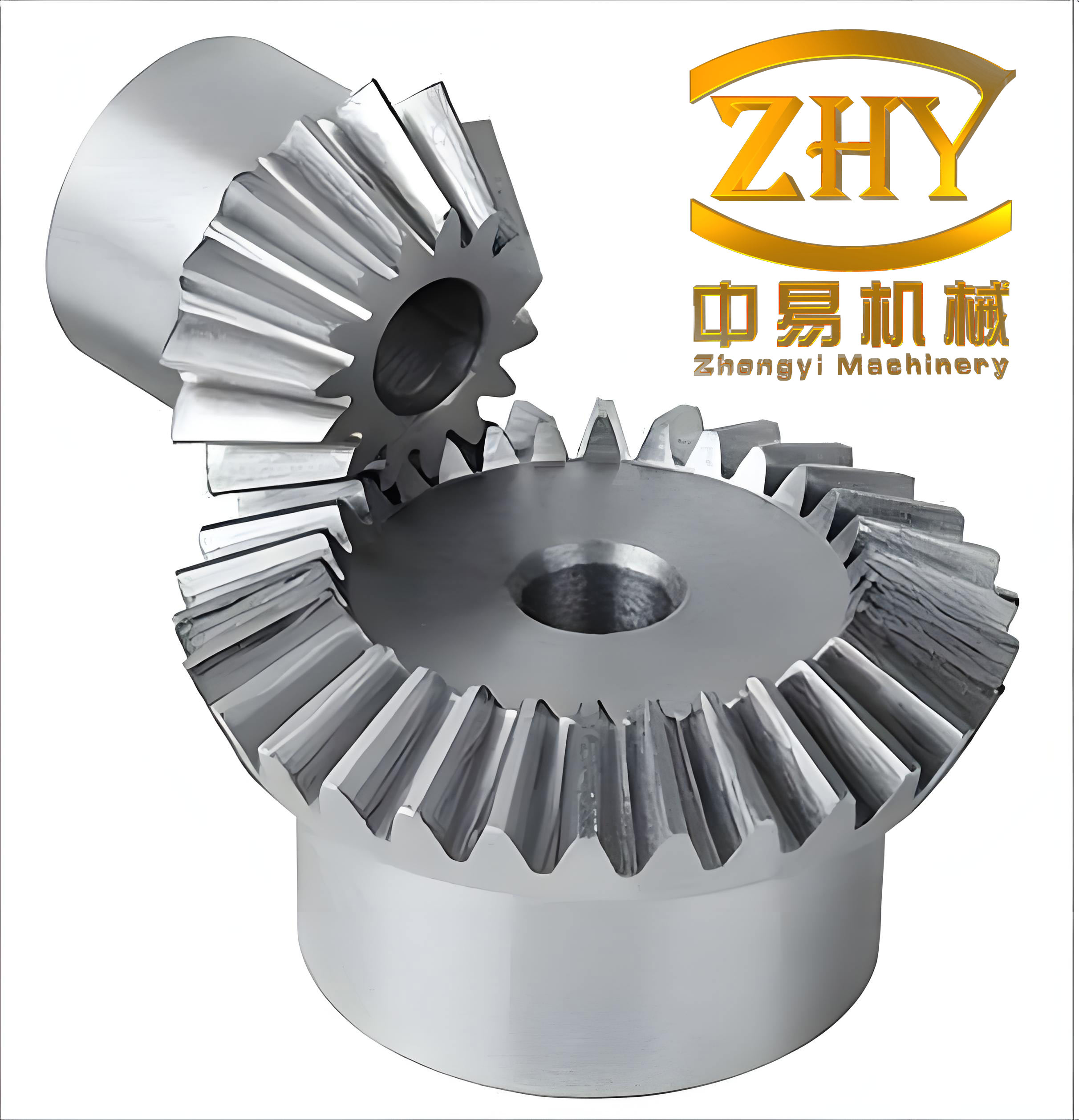
The straight bevel gear system parameters used in this analysis are based on common industrial applications. The gear design parameters include module \( m = 4 \, \text{mm} \), number of teeth on driving gear \( z_1 = 12 \), pitch cone angle \( \delta_1 = 32^\circ \), number of teeth on driven gear \( z_2 = 18 \), normal pressure angle \( \alpha_n = 25^\circ \), and addendum coefficient of 1. The dynamic parameters are summarized in Table 1.
| Dynamic Parameter | Value |
|---|---|
| Characteristic length \( b_c \) (m) | 1×10⁻⁴ |
| Dimensionless backlash \( b \) | 0.4 |
| Dimensionless bearing clearance \( b_j \) | 1 |
| Input torque \( T_g \) (N·m) | 200 |
| Static transmission error \( E_m \) (m) | 2×10⁻⁵ |
| Average mesh stiffness \( K_m \) (N/m) | 1×10⁹ |
Nonlinear Dynamic Characteristics Analysis
The nonlinear dynamic behavior of the straight bevel gear system is analyzed through numerical simulations, focusing on the effects of mesh frequency and mesh damping ratio. The fourth-order variable-step Runge-Kutta method is employed to solve the dimensionless equations, and the system’s response is visualized using bifurcation diagrams, phase portraits, and Poincaré maps. The Poincaré section is defined based on time sampling to capture periodic and chaotic motions.
Influence of Mesh Frequency
The mesh frequency \( \omega \) is varied over the range [0.1, 2.5] to examine its impact on system dynamics. The bifurcation diagram of relative mesh displacement is shown in Figure 2, revealing several key phenomena. Initially, the system exhibits period-1 motion. At \( \omega = 0.568 \), a jump bifurcation occurs, altering the system’s trajectory and inducing additional bifurcations. As \( \omega \) increases to 0.874, a period-doubling bifurcation transitions the system to period-2 motion, characterized by two impacts per cycle. The phase portrait and Poincaré map at this frequency show two distinct points, with relative mesh displacement ranging between -0.3 and 0.8 and velocity between -0.4 and 0.4.
Further increases in \( \omega \) lead to additional period-doubling bifurcations, resulting in period-4 and period-8 motions. At \( \omega = 0.918 \), a grazing bifurcation occurs, where the system trajectory touches the backlash boundary, transitioning from single-sided to double-sided impacts. This is evident in the phase portrait, where the left-side trajectory grazes the backlash limit at \( b_1 = -0.4 \). Subsequently, continuous period-doubling bifurcations drive the system into chaotic motion, characterized by a dense set of points in the Poincaré map and irregular impact patterns. The chaos persists until \( \omega = 1.276 \), where a jump bifurcation abruptly returns the system to period-2 motion. After a brief period of high-period and chaotic behavior, inverse period-doubling bifurcations restore period-1 motion for \( \omega \geq 1.718 \). The phase portrait at \( \omega = 1.8 \) shows a stable elliptical trajectory with single-sided impacts, indicating period-1 motion.
The sequence of bifurcations highlights the sensitivity of straight bevel gear systems to mesh frequency variations. Jump and grazing bifurcations disrupt stability, while period-doubling cascades lead to chaos, emphasizing the need for careful frequency selection in design.
Influence of Mesh Damping Ratio
The mesh damping ratio \( \xi \) is a critical parameter affecting system stability and vibration suppression. To analyze its influence, bifurcation diagrams are generated for \( \xi = 0.06 \) and \( \xi = 0.08 \), with mesh frequency varying over [0.1, 2.5]. For \( \xi = 0.06 \), the system starts in period-1 motion, undergoes a jump bifurcation, and enters chaos through continuous period-doubling. The chaotic region exhibits粘连趋势, where attractors merge, complicating motion patterns. In contrast, for \( \xi = 0.08 \), the system experiences fewer bifurcations, with period-doubling leading only to period-8 motion before stabilizing to period-1. The chaotic regions are significantly reduced, demonstrating the damping effect on suppressing nonlinear instabilities.
Phase portraits and Poincaré maps at \( \omega = 1.04 \) further illustrate this effect. For \( \xi = 0.06 \), the Poincaré map shows numerous scattered points, indicating chaotic motion with irregular impacts and broad displacement ranges. For \( \xi = 0.08 \), the map displays eight distinct points, corresponding to period-8 motion with bounded displacement and velocity. This confirms that higher mesh damping ratios mitigate chaos and promote periodic behavior, enhancing system reliability.
Table 2 summarizes the impact of mesh damping ratio on system dynamics, highlighting the transition from chaos to stability with increasing damping.
| Mesh Damping Ratio \( \xi \) | Dynamic Behavior | Key Observations |
|---|---|---|
| 0.06 | Chaotic motion with粘连趋势 | Irregular impacts, broad displacement range |
| 0.07 | Mixed periodic and chaotic motion | Period-doubling cascades, jump bifurcations |
| 0.08 | Stable periodic motion | Reduced chaos, bounded displacements |
The results underscore the importance of selecting an appropriate mesh damping ratio in straight bevel gear design. Increasing damping not only suppresses chaotic vibrations but also reduces noise and wear, contributing to longer service life and improved performance.
Discussion on Nonlinear Phenomena
The straight bevel gear system exhibits rich nonlinear dynamics due to the interplay of tooth surface friction, backlash, and time-varying stiffness. Jump bifurcations, as observed at \( \omega = 0.568 \) and \( \omega = 1.276 \), cause abrupt changes in system trajectory, often preceding chaos. Grazing bifurcations, such as at \( \omega = 0.918 \), trigger transitions between single-sided and double-sided impacts, amplifying vibration levels. Period-doubling bifurcations create routes to chaos, where the system loses periodicity and exhibits sensitive dependence on initial conditions.
The dimensionless equations facilitate the analysis of these phenomena by scaling parameters to manageable ranges. The time-varying mesh stiffness \( K_n(t) \) introduces parametric excitation, while the backlash function \( f(X) \) adds piecewise nonlinearity. Tooth surface friction, represented by \( F_f \), introduces velocity-dependent forces that further complicate dynamics. The Poincaré maps effectively capture these behaviors, with periodic motions showing finite points and chaos showing fractal-like structures.
In practical terms, controlling these nonlinearities is essential for optimizing straight bevel gear performance. For instance, minimizing backlash through precise manufacturing can reduce grazing-induced impacts. Similarly, incorporating damping materials or active control strategies can elevate the effective mesh damping ratio, curbing chaotic tendencies. The analysis presented here provides a framework for such improvements, linking parameter variations to dynamic responses.
Conclusion
This study establishes a nonlinear dynamic model for straight bevel gear transmission systems, incorporating tooth surface friction, backlash, and time-varying mesh stiffness. The dimensionless equations are solved numerically, revealing complex behaviors including jump, grazing, and period-doubling bifurcations that lead to chaotic motion. The mesh frequency significantly influences system stability, with low frequencies promoting period-1 motion and higher frequencies inducing chaos through bifurcation cascades. The mesh damping ratio plays a crucial role in suppressing chaos; increasing damping transforms chaotic motion into stable periodic patterns, enhancing system reliability and smoothness.
These findings emphasize the importance of parameter optimization in straight bevel gear design. By selecting appropriate mesh frequencies and damping ratios, engineers can mitigate nonlinear instabilities, reduce vibration and noise, and improve transmission accuracy. Future work could explore advanced control techniques or material modifications to further enhance dynamic performance. Overall, this analysis contributes to a deeper understanding of straight bevel gear dynamics and offers practical insights for achieving robust and efficient gear systems.