
In modern mechanical engineering, the design and analysis of gears play a critical role in ensuring efficient power transmission. Among various gear types, the straight bevel gear is widely used for transmitting motion and power between intersecting shafts. This article explores the parametric design of straight bevel gears using SolidWorks, enhanced by Visual Basic (VB) for automation, and conducts finite element analysis (FEA) via COSMOS software to evaluate stress, strain, and displacement under load. The integration of parametric modeling and FEA enables rapid prototyping and optimization of straight bevel gears, reducing design cycles and improving reliability.
Straight bevel gears feature teeth that are straight and tapered, converging at a common point. Their complex geometry necessitates precise modeling to avoid failures such as tooth bending or pitting. Traditional design methods rely on manual calculations and iterative testing, which are time-consuming. However, with SolidWorks—a parametric 3D CAD software—and its API, developers can automate the creation of straight bevel gear models. This approach allows designers to input key parameters, such as tooth count and module, and generate accurate 3D models programmatically. Subsequently, FEA tools like COSMOS simulate real-world conditions, identifying critical stress points and informing design improvements.
The parametric design process begins by defining variables that govern the straight bevel gear’s geometry. Key parameters include the number of teeth for the pinion and gear (denoted as \( z_1 \) and \( z_2 \)), module (\( m \)), pressure angle (\( \alpha \)), addendum coefficient (\( h_a^* \)), and dedendum coefficient (\( c^* \)). These variables drive derived dimensions through mathematical relationships, ensuring consistency and accuracy. For instance, the gear ratio (\( u \)) is calculated as \( u = z_2 / z_1 \), while the addendum (\( h_a \)) and dedendum (\( h_f \)) heights are derived as \( h_a = h_a^* m \) and \( h_f = (h_a^* + c^*) m \), respectively. Other critical dimensions, such as the pitch cone angle (\( \delta \)) and cone distance (\( R \)), are computed using trigonometric functions. The parametric model incorporates these equations to dynamically update the gear’s geometry, facilitating the creation of a family of straight bevel gears with varying specifications.
To illustrate the interrelationships among parameters, consider the following table summarizing key formulas for straight bevel gear design:
| Parameter | Formula |
|---|---|
| Gear Ratio (\( u \)) | $$ u = \frac{z_2}{z_1} $$ |
| Addendum (\( h_a \)) | $$ h_a = h_a^* m $$ |
| Dedendum (\( h_f \)) | $$ h_f = (h_a^* + c^*) m $$ |
| Pitch Cone Angle (\( \delta_1 \) for pinion) | $$ \delta_1 = \arctan \left( \frac{z_1}{z_2} \right) $$ |
| Cone Distance (\( R \)) | $$ R = \frac{m}{2} \sqrt{z_1^2 + z_2^2} $$ |
| Addendum Angle (\( \theta_a \)) | $$ \theta_a = \arctan \left( \frac{h_a}{R} \right) $$ |
| Dedendum Angle (\( \theta_f \)) | $$ \theta_f = \arctan \left( \frac{h_f}{R} \right) $$ |
| Face Width (\( b \)) | $$ b = \psi_R R $$ (where \( \psi_R \) is the face width coefficient, typically 0.25–0.3) |
In SolidWorks, the modeling of a straight bevel gear starts with creating a blank body. A sketch is drawn on the front plane, defining six key points that outline the gear’s axial cross-section. These points correspond to dimensions such as the pitch cone, addendum, and dedendum. For example, point O represents the apex of the pitch cone, while points A, B, C, D, and E define the outer and inner boundaries based on calculated values like \( h_a \), \( h_f \), and \( \delta \). The sketch is then revolved around the central axis to form the solid blank. This step relies heavily on parametric equations; for instance, the pitch cone angle \( \delta_1 \) determines the taper, and the cone distance \( R \) influences the overall size. By linking these dimensions to global variables, any change in input parameters automatically updates the blank geometry.
Next, the involute tooth profile is generated. Since the actual tooth shape of a straight bevel gear is spherical, a simplified approach uses the “back cone” to create an equivalent spur gear—the virtual gear—whose teeth approximate the straight bevel gear’s large-end profile. The involute curve is defined parametrically in Cartesian coordinates as:
$$ x = r_b (\cos \theta + \theta \sin \theta) $$
$$ y = r_b (\sin \theta – \theta \cos \theta) $$
Here, \( r_b \) is the base circle radius, calculated as \( r_b = \frac{m z_v}{2} \cos \alpha \), where \( z_v \) is the virtual tooth count (\( z_v = z / \cos \delta \)). The variable \( \theta \) represents the roll angle, which ranges to define the curve. In SolidWorks, a series of points are computed using these equations and connected via a spline to form the involute. This curve is mirrored across the base circle to create the complete tooth profile for both the large and small ends of the straight bevel gear. The tooth space is then generated by lofting between these profiles, resulting in a single cutout. Replicating this cutout around the axis using a circular pattern (with the number of instances equal to the tooth count) forms the full set of teeth. Finally, features like the bore and keyway are added to complete the straight bevel gear model.
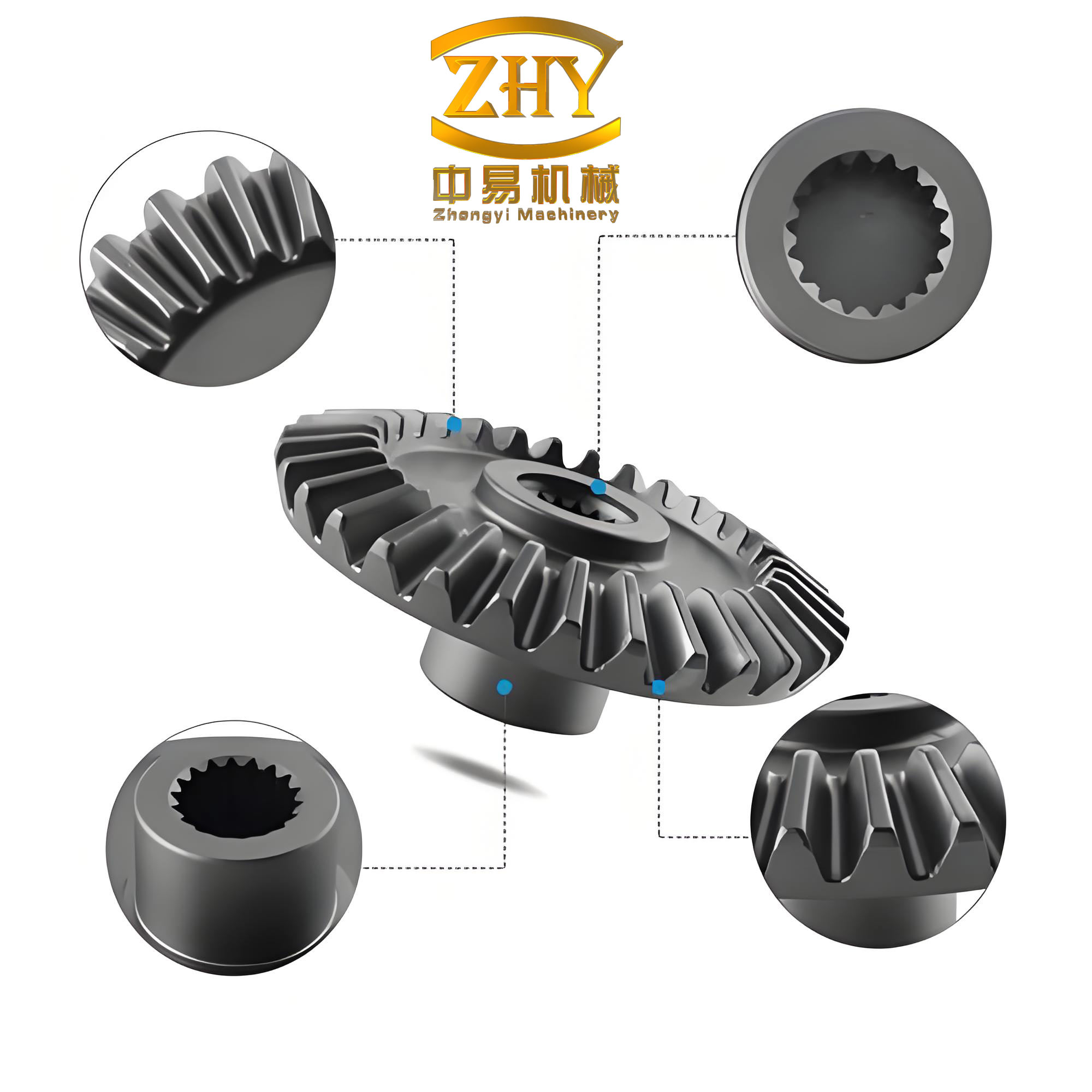
The parametric design is implemented through VB programming, which interfaces with SolidWorks via its API. A user-friendly interface in VB allows input of key parameters, such as \( z_1 \), \( z_2 \), \( m \), \( \alpha \), \( h_a^* \), and \( c^* \). The code then computes derived values and drives the SolidWorks model. For example, the gear ratio \( u \) and cone distance \( R \) are calculated automatically, and the model regenerates with updated dimensions. This automation enables rapid generation of multiple straight bevel gear variants, supporting applications in automotive differentials, industrial machinery, and aerospace systems. The table below shows a sample parameter set for a typical straight bevel gear design:
| Parameter | Value |
|---|---|
| Pinion Teeth (\( z_1 \)) | 20 |
| Gear Teeth (\( z_2 \)) | 40 |
| Module (\( m \)) in mm | 5 |
| Pressure Angle (\( \alpha \)) in degrees | 20 |
| Addendum Coefficient (\( h_a^* \)) | 1.0 |
| Dedendum Coefficient (\( c^* \)) | 0.25 |
| Face Width Coefficient (\( \psi_R \)) | 0.3 |
Once the straight bevel gear model is created, finite element analysis is performed using COSMOS to assess its structural integrity. The gear is typically subjected to loads simulating real operating conditions, such as those in a power transmission system. The material selected for this analysis is AISI 1045 steel, which has a yield strength of 450 MPa and an ultimate tensile strength of 620 MPa. The material properties are defined in COSMOS as follows:
| Property | Value |
|---|---|
| Young’s Modulus (\( E \)) | 210 GPa |
| Poisson’s Ratio (\( \nu \)) | 0.3 |
| Density (\( \rho \)) | 7850 kg/m³ |
| Yield Strength (\( \sigma_y \)) | 450 MPa |
Boundary conditions are applied to simulate mounting: the bore and keyway surfaces are constrained in all translational and rotational degrees of freedom. A load equivalent to the transmitted torque is applied to the tooth surfaces. For instance, the tangential force (\( F_t \)) is calculated as \( F_t = \frac{2T}{d_m} \), where \( T \) is the torque and \( d_m \) is the mean pitch diameter. This force is decomposed into radial (\( F_r \)) and axial (\( F_a \)) components based on the pressure angle and pitch cone geometry. In FEA, these forces are distributed across the tooth contacts to mimic meshing behavior.
The mesh generation in COSMOS uses tetrahedral elements, with refinement near the tooth roots where stress concentrations are expected. A typical mesh for a straight bevel gear may consist of over 100,000 elements to ensure accuracy. The analysis solves for von Mises stress, displacement, and strain. Results indicate that the maximum stress often occurs at the fillet region of the teeth, particularly at the small end of the straight bevel gear, due to bending moments. For example, under a load of 1000 N·m torque, the peak stress might exceed the material’s yield strength, highlighting potential failure points. The displacement and strain fields further reveal deformation patterns, aiding in optimizing the gear geometry.
To quantify the FEA results, consider the following equations for stress and deformation. The von Mises stress (\( \sigma_v \)) is given by:
$$ \sigma_v = \sqrt{ \frac{ (\sigma_1 – \sigma_2)^2 + (\sigma_2 – \sigma_3)^2 + (\sigma_3 – \sigma_1)^2 }{2} } $$
where \( \sigma_1, \sigma_2, \sigma_3 \) are the principal stresses. The maximum displacement (\( u_{\text{max}} \)) is derived from the linear elastic solution, and the strain energy (\( U \)) can be expressed as:
$$ U = \frac{1}{2} \int_V \boldsymbol{\sigma} : \boldsymbol{\epsilon} dV $$
Here, \( \boldsymbol{\sigma} \) and \( \boldsymbol{\epsilon} \) are the stress and strain tensors, respectively. In practice, for a straight bevel gear, these values are computed numerically by COSMOS. For instance, a simulation might show \( \sigma_v = 469.6 \) MPa at the tooth root, indicating a risk of fatigue failure if the material’s endurance limit is lower. This necessitates design adjustments, such as increasing the fillet radius or modifying the tooth profile.
The parametric design and FEA process for straight bevel gears enables iterative optimization. By varying parameters like module or pressure angle, designers can reduce stress concentrations. For example, increasing the module enlarges the tooth size, distributing load more evenly. Similarly, adjusting the face width coefficient \( \psi_R \) affects the bending strength. The table below compares two design iterations for a straight bevel gear under the same load:
| Design Parameter | Iteration 1 | Iteration 2 |
|---|---|---|
| Module (\( m \)) in mm | 5 | 6 |
| Max Stress (MPa) | 469.6 | 350.2 |
| Max Displacement (mm) | 0.402 | 0.285 |
| Safety Factor | 0.96 | 1.29 |
As shown, Iteration 2 with a larger module reduces stress and displacement, improving the safety factor. This demonstrates the value of integrating parametric design with FEA for straight bevel gears. Moreover, the automation via VB allows rapid exploration of design spaces, ensuring that optimal parameters are identified efficiently.
In conclusion, the parametric design of straight bevel gears using SolidWorks and VB streamlines the creation of accurate 3D models, while finite element analysis via COSMOS provides critical insights into performance under load. This combined approach facilitates the development of reliable straight bevel gears for various industrial applications, emphasizing the importance of iterative design and simulation-driven optimization. Future work could extend this methodology to other gear types, such as spiral bevel gears, or incorporate dynamic analysis for enhanced realism.