
In the manufacturing industry, the demand for high-precision straight bevel gears has increased significantly, especially after heat treatment processes like carburizing and quenching, which often introduce deformations that affect gear meshing quality. Traditional grinding machines for straight bevel gears are scarce and expensive, making them inaccessible for many small to medium-sized enterprises. To address this, I explored the transformation of a standard Y7132 gear grinding machine into a CNC-based generating machine for grinding straight bevel gears. This approach leverages the principles of flat-top gear shaping, adapted for grinding operations. The modified machine enables precise grinding of straight bevel gears through a generating method, effectively mitigating heat treatment distortions and improving gear accuracy and surface finish. This article details the working principles, structural modifications, and a practical grinding example, emphasizing the application of generating grinding for straight bevel gears.
The core of this transformation lies in the flat-top gear generating principle, which is commonly used in gear shaping machines like the Y236. In this method, a flat-top gear—essentially a bevel gear with a 90-degree top cone angle—serves as the imaginary generating gear. The grinding process involves simulating the engagement between this flat-top gear and the workpiece gear. Instead of using cutting tools, as in shaping, we employ grinding wheels to replicate the tooth surfaces. The key advantage of this principle is that the grinding direction remains unaffected by the root angle of the gear being processed, simplifying the machine’s kinematics. The generating motion requires coordinated movements between the workpiece and the grinding wheel to achieve the desired tooth profile. For a straight bevel gear, the generating ratio \( i_c \) is critical and is given by the formula:
$$ i_c = \frac{\cos \theta_f}{\sin \delta} $$
Alternatively, it can be expressed in terms of gear teeth counts:
$$ i_c = \frac{z_c \cos \theta_f}{z} $$
where \( \theta_f \) is the root angle of the straight bevel gear, \( \delta \) is the pitch angle, \( z \) is the number of teeth on the workpiece gear, and \( z_c \) is the number of teeth on the flat-top gear. This ratio dictates the relative motion between the workpiece rotation and the generating rotation during grinding. Another important parameter is the tool post spacing angle \( \lambda \), which influences tooth thickness and contact patterns. It is approximated as:
$$ \lambda \approx \frac{180}{\pi R} \left( \frac{s}{2} + h_f \tan \alpha \right) $$
Here, \( R \) is the cone distance at the large end, \( s \) is the arc tooth thickness at the large end, \( h_f \) is the dedendum at the large end, and \( \alpha \) is the pressure angle. This angle ensures that the grinding wheel’s conical surface aligns correctly with the tooth flank during the generating process.
The structural transformation of the Y7132 grinding machine involves retrofitting it with CNC systems to control multiple axes. Originally designed for cylindrical gear grinding, the Y7132 machine was modified to incorporate servo motors for driving the worktable, rotary table, and ram (which holds the grinding wheel). The grinding wheel itself is powered by a standard three-phase induction motor, but all other movements—such as linear and rotary motions—are precisely controlled via CNC. The ram and horizontal worktable were upgraded to ball screw drives to enhance accuracy and repeatability. In this setup, the grinding wheel’s conical surface acts as a fixed representation of the flat-top gear’s tooth surface. The workpiece gear undergoes a planetary motion: it rotates about its own axis (self-rotation) while simultaneously revolving around a central axis (generating rotation), synchronized with horizontal movements to maintain proper engagement with the grinding wheel.
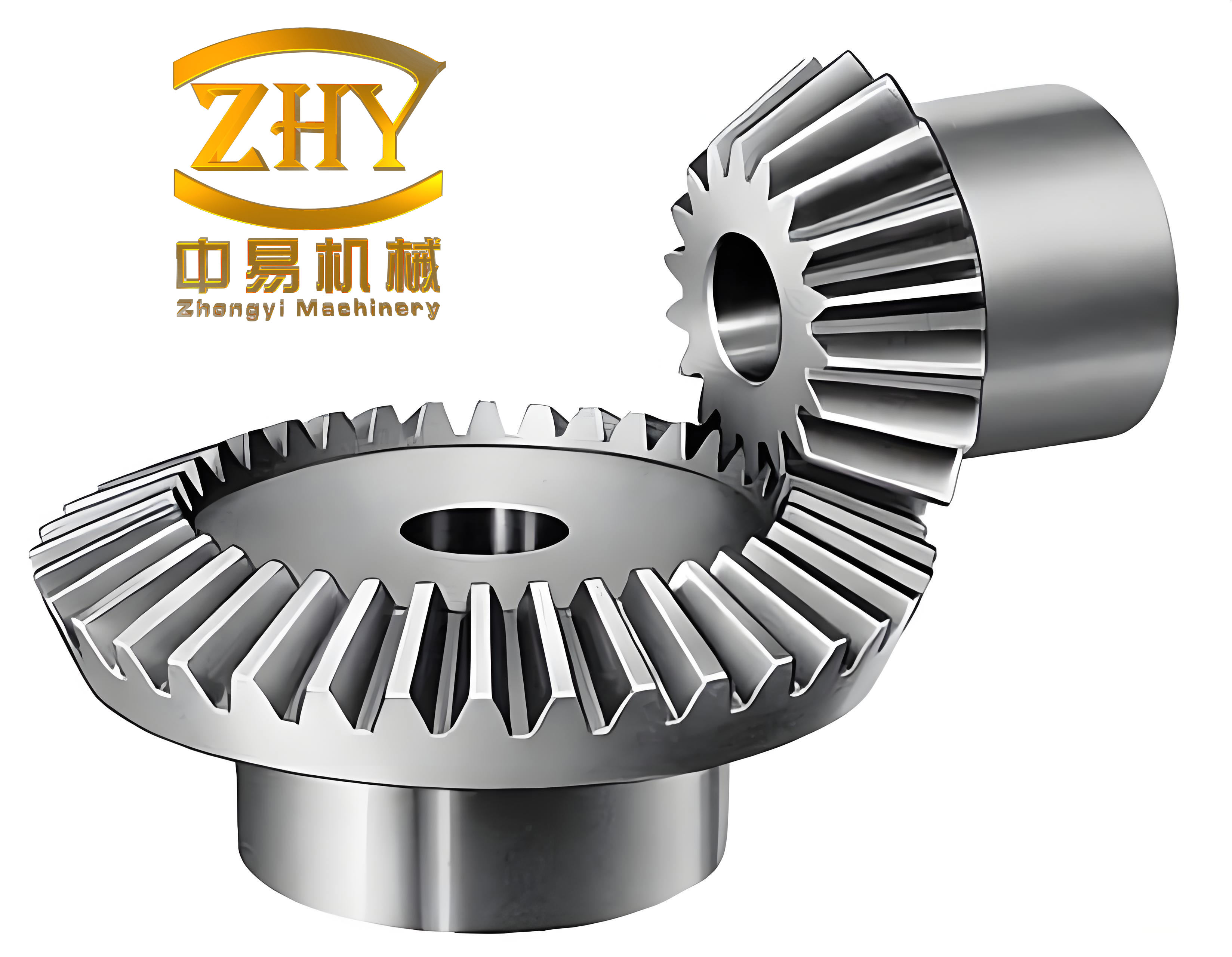
To illustrate the grinding process, consider a Gleason straight bevel gear with specific parameters. The gear has a large-end module \( m = 11.467 \, \text{mm} \), pressure angle \( \alpha = 22.5^\circ \), number of teeth \( z = 18 \), addendum coefficient \( h_a^* = 0.8 \), clearance coefficient \( c^* = 0.188 \), and tangential shift coefficient \( x_t = 0.038 \). Using the formulas above, we calculate the generating ratio and tool post spacing angle. For instance, the generating ratio \( i_c \) is computed as 1.2959, meaning that for every degree of generating rotation, the workpiece rotates 1.2959 degrees. Similarly, the tool post spacing angle \( \lambda \) is approximately 5.95 degrees. These values are crucial for programming the CNC system to coordinate the motions accurately.
The machine setup begins with adjusting the root angle seat to align the gear’s root cone parallel to the ram’s motion path. The gear’s axis of self-rotation and the generating axis must be positioned within the symmetric center plane of the grinding wheel’s conical surfaces. A key distance \( r \), which is the projection of the offset between the gear’s apex and the generating axis onto the horizontal plane, is determined based on geometric constraints. In this example, \( r = 178.2773 \, \text{mm} \). The grinding process involves a series of coordinated movements: for each increment of self-rotation, the generating rotation and horizontal displacement are adjusted accordingly. For instance, if the gear self-rotates by 0.5 degrees, it must generate-rotate by 0.77166 degrees, and the worktable moves horizontally to maintain the contact point between the grinding wheel and tooth flank. This sequence is repeated iteratively to grind the entire tooth surface, from the tip to the root.
A detailed analysis of the generating grinding actions reveals the importance of motion synchronization. Initially, the gear is generating-rotated by the tool post spacing angle \( \lambda \) to align the reference line with the grinding wheel’s path. The horizontal worktable then shifts to bring the gear into contact with the wheel. As grinding proceeds, each self-rotation step is paired with a corresponding generating rotation and horizontal adjustment. The following table summarizes the key parameters and calculations for the example straight bevel gear:
| Parameter | Symbol | Value | Unit |
|---|---|---|---|
| Large-end module | \( m \) | 11.467 | mm |
| Pressure angle | \( \alpha \) | 22.5 | degrees |
| Number of teeth | \( z \) | 18 | – |
| Generating ratio | \( i_c \) | 1.2959 | – |
| Tool post spacing angle | \( \lambda \) | 5.95 | degrees |
| Cone distance at large end | \( R \) | Calculated based on gear geometry | mm |
| Dedendum at large end | \( h_f \) | Derived from \( h_f = m (h_a^* + c^*) \) | mm |
In practice, the grinding wheel is dressed using the original Y7132 dressing attachment or a custom setup with a diamond pen controlled by the CNC axes. Compensation for wheel wear is achieved by adjusting the vertical worktable. The determination of the self-rotation angle is critical; insufficient rotation leaves parts of the tooth unground, while excessive rotation risks damaging the tooth root or adjacent teeth. Empirical testing or analytical methods, such as those discussed in gear machining literature, can optimize this angle. Additionally, the grinding wheel’s tip is rounded to prevent interference with the tooth root fillet, ensuring smooth transitions and avoiding stress concentrations.
The transformation of the Y7132 machine into a generating grinder for straight bevel gears offers a cost-effective solution for post-heat treatment precision grinding. By adopting the flat-top gear principle, the modified machine achieves high accuracy in tooth profile and surface finish. The CNC integration allows for flexible programming and repeatability, making it suitable for small-batch production. The success of this approach demonstrates that conventional machines can be upgraded to handle complex tasks like straight bevel gear grinding, bridging the gap between affordability and advanced manufacturing needs. Future work could focus on optimizing motion algorithms and expanding the method to other gear types.
In summary, the generating method for grinding straight bevel gears, implemented through CNC retrofitting, provides a viable alternative to expensive specialized equipment. The coordination of self-rotation, generating rotation, and horizontal movements, guided by precise calculations, ensures efficient material removal and profile accuracy. This innovation highlights the potential of adapting existing machinery to meet evolving industrial demands, particularly for high-precision straight bevel gears in applications such as automotive transmissions and industrial machinery.