
In the field of gear transmission systems, the accurate calculation of meshing stiffness is crucial for understanding dynamic behavior, stability, and noise generation. Straight bevel gears, due to their complex tooth geometry, present significant challenges in stiffness computation compared to cylindrical gears. Traditional methods often rely on finite element analysis (FEA), which, while accurate, is computationally intensive and time-consuming. This study aims to develop a rapid analytical method for determining the meshing stiffness of straight bevel gears by leveraging energy principles and equivalent models. We focus on converting the straight bevel gear into an equivalent spur gear at the midpoint of the tooth width, simplifying the analysis while maintaining reasonable accuracy. The proposed approach not only enriches the theoretical foundation of gear stiffness calculations but also provides a practical tool for dynamics research.
The importance of time-varying meshing stiffness as a primary excitation in gear systems cannot be overstated. It influences parametric vibrations and overall system stability. For straight bevel gears, the varying tooth profile along the width complicates direct application of methods used for spur or helical gears. Previous research has extensively covered cylindrical gears, but studies on straight bevel gears remain limited, often resorting to numerical techniques like FEA. In this work, we introduce a method that combines energy-based calculations with displacement compatibility principles to derive both single-tooth and time-varying meshing stiffness. We validate our results against finite element simulations and analyze potential error sources, offering insights for future improvements.
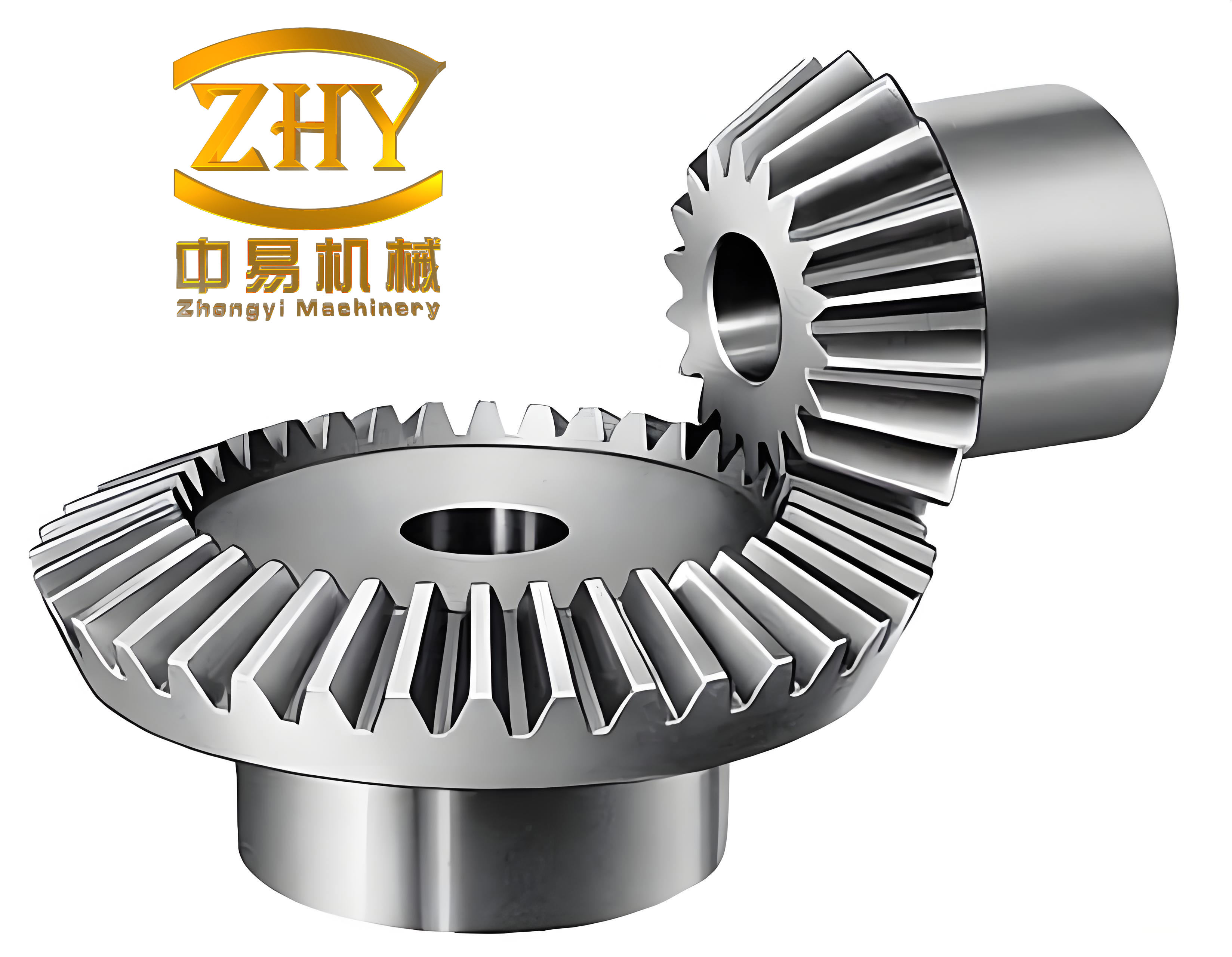
To begin, we establish a model for single-tooth meshing stiffness of straight bevel gears. The key step involves transforming the straight bevel gear into an equivalent spur gear at the tooth width midpoint. This simplification allows us to treat the tooth as a variable-section cantilever beam rooted at the dedendum circle. The parameters of the straight bevel gear, such as pitch cone angle and pitch diameter, are derived from basic gear geometry. For a straight bevel gear, the pitch cone angle δ and pitch diameter d are given by:
$$ \delta_1 = \arctan\left(\frac{z_1}{z_2}\right), \quad \delta_2 = 90^\circ – \delta_1 $$
$$ d_1 = m z_1, \quad d_2 = m z_2 $$
where z₁ and z₂ are the tooth numbers of the driving and driven gears, respectively, and m is the module. The outer cone distance R is calculated as:
$$ R = \frac{1}{2} \sqrt{d_1^2 + d_2^2} $$
The tooth width b relates to the cone distance through the tooth width coefficient φ_d:
$$ \phi_d = \frac{b}{R} $$
Using these, the equivalent tooth number z_v and module m_v at the tooth width midpoint are:
$$ z_{v1} = \frac{z_1}{\cos \delta_1}, \quad z_{v2} = \frac{z_2}{\cos \delta_2} $$
$$ m_v = m (1 – 0.5 \phi_d) $$
This equivalent spur gear model forms the basis for subsequent stiffness calculations. The tooth is idealized as a cantilever beam with variable cross-section, subjected to a meshing force F along the line of action. The angle α₁ between the force and the tooth thickness direction is considered in the deformation analysis. The stiffness components—bending, shear, and axial compression—are derived using energy methods. The bending stiffness K_b, shear stiffness K_s, and axial compression stiffness K_a for a single tooth are expressed as:
$$ \frac{1}{K_b} = \int_0^d \frac{(x \cos \alpha_1 – h \sin \alpha_1)^2}{E I_x} dx $$
$$ \frac{1}{K_s} = \int_0^d \frac{1.2 \cos^2 \alpha_1}{G A_x} dx $$
$$ \frac{1}{K_a} = \int_0^d \frac{\sin^2 \alpha_1}{E A_x} dx $$
where E is the elastic modulus, G is the shear modulus given by G = E / [2(1 + υ)] with υ as Poisson’s ratio, I_x is the area moment of inertia, and A_x is the cross-sectional area at distance x from the meshing point. For a rectangular section, I_x = (2/3) h_x^3 b and A_x = 2 h_x b, where h_x is half the tooth thickness at x.
Additionally, the Hertzian contact stiffness K_h accounts for elastic deformation at the contact interface and is constant along the meshing line:
$$ \frac{1}{K_h} = \frac{4(1 – \upsilon^2)}{\pi E b} $$
The fillet foundation stiffness K_f, which considers deformation of the gear body, is given by:
$$ \frac{1}{K_f} = \frac{\delta_f}{F} $$
where δ_f is the deformation of the gear body under force F. Combining these, the single-tooth meshing stiffness K_e for a pair of straight bevel gears is:
$$ K_e = \frac{1}{\frac{1}{K_{b1}} + \frac{1}{K_{s1}} + \frac{1}{K_{a1}} + \frac{1}{K_{f1}} + \frac{1}{K_{b2}} + \frac{1}{K_{s2}} + \frac{1}{K_{a2}} + \frac{1}{K_{f2}} + \frac{1}{K_h}} $$
This model provides a comprehensive approach to calculating single-tooth stiffness for straight bevel gears, incorporating various deformation mechanisms.
Next, we extend this to time-varying meshing stiffness, which accounts for multiple teeth in contact during operation. The contact ratio determines the transitions between single and double tooth pairs. For straight bevel gears, the transverse contact ratio at the tooth width midpoint is essential. The individual transverse contact ratios for the pinion and gear are:
$$ \epsilon_{a1} = \frac{z_{v1} \cos^2 \beta_b}{2\pi \cos \alpha_n} \left[ \sqrt{\left(1 + \frac{2 h_{anm1}^*}{z_{v1}}\right)^2 – \cos^2 \alpha_n} – \cos \alpha_n \right] $$
$$ \epsilon_{a2} = \frac{z_{v2} \cos^2 \beta_b}{2\pi \cos \alpha_n} \left[ \sqrt{\left(1 + \frac{2 h_{anm2}^*}{z_{v2}}\right)^2 – \cos^2 \alpha_n} – \sin \alpha_n \right] $$
where β_b is the base helix angle (zero for straight bevel gears), α_n is the normal pressure angle, and h_{anm1}^* and h_{anm2}^* are the modified addendum coefficients at the midpoint. These coefficients are adjusted as:
$$ h_{anm1}^* = 0.52 + 0.44 \mu_v $$
$$ h_{anm2}^* = 1.41 – 0.44 \mu_v $$
with μ_v = z_{v2} / z_{v1}. The total transverse contact ratio is ε_a = ε_{a1} + ε_{a2}. Based on displacement compatibility, when multiple teeth are in contact, the deformation of each tooth pair must satisfy equilibrium. For a driven gear rotation angle θ, the deformations Δ₁ and Δ₂ for the first and second tooth pairs are:
$$ \Delta_1 = L_1 \theta \cos \alpha_1 $$
$$ \Delta_2 = L_2 \theta \cos \alpha_2 $$
where L₁ and L₂ are the distances from the meshing points to the gear center. The meshing force for each pair is F_i = K_i Δ_i, and the total force F_N balances the external load:
$$ F_N = \sum_{i=1}^N F_i = \sum_{i=1}^N K_i \Delta_i $$
The overall meshing stiffness K is then:
$$ K = \frac{F_N}{\Delta} = \sum_{i=1}^N K_i \frac{\Delta_i}{\Delta_1} = \sum_{i=1}^N K_i \frac{L_i \cos \alpha_i}{L_1 \cos \alpha_1} $$
This formulation allows us to compute the time-varying stiffness by summing contributions from all engaged teeth, with K_i obtained from the single-tooth model. The nonlinear nature of K arises from the dependence on gear position and load distribution.
To validate our method, we conduct case studies using three sets of straight bevel gear parameters. The finite element method (FEM) serves as a benchmark, employing a quasi-static approach with hexahedral elements for efficiency and accuracy. Contact regions are finely meshed to capture stress concentrations. The single-tooth and time-varying stiffness results from our analytical model are compared against FEM outputs.
| Parameter | Set 1 | Set 2 | Set 3 |
|---|---|---|---|
| Module (mm) | 2 | 4 | 4 |
| Number of Teeth (Driving) | 17 | 19 | 20 |
| Number of Teeth (Driven) | 19 | 34 | 25 |
| Normal Pressure Angle (°) | 20 | 23 | 20 |
| Tooth Width (mm) | 8 | 12 | 10 |
| Addendum Coefficient | 1 | 1 | 1 |
| Dedendum Coefficient | 0.2 | 0.2 | 0.2 |
| Modification Coefficient | 0 | 0 | 0 |
| Elastic Modulus (MPa) | 2.06 × 10⁵ | 2.06 × 10⁵ | 2.06 × 10⁵ |
| Poisson’s Ratio | 0.3 | 0.3 | 0.3 |
For each set, we compute the single-tooth meshing stiffness over one engagement cycle. The stiffness is generally lower at the entry and exit points, higher in the middle. The time-varying stiffness shows periodic variations due to alternating single and double tooth contacts. The results from our method and FEM are in good agreement in trend, though numerical differences exist. The single-tooth stiffness K_e and time-varying stiffness K are evaluated, and relative errors are calculated.
| Parameter Set | Method | Max Single-Tooth Stiffness (kN/mm) | Relative Error (%) | Avg Time-Varying Stiffness (kN/mm) | Relative Error (%) |
|---|---|---|---|---|---|
| Set 1 | FEM | 313 | 13.4 | 505 | 8.0 |
| Analytical | 355 | 546 | |||
| Set 2 | FEM | 835 | 23.1 | 1409 | 16.8 |
| Analytical | 1028 | 1646 | |||
| Set 3 | FEM | 758 | 21.5 | 1275 | 12.8 |
| Analytical | 921 | 1439 |
The errors stem from simplifications in the equivalent model, such as ignoring variations along the tooth width and assuming uniform load distribution. For straight bevel gears, the tooth profile changes continuously, and our midpoint approximation may not fully capture this complexity. Additionally, the contact ratio calculation based on the midpoint might deviate from actual conditions, affecting the transition between single and double tooth zones. Future work could involve segmenting the tooth width into multiple sections for improved accuracy.
In conclusion, we have developed an analytical method for calculating meshing stiffness of straight bevel gears, leveraging equivalent spur gear models and energy principles. The single-tooth stiffness model incorporates bending, shear, axial compression, Hertzian contact, and foundation deformations. The time-varying stiffness model uses displacement compatibility to handle multiple tooth engagements. Validation with FEM shows consistent trends but highlights areas for refinement, particularly in representing tooth geometry and load distribution. This research contributes to the theoretical framework for gear stiffness and aids in dynamics analysis of straight bevel gear systems. Further improvements could focus on multi-segment approaches and enhanced contact ratio models to reduce errors and better reflect the unique characteristics of straight bevel gears.