
In mechanical transmission systems, the straight bevel gear plays a pivotal role in transmitting motion and power between intersecting axes. Traditionally, the manufacturing of straight bevel gears relies on specialized equipment like gear planers using generating methods, which offer high precision but suffer from inefficiencies, complex setup, and limited versatility. As an alternative, forming methods for milling straight bevel gears on universal machines provide a flexible solution, especially for small-module gears. In this article, I will explore the principles and techniques for machining straight bevel gears using universal CNC equipment, emphasizing how numerical control enhances precision, efficiency, and adaptability. By integrating formulas, tables, and practical insights, I aim to demonstrate how standard CNC machines can be leveraged to produce high-quality straight bevel gears without dedicated gear-cutting tools.
The straight bevel gear is widely used in applications requiring reliable power transmission at angles, such as in automotive differentials and industrial machinery. Conventional methods, like planing, simulate the engagement of two gears through complex kinematic chains, but they involve significant non-cutting time for tool retraction, leading to low productivity. Moreover, adjusting these machines for different gear parameters is tedious and requires specialized skills. In contrast, milling straight bevel gears using forming methods on universal CNC equipment simplifies the process, reduces setup time, and improves economic feasibility for small-batch production. This approach is particularly advantageous for small-module straight bevel gears, where precision and efficiency are critical. Throughout this discussion, I will delve into various milling techniques, their implementation on CNC platforms, and the mathematical foundations that underpin these processes.
To begin, let’s examine the fundamental geometry of a straight bevel gear. The key parameters include the module (m), number of teeth (z), pitch diameter (D), face width (b), and cone angles. The pitch diameter relates to the module and number of teeth as follows: $$D = m \times z$$. The root angle (δ_f) and face angle (δ_a) determine the gear’s conical shape, influencing the machining path. For a straight bevel gear, the tooth profile tapers from the outer to the inner diameter, and the tooth depth (h) is typically calculated as $$h = 2.25 \times m$$ for standard full-depth teeth. Understanding these parameters is essential for programming CNC machines, as they define the tool paths and offsets required for accurate milling.
| Method | Precision | Efficiency | Setup Complexity | Applicability to Small-Module Gears |
|---|---|---|---|---|
| Planing (Generating) | High (up to Grade 7) | Low | High | Moderate |
| Milling (Forming) | Moderate to High | High | Low | Excellent |
Milling straight bevel gears on universal equipment involves three primary techniques: single-cut, double-cut, and triple-cut methods. Each method varies in the number of passes per tooth slot and the adjustments needed between cuts. The single-cut method is the simplest, where a disk-type milling cutter is aligned parallel to the root cone of the gear blank. The cutter engages from the small end to the large end in a single pass, with multiple depth increments for larger modules. Although efficient, this method produces gears with uniform tooth profiles along the face width, leading to significant deviations from the ideal tapered form. The tooth profile error increases with distance from the large end, making it suitable only for low-precision applications. The cutting motion can be described by a linear path along the root cone, with the depth of cut (a_p) controlled incrementally: $$a_p = \frac{h}{n}$$, where n is the number of depth steps.
In the double-cut method, each tooth slot is machined in two passes, introducing relative displacement between the cutter and gear blank. Initially, the cutter’s centerline is offset by a distance S from the gear axis, and the blank is rotated by an angle A. After the first pass, the cutter shifts in the opposite direction by 2S, and the blank rotates by 2A for the second pass. This approach approximates the profile of a constant-depth tooth, improving accuracy compared to the single-cut method. The offset S and rotation angle A are derived from the gear geometry. For instance, S can be calculated based on the face width and cone angle: $$S = b \times \tan(\delta_f)$$, and A is related to the tooth spacing: $$A = \frac{360}{z} \times k$$, where k is a correction factor. This method reduces profile errors and is more versatile for various straight bevel gear designs.
The triple-cut method is the most refined approach for universal milling, involving three passes per tooth slot: a roughing cut followed by two finishing cuts for each side of the tooth. First, all tooth slots are roughed out to a uniform width. Then, for finishing, the worktable is offset by a distance S, and the gear blank is rotated by a small angle ω to machine one side of the tooth. The process is repeated in the opposite direction for the other side. This method closely mimics the theoretical tooth profile and allows for the production of crowned teeth, which enhance contact patterns and load distribution. The offset and rotation parameters are critical and can be computed using the following formulas: $$S = \frac{m \times z}{2} \times \sin(\delta_f)$$ and $$\omega = \frac{180}{\pi} \times \arctan\left(\frac{S}{D}\right)$$. By adjusting these values, the triple-cut method achieves higher precision, making it ideal for small-module straight bevel gears where dimensional accuracy is paramount.
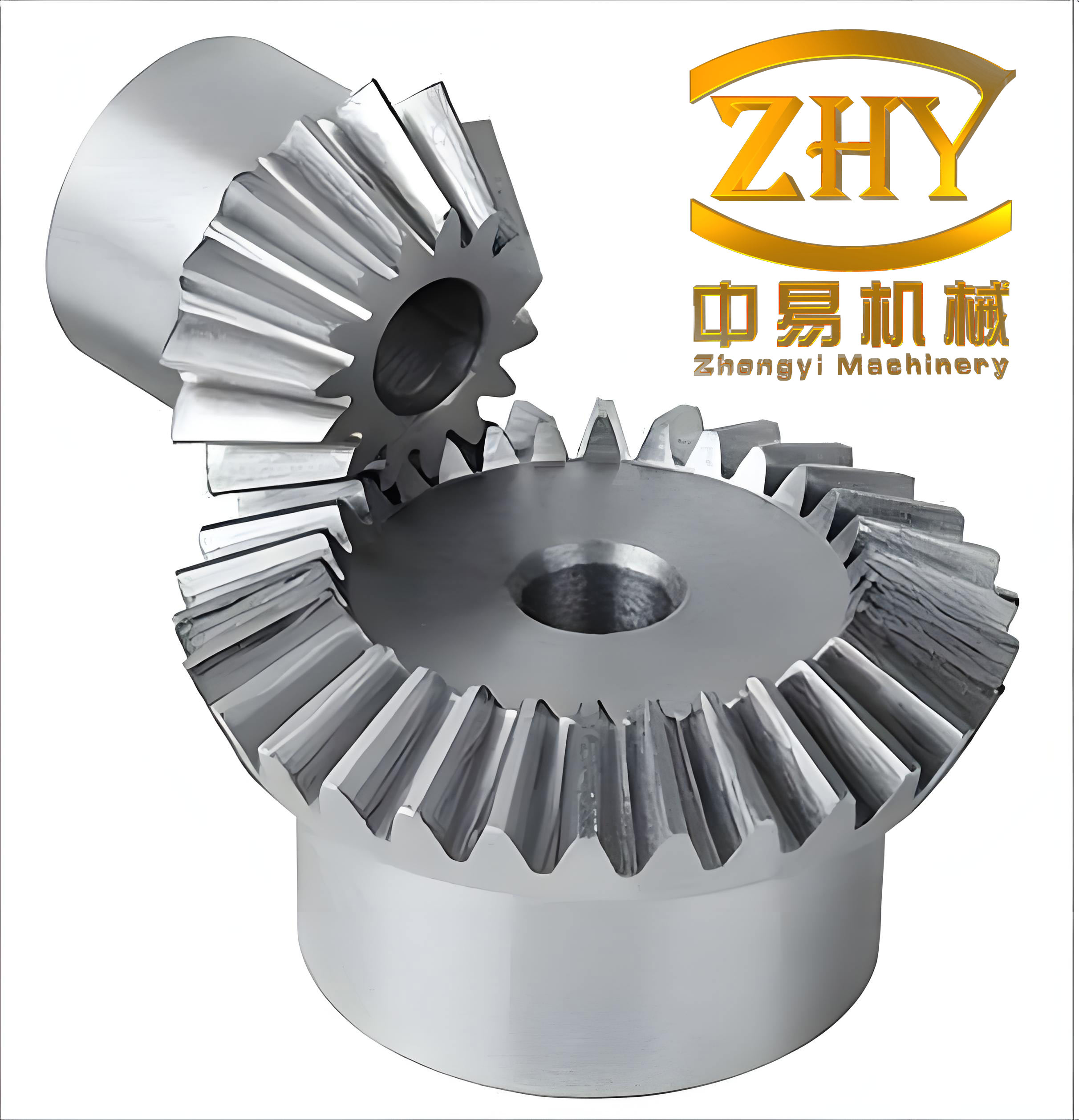
Implementing these milling techniques on universal CNC equipment unlocks new possibilities for gear manufacturing. CNC machines, such as machining centers and lathes, offer multi-axis control, high precision, and programmable logic, which can simulate the manual adjustments of traditional milling. For straight bevel gear machining, the essential requirements include two-axis interpolation for following the cone path, a spindle with indexing and locking capabilities for分度, and a independently controlled tool spindle for cutting. Advanced CNC systems often integrate these features, but even basic machines can be adapted with fixtures and custom programming. In the following sections, I will detail how to apply these methods on specific CNC platforms, focusing on practical considerations and mathematical models.
On a CNC lathe, typically equipped with X and Z axes, modifications are needed to add a tool spindle for milling and a分度 mechanism for the workpiece. For single-cut milling of straight bevel gears, a disk cutter is mounted on a motorized tool post, and the lathe’s axes control the linear motion along the root cone. The programming involves generating tool paths that increment the depth of cut while maintaining the conical trajectory. For example, the tool path for a single tooth slot can be defined parametrically: let the root angle be δ_f, the face width be b, and the initial depth be h_i. The coordinates for the tool path are given by: $$X = \frac{D}{2} + \Delta X – u \times \cos(\delta_f)$$ and $$Z = \frac{h_i – X \times \cos(\delta_f)}{\sin(\delta_f)} + u \times \sin(\delta_f)$$, where u is the parameter along the path from the large to small end, and ΔX is an offset for tool clearance. This allows for efficient machining of small-module straight bevel gears, with cycles as short as 25 seconds for an 18-tooth gear. However, for double-cut or triple-cut methods, additional Y-axis motion is required, which may necessitate a CNC lathe with live tooling or a Y-axis option.
| CNC Machine Type | Axes Available | Modifications Required | Compatible Milling Methods | Typical Precision |
|---|---|---|---|---|
| CNC Lathe (Basic) | X, Z | Tool spindle,分度 attachment | Single-cut | Moderate |
| CNC Milling Machine (3-Axis) | X, Y, Z | 分度 head | Single-cut, Double-cut | High |
| Machining Center (5-Axis) | X, Y, Z, A, C | None | All methods | Very High |
On a CNC milling machine, the process is more straightforward, as the machine’s spindle serves as the tool rotor, and the worktable handles the linear motions. For a standard 3-axis vertical CNC mill, a分度 head is added to hold and rotate the gear blank. The tool path for milling a straight bevel gear involves interpolating the X and Y axes to follow the cone angle while the Z-axis controls the depth. For instance, in the triple-cut method, the roughing pass is programmed to cut all tooth slots to a uniform depth, followed by finishing passes with calculated offsets and rotations. The mathematical model for the tool path can be derived from the gear parameters. Let the pitch diameter be D, root angle δ_f, and number of teeth z. The tool path for one side of a tooth can be expressed as: $$X = \frac{D}{2} \times \cos(\theta) + S \times \sin(\theta)$$ and $$Y = \frac{D}{2} \times \sin(\theta) – S \times \cos(\theta)$$, where θ is the angular position, and S is the offset for the finishing cut. This ensures accurate profile generation and can be extended to produce crowned teeth by introducing additional curvature in the path.
For more advanced setups, such as horizontal machining centers or turning-milling complexes, no additional fixtures are needed, as these machines inherently support multi-axis machining and分度. In a horizontal machining center, the spindle rotation drives the cutter, while the X and Z axes interpolate for the conical path, and the Y axis handles tool positioning. The B-axis (rotary table) enables precise分度 for each tooth slot. I have developed a parametric program for such systems, which automates the triple-cut method for straight bevel gears. The program uses variables for gear parameters, such as module, tooth count, and angles, and computes the tool paths dynamically. For example, the depth of cut is controlled through iterative loops, and the offsets are applied based on real-time calculations. This not only improves the accuracy of small-module straight bevel gears but also allows for batch production with minimal manual intervention.
The integration of CNC technology also facilitates the machining of crowned teeth, which are essential for optimizing contact patterns and reducing stress concentrations in straight bevel gears. Crowning involves modifying the tooth profile to have a slight convexity, which can be achieved by superimposing a curvature on the tool path. Mathematically, this can be represented by adding a parabolic term to the linear tool path: $$Z_{\text{crowned}} = Z + k \times (X – X_0)^2$$, where k is the crowning factor, and X_0 is the reference position. This adjustment compensates for misalignments and thermal expansions, enhancing the gear’s performance in practical applications. On CNC machines, this is implemented through advanced programming techniques, such as parametric subroutines or CAM software, further demonstrating the versatility of universal equipment for straight bevel gear production.
In terms of efficiency, CNC-based milling of straight bevel gears significantly outperforms traditional methods. For instance, the triple-cut method on a machining center can reduce cycle times by up to 50% compared to planing, while maintaining comparable precision. Moreover, the ability to perform multiple operations in a single setup—such as turning the gear blank and milling the teeth on a turning-milling center—minimizes handling errors and reduces overall lead time. The economic benefits are substantial, especially for small batches or prototyping, where the cost of dedicated gear-cutting equipment is prohibitive. By leveraging standard CNC machines, manufacturers can achieve high utilization rates and adapt quickly to design changes, making straight bevel gear production more accessible and cost-effective.
In conclusion, the adoption of universal CNC equipment for machining straight bevel gears, particularly small-module variants, offers a compelling alternative to specialized methods. Through techniques like single-cut, double-cut, and triple-cut milling, and the use of parametric programming, these machines can achieve high precision and efficiency. The mathematical models and formulas discussed provide a foundation for optimizing tool paths and gear quality. As CNC technology continues to evolve, the capabilities for producing complex gear geometries will expand, further enhancing the role of straight bevel gears in modern mechanical systems. I encourage engineers and machinists to explore these approaches, as they not only improve manufacturing flexibility but also contribute to innovation in gear design and application.